Walat Afrin has been fighting against the Islamic State (IS) since 2011. He says he participated in many of the major battles fought for years in these same territories until the defeat of the extremist group in 2019: Kobani, Manbij, Tel Abyad, or Ras el Ain. At 49 years old, a member of the Kurdish People's Defense Units (YPG), he cannot hide his indignation. Pointing to the squalor that prevails in the school where he and his family have been sheltered, the former fighter asserts with a raised voice: "Look at how we ended up!".
"The Americans (USA) have betrayed us! (Donald) Trump has sold us out! Why did we lose so many fighting against IS?" he adds with the same bitter tone.
The Kurdish family is one of nearly 600 - several thousand people - who have arrived in recent days in the city of Derik, in eastern Syria, escaping the open war that has resulted from the conflict between the Syrian army and Kurdish forces that controlled what was called the Autonomous Democratic Administration of North and East Syria, which has been reduced in a few days to isolated pockets.
Like the rest of the former territory controlled by Kurdish forces, Derik, a town of about 40,000 inhabitants - located not far from the border with Iraqi Kurdistan - was plunged into chaos.
Dozens of vans of displaced Syrians were trying to settle in schools and empty dwellings. They are easily recognizable because they carry their belongings covered with white plastic tarps, adorned with the emblem of the United Nations.
"We had to set up 16 schools and five rooms to accommodate them," explained Wafa Ali, a resident of the town who was leading a hastily established group of volunteers to deal with the growing humanitarian crisis.
Once again, Syria is described in tragic terms. People fleeing from war and others preparing for it.
As night fell, groups of young people armed with kalashnikovs began to patrol the streets. They were seen grouped around small fires or driving with bulky anti-aircraft machine guns along what is called the Corniche, the nearby Bazaar Avenue, or the well-known Syriac Church of Mar Shamone.
Next to the temple, a Christmas tree continued to be lit as a testimony to the significant Christian presence in this town.
All the newcomers expressed their enormous apprehension at experiencing a recreation of gloomy days they thought were a thing of the past.
Especially when it was known that a significant number of Islamic State prisoners had managed to escape from at least one of the prisons controlled by Kurdish forces and many of their relatives had done the same in the well-known Al Hol camp, located in the province of Al Hasaka.
In the late afternoon, the director of this last facility, Jihan Hinan, admitted in a phone conversation that both her followers and the security guards had fled the enclave.
"They have burned and looted the administrative facilities. We had to flee," explained the person in charge of the place, which houses tens of thousands of family members of ISIS members, including many minors who have been indoctrinated in the radical ideology of that group for years.
The fate of the thousands of IS prisoners incarcerated in Syria has become a weapon of contention between Damascus and the so-called Syrian Democratic Forces (SDF), the Kurdish-controlled alliance led by Mazloum Abdi.
HTS sources admitted the escape of a large number of relatives and militants of that group from the Al Shaddadi prison and the Al Hol complex but accused the Syrian Democratic Forces (SDF) - the name of the coalition led by the Kurds - of having relinquished control of those facilities, facilitating the escape.
The Syrian Interior Minister estimated that 120 IS militants had escaped from Al Shaddadi but said that at least 80 had been recaptured.
For their part, the Kurds acknowledged their withdrawal from Al Hol and attributed it to the "international indifference to the issue of the ISIS terrorist organization" and its "failure.. to assume its responsibilities to address this serious issue".
The SDF also indicated that the military loyal to President Ahmed al Sharaa had attacked Al Shaddadi and also the Al Aqtaan penitentiary.
An Iraqi expert on the extremist nebula, Raed Ahmed, estimated that the SDF managed a dozen prisons in the three provinces it controlled in the east of the country - Raqqa, Hasaka, and Deir Ezzor - where they monitored over 9,000 former IS fighters.
"The most important contingent, about 4,000, had recently been transferred to the Ghweiran prison," he commented.
According to his opinion, so far IS only had a limited presence in Syria in the desert regions near Deir Ezzor, Homs, and Sweida, and their number did not exceed "a few hundred militants".
But he also recalled that in 2013, the escape of just five hundred fundamentalist prisoners from the Abu Greib prison in Iraq was the prelude to the return of this movement and its subsequent expansion in that country and Syria until it occupied a territory of dimensions similar to Great Britain.
"It is evident that the USA determines the objectives that the Government forces can achieve. By losing control of Al Hol, the SDF are no longer practically allies of the USA, and the Government (of Ahmed al Sharaa) is now their only partner. The SDF has lost its influence over the IS prisons, and the USA no longer needs them," he added.
The escalation of violence between the Syrian army and the Syrian Democratic Forces also threatens to destabilize neighboring nations such as Turkey and Iraq, after thousands of Kurds demonstrated in the last hours in support of members of their community and announced their intention to cross borders to join them.
Northern Iraqi cities such as Duhok, Suleimaniya, Zakho, or Kirkuk witnessed significant gatherings during the night from Monday to Tuesday where the Kurdish population demanded that the autonomous authorities of Iraqi Kurdistan (KRG) open the borders, while numerous groups were heading individually towards the border to cross even without permission.
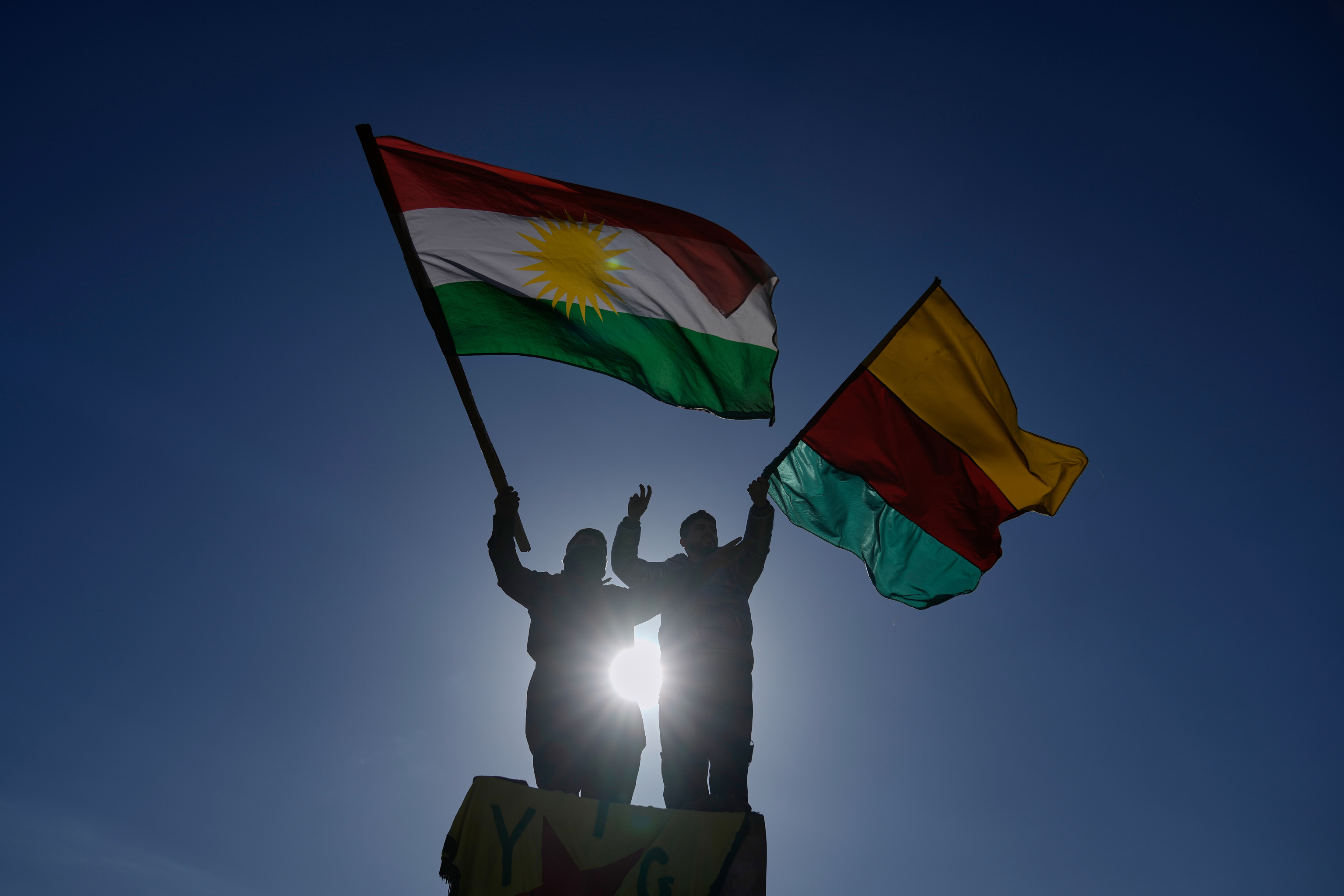
Hundreds of Syrians gathered along the road that connects the crossing between Iraqi Kurdistan and the area still dominated by the SDF to welcome with Kurdish flags and applause the "volunteers" who began to arrive at that enclave during the day.
Figures like the carpenter Haji Muslim Baki, 40 years old, who showed up at the Semalka crossing around midday with a dozen young people to be welcomed with shouts of joy from children and women gathered there.
Many waved Kurdish flags and shouted slogans like "Long live the Rojava revolution! (the name they give to the territory in eastern Syria)!".
"Our people are being killed and I couldn't stay in Erbil (Iraqi Kurdistan) doing nothing. I come to fight," said the Kurd.
At least one of the armed Kurdish groups located in the KRG territory, the Kurdistan Freedom Army of Iran (PAK), led by Hussein Yazdanpanah, announced that they are "negotiating" to join the SDF forces.
Yazdanpanah himself, a veteran Kurdish leader who does not hide his aspirations to establish an independent state for that community divided by the borders of three countries, lashed out against the US, accusing it of allying with Sharaa and "changing its moral values for interests."
An especially significant statement considering that the PAK troops were trained and armed by Washington during the battles fought in Iraq and Syria to end the rule of the Islamic State (ISIS).
Murat Karayilan, a senior official of the Kurdistan Workers' Party (PKK) - whose founder Abdullah Ocalan has been in a Turkish prison since 1999 - also indicated that despite their militants having agreed to disarm and dissolve last year, they will not "abandon" the Syrian Kurds.
"At all costs, we will never leave them alone. We, the entire Kurdish people and the movement, will do whatever is necessary," he stated in remarks to the Afp agency.
Karayilan, as Ocalan had already stated hours earlier, believes that the current crisis jeopardizes the continuity of negotiations between Ankara and their armed group to end a history of antagonism dating back to the 1970s and 1980s.
"This attack also aims to destroy the process. It renders that process meaningless," stated the leader, based in the mountains of northern Iraq.
Thousands of Kurds from Turkey - representing almost 20% of the country's population - also joined the demonstrations in support of what they call Rojava - eastern Syria - with the support of parties like the DEM, the third-largest party in the Turkish Parliament. This group called for new protests on Tuesday in the town of Nusaybin, right across from the Syrian town of Qamichli, the main Kurdish-controlled enclave.
In Derik, the displaced people crowded around visitors to recount their terrible experiences. They speak of roads littered with bodies in ditches, summary executions, robberies, and beatings.
There are many who have experienced displacement after displacement. "This is the fourth time we have had to flee from war in the last eight years. We are tired," said 44-year-old Sultana Kama, originally from Afrin.
Sarbas Murad had to travel for three days to reach Derik from Mansura - west of Raqqa. As he traveled in a convoy of 50 vehicles near Hasaka, their vehicles were intercepted by another carrying government loyalists from Damascus.
"They stopped us and violently pulled people out of the cars. We were civilians, but there were also Kurdish fighters. They executed four girls who were in uniform right there. The bodies were left on the side of the road. They did the same with another 15 young men," recounts the 41-year-old Kurd.
He says he survived because one of the militants took pity on him when he mentioned he had children. "He let me go, but they already had me lying on the ground," he points out.
"They hate the Kurds. Many were laughing and saying, 'Where are the Americans (USA) now? Trump is with us!' Once again, the Kurds have been betrayed," concluded 40-year-old Sharmin Alush.