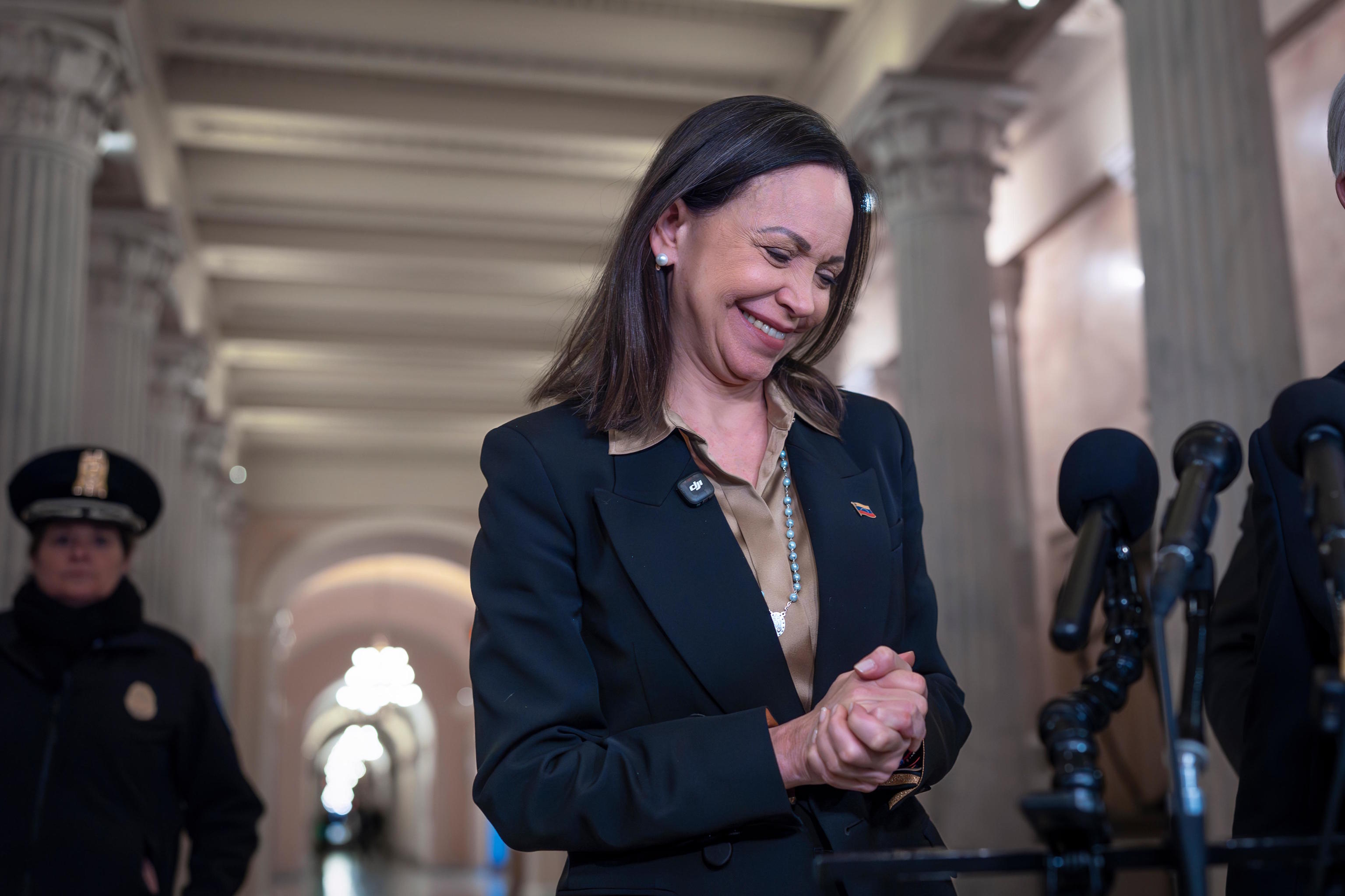
The President of the United States, Donald Trump, has opened the door for the first time this Tuesday for María Corina Machado to potentially play a role in the transition of Venezuela. Machado was at the White House last Thursday to meet Trump in person, with whom she had only spoken on the phone. The meeting went well, much longer than expected, but at the end, the president chose to maintain the low profile he had decided to set beforehand. Unlike what happened with Juan Guaidó in his first term, Trump did not receive Machado as a prominent authority, with a formal greeting at the main door or a public appearance before the cameras. It was a private lunch and meeting, and the only image that emerged was of Trump, smiling, accepting the Nobel Peace Prize medal.
Machado, temporarily based in Washington to build ties with the administration, is trying to convince the president that Delcy Rodríguez, her brother, and Maduro's hierarchs are not the best option for the United States. And it's not easy. Trump spoke on the phone with Delcy, the current president of Venezuela, and showered her with praise and compliments: "she is fantastic". He repeated the same today, while at least showing receptiveness to the possibility of Machado and the opposition having some kind of role.
"I used to have a strong aversion towards Venezuela, but now I love Venezuela. They have been working very well with us. It has been wonderful," he said today, from the White House press room, in a press conference to talk about his first year in power. No one asked him about Venezuela, he brought it up on his own through his favorite topic: immigration. Speaking about criminals and mentally ill individuals, one of his favorite subjects, insisting that countries like Venezuela have emptied their prisons and asylums into the U.S.
But after reiterating that the collaboration with Caracas is now magnificent, Trump mentioned Machado. "An incredibly kind woman also did something extraordinary, as you know, a few days ago," he said in reference to her giving him her Nobel Peace Prize medal. "I am talking to her and maybe we can involve her in some way. I would love to be able to do that. María, maybe we can make it happen," he directly told her.
Trump did not specify anything, but it is the first time he has considered something like this. Since October, when Machado won the Nobel Prize, his attitude was distant. He even said, after capturing Nicolás Maduro, that she "does not have the support and respect of the people" of Venezuela. That's why he has decided to work with the Bolivarian regime. "We are dealing with the people who elected the president and with all the people of Venezuela, and things are going great for us. Oil companies are preparing for massive investments there. They have more oil than even Saudi Arabia, imagine that," he said delighted.
Trump and his team have not given any indication that they advocate for a regime change. They mention the possibility of elections, but not necessarily in the near future. They have made it clear to Delcy Rodríguez that if she does not cooperate and obey, she could end up like Maduro, but there are no official or at least public plans to force an exit, hold quick elections, or have an active role for the opposition, from Machado to Edmundo González. At least not yet.