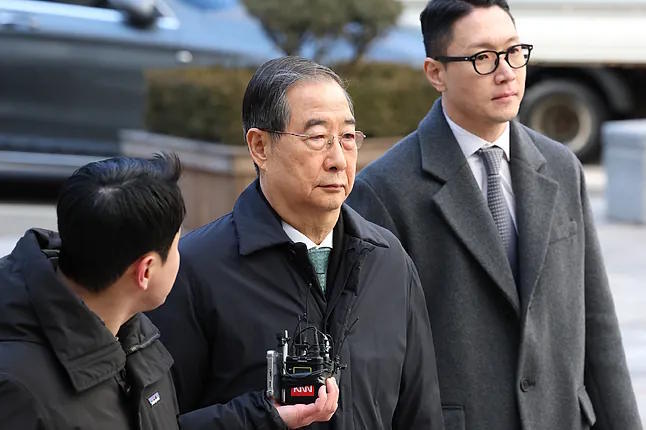
For decades, Han Duck-soo was the archetype of the South Korean technocrat: discreet and efficient, he appeared in governments of different ideological backgrounds. This Wednesday, that career ended in a courtroom in Seoul, when a court concluded that his complicity in the martial law decreed in December 2024 led him to engage in intolerable insurrection.
At 76 years old, Han, former prime minister and interim president of South Korea for weeks, has been sentenced to 23 years in prison for his role in the most serious episode experienced in Seoul in decades, when then President Yoon Suk-yeol invoked an authoritarian decree that briefly suspended the South Korean democratic system, in what the judges have deemed an attempt to subvert the constitutional order.
Han supported Yoon throughout the declaration of martial law. This is the conclusion reached by the court, which has imposed a sentence that exceeds by eight years the penalty requested by the prosecution.
"The defendant ignored his duty and responsibility as prime minister until the end," stated Judge Lee Jin-gwan while reading a sentence that was broadcast live.
This sentence, which describes martial law as an act of insurrection, comes a week after the first sentence against former President Yoon, who received a five-year prison term for obstructing the execution of an arrest warrant, abuse of power, and fabrication and destruction of official documents.
Yoon still faces another sentence for leading a rebellion. For this trial, prosecutors have gone even further and have requested the death penalty.
Yoon's decree led to the deployment of the army in the National Assembly (Parliament), an unprecedented image since the darkest years of military authoritarianism in the late 20th century. The opposition-controlled Parliament managed to block the measure just five hours later. That episode led to Yoon's removal in April 2025 by the Constitutional Court and forced the calling of early elections.
Since then, the judiciary has been advancing against Yoon and key members of his administration. According to the court, Han played an "important" role in providing legal and procedural cover for martial law. The judges consider it proven that he never explicitly opposed or mobilized the cabinet to stop the decree.
"The defendant ensured, at least formally, compliance with procedural requirements," stated Judge Lee, dismantling Han's defense, who during the trial insisted that he never supported or facilitated martial law and that his actions were limited to technical duties.
After Yoon's removal, Han assumed the interim presidency and for weeks was seen as a figure of stability, even as a possible conservative candidate in the upcoming elections.
But that political capital quickly evaporated, and in May he resigned in an attempt to run for the presidency, a maneuver that failed when the conservative party itself refused to nominate him for an election that was ultimately won by the progressive Lee Jae-myung.