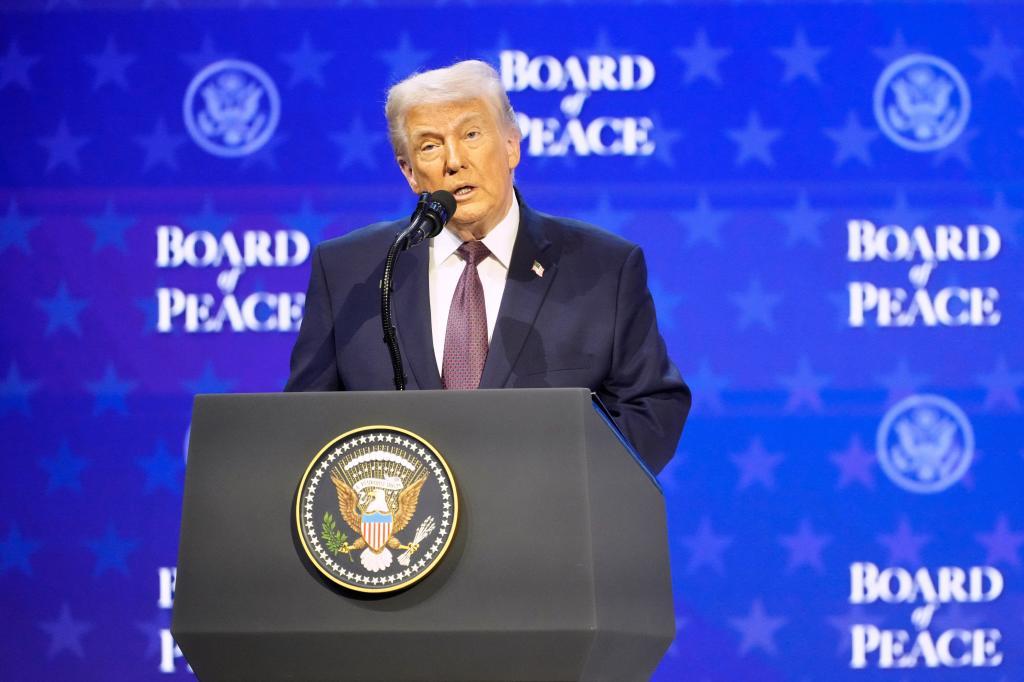
Trump was once again himself, although the audience of his speech expected an even more extreme version and the final feeling was one of relief. In his meandering review of current events, of which he is the absolute protagonist, the blond president spent a good amount of time in his long speech talking about the war in Ukraine.
It was striking that on two occasions he mentioned that "tomorrow [today]" he was going to meet with Volodymyr Zelensky, whom he placed among the audience: "Maybe he's watching me around here." But the President of Ukraine was neither among the audience nor in Davos, but in Kiev, as his presidential office had to point out. Finally, Zelensky is traveling today to meet with him. We also know, because the Kremlin has published it, that Steve Witkoff, Trump's special envoy and former real estate developer, is traveling to Moscow to meet with Vladimir Putin again as part of the peace talks.
Donald Trump considered that it is NATO and Europe who "should take care of Ukraine, not the United States," a position that contrasts with that of all American presidents since Bill Clinton. "What do the United States get out of all this work, all this money, apart from death, destruction, and colossal sums of money that end up in the hands of people who do not appreciate what we do? They do not appreciate what we do, I mean NATO, I mean Europe. They are the ones who should take care of Ukraine, not us."
It is not the first time that the blond president announces his desire to disconnect from this conflict, repeatedly using the argument that it is not his war, but "Joe Biden's war," and that with him in power "it would never have happened," a statement to which Putin joined in to stroke his ego at their meeting in Alaska.
The President of the United States continued to insist along the same lines: "The United States is very far away, separated by a great and beautiful ocean. We have nothing to do with that." It is a statement that confirms what has already been published in the National Security Strategy, the bible of international relations in which this Administration has made it clear its distancing from Europe (a lost continent, according to Trump's opinion, whose countries are "unrecognizable," as he said yesterday) to focus on what he calls "our hemisphere".
Trump once again expressed optimism about the peace talks in Davos, despite the Russian regime doing everything possible to prove the opposite: "We are reasonably close to an agreement to end the war in Ukraine."
The problem is that this optimism, as has happened for months, does not translate into anything. Vladimir Putin demands territories that his soldiers have not even been able to conquer, such as 25% of the Donetsk region that Russia has been trying to take in vain for four years, advancing slowly and painfully. The Kremlin does not back down from this maximalist demand, which Zelensky flatly rejects, supported by his European allies.
This point, combined with the security guarantees after the signing of a hypothetical peace agreement, with the deployment of international troops in Ukraine (promoted by the so-called "Volunteer Coalition") which Moscow flatly refuses, makes signing any commitment today almost impossible.
Trump reiterated in Davos another idea previously expressed, but not necessarily true: "When Putin is convinced to sign, Zelensky refuses, and when Zelensky agrees, Putin backs out." But in reality, Ukraine has accepted, from the beginning, all ceasefires proposed by the United States, and it has been Russia that has rejected them.
The ball is now back in the Kremlin's court. But even in the case of an agreement that clearly benefits Russia, it does not seem that Moscow will accept the latest version of the text revised by Ukraine and Europe, as Kremlin officials have been leaking to various media outlets for weeks.
Despite the efforts of the United States to appease the Russian autocrat, American intelligence sources have repeatedly revealed that Vladimir Putin does not have a real will to end the war. The reason is that for almost four years, he has been receiving distorted information, as reported by the Financial Times, from his generals, who sell him great victories on the front and a Ukrainian army always on the brink of collapse. An example is the battle of Kupiansk, which the Russian Chief of Staff, Valery Gerasimov, sold as a great victory two months ago. Weeks after declaring the city conquered, Ukrainian troops expelled the remaining Russian troops besieged in the center and even Zelensky went there to record a video-selfie.
In this phase of the war, with the front almost frozen, the ones suffering the most are the Ukrainian civilians. In cities like Kiev, days pass without electricity or heating, with an energy infrastructure almost destroyed by Russia.
The President of Latvia, with Ukrainian soldiers, in Davos.E. M.
Even a handful of Ukrainian officers have traveled to the famous Swiss spa town in recent days to speak with European politicians. Yesterday they were photographed with Edgars Rinkvis, President of Latvia: "I had the opportunity to meet Ukrainian soldiers in Davos. They are here to tell their stories about the war. They defend both Ukraine and Europe, and freedom, and for that, they deserve a huge thank you."