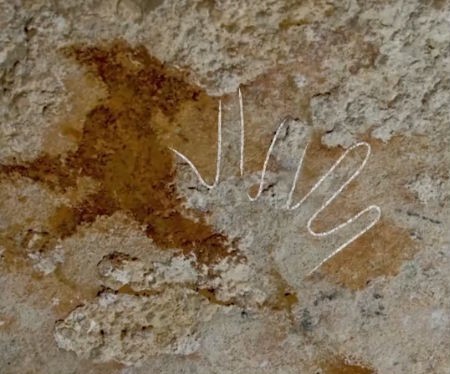
Hands in a cave in the province of Sulawesi, Indonesia, have become the oldest rock art in human history, as well as the imprint of the oldest painter in human history, dating back 67,800 years.
The hands were discreetly preserved in the limestone cave of Leang Metanduno, on the island of Muna in the Flores Sea, surrounded by other rock art images, including much more recent hunting scenes. Indonesia is already famous for hosting the world's oldest rock art, dating back to the Pleistocene. These hands now surpass in age the humanoid figures hunting a wild pig, dated to 51,200 years in 2024; as well as the image of a wart hog (Sus celebensis), a native animal of the island, painted in Leang Tedongnge cave, considered in 2022 the oldest painting, dating back around 45,500 years according to uranium dating.
The southeastern part of Sulawesi, where rock art was first reported in 1977, had remained largely unexplored until now. Maxime Aubert, an archaeologist and geochemist from the Griffith Centre for Social and Cultural Research (GCSCR), and his colleagues began exploring caves in this province, discovering 44 sites, 14 of them previously unknown. Dr. Adhi Agus Oktaviana, a rock art specialist from the Indonesian National Research and Innovation Agency (BRIN), had discovered the hands several years ago while working on a book about Indonesian rock art. "In fact, this particular cave is a well-known tourist destination, but no one had noticed the presence of ancient and blurred hands until that moment," Aubert points out.
Oldest Figurative Rock Art Discovered in Indonesia
The Malaga Cave Used by Neanderthals and Sapiens for 58,000 Years
Researchers took samples of tiny calcium carbonate deposits that had formed under the paintings and used high-resolution uranium series laser ablation dating. The results revealed minimum ages of up to 67,800 years, surpassing the previously known oldest rock art. In some cases, two distinct episodes of artistic creation were discovered, separated by approximately 35,000 years, indicating a long artistic tradition during the Pleistocene in the same setting.
"Although we cannot yet link this art to a specific culture in the modern sense, the fact that painting continued in these caves for tens of thousands of years demonstrates that it was a lasting tradition, passed down through many generations," explains Aubert.
Many of the rock hands found in Sulawesi also have a particularity. The fingertips are carefully modified to appear pointed, resembling animal claws, and it is believed that the newly discovered hands may have undergone the same modification. "Altering human hand images in this way may have had a symbolic meaning, possibly related to how this ancient society understood the relationships between humans and animals. In previous research in Sulawesi, we found images of human figures with bird heads and other animal features, dated to at least 48,000 years, which we interpreted as the representation of beings that were half human, half animal. Together, these findings suggest that early populations in this region had complex ideas about humans, animals, and identity from very ancient times," Aubert points out. According to Professor Adam Brumm from the Australian Research Centre for Human Evolution (ARCHE) at Griffith University, "this art could symbolize the idea that humans and animals were closely connected."
Blurred hands behind more modern rock figures.Maxime Aubert
The technique used to paint the hands does not solve the mystery of whether we are seeing the artist's hand or a model's hand. Someone would press their hand against the rock and, using their mouth or a rudimentary bone or reed tube, blow the pigment, in this case, red color, iron oxides. When the hand was removed, its outline remained.
"The hands show that these people were capable of complex symbolic behavior. Creating images on cave walls suggests that they were marking places that were important to them and expressing ideas about identity, a sense of belonging, or relationships with the natural world. It was not a casual activity. It required planning, shared knowledge, and cultural significance. It is now evident that Sulawesi was home to one of the richest and most enduring artistic cultures in the world," explains Aubert.
The findings also support the theory that early humans migrated to Sahul (an ancient continent connecting Australia with New Guinea) through a northern route involving maritime travel between Borneo and Papua, a region that remains largely unexplored archaeologically. "The artists were early modern humans living in Southeast Asia during the Ice Age, at a time when sea levels were much lower, and the region looked very different," Aubert points out. "Archaeological and genetic evidence from present-day indigenous peoples of Australia and Papua suggest that they were part of the populations moving through Indonesia towards Australia and New Guinea, and are likely ancestors of Australian and Papuan indigenous peoples."