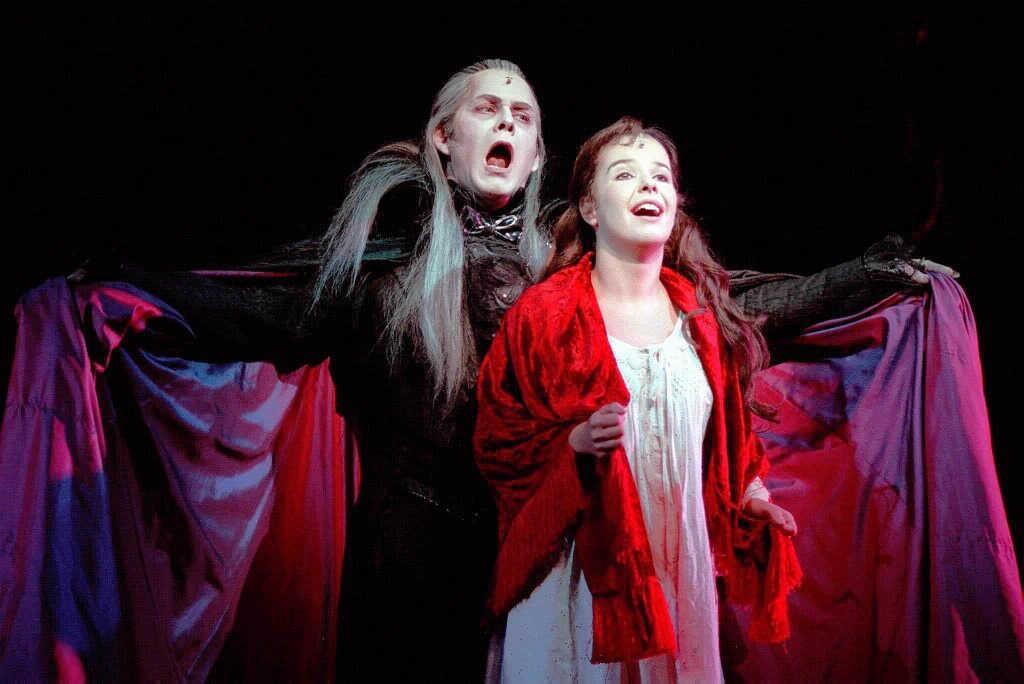
David Roas is focused on a new genre. This professor of Literary Theory and Comparative Literature at the Autonomous University of Barcelona, where he directs the Fantastic Studies Group, has discovered a trace of the vampire in the depopulated Spain. He follows its steps through what has begun to be called "agrohorror." He talks about Amancio, the Village Vampire. "It's a type of villager who has turned into a vampire and lives in his crappy house. There is an impact of the vampire on our culture. Fantastic writing set in the Spanish rural world is an example. The author, Alejo Ibáñez Pérez, had made a short film a few years ago and now publishes the story with a small publishing house."
The local press mentions this vampire appearance. It was in 2022, when the centenary of the premiere of Nosferatu: A Symphony of Horror was celebrated, the canon established by Murnau, the German film director. Amancio could be the vampire marking the resurgence of the myth. Well, Luca Guadagnino's cannibals in Bones could pass as remastered vampires.
The vampire has kept its promise: it is immortal. Movies, series, and comics have brought it back in 2025, right on the 20th anniversary of the release of Twilight, the best-selling saga that tells the love story between vampires and werewolves, very popular in its film adaptation. The Sinners, the movie by Michael B. Jordan. Dracula, by Luc Besson. The series Silence, by Eduardo Casanova. Nosferatu (Planeta Comic), the comic by Diego Olmos. Dying (Norma), the graphic novel debuting by Fran Mariscal. And this year there will be a legion of female vampires roaming the pages of High Blood (Alianza), the debut novel, "gothic, vampiric, and tropical," by Claudia Amador.
The myth maintains its vigor. "Forget about Twilight. In the vampire, two things come together. The desire for immortality and the dark side. The vampire that interests me is the monster of the night. It is chaos against order and light. What we would like to be. That wild side and the immortal desire. The ghost has less substance. The vampire is the monster of what is not controlled. The wild. The blood," ventures David Roas trying to put together a theory about the attraction it generates. Why is the vampire everywhere again? "On one hand, it is scary, but on the other, it reveals things about us."
In all available adaptations of the myth, the gothic vampire is always present. "The educated one. Although there has been everything in its representation. Everything from foreign forms to more popular ones. In the Asian world, they have their particular vampires, for example. But the gothic vampire has always dominated," considers Roas.
The vampire is actually an aggregator of our fears. "If I had to design a Nosferatu with current codes, I would look at the environment," emphasizes Roas. "We live in a global situation where it seems that there is no referee. All the leaders of all powers seem to be crazy. We have the feeling of approaching a dozen collapses. We also live in despair. What better than to use the vampire to gather all fears? In each era, it has been accommodating to what was happening. To concerns. When I explain Dracula in class, I like to explain it in a political sense. It is a monster that comes from the wild world to invade London. From there, issues have been incorporated. For example, in We Are the Night, a German film from 2010, one of the vampires tries to convince her friends to become vampires, and the arguments are as follows: we eat and do not get fat, we have sex and do not get pregnant. There was a female empowerment. Ideologically, it is filled with different ideas. That is why sometimes, depending on the countries and moments, it symbolizes different things," he adds.
"In 'We Are the Night,' a vampire convinces her friends to become vampires by saying: 'We have sex and do not get pregnant'"
The doctoral thesis The Evolution of the Vampire Figure in English and American Literature as a Social and Economic Symbol of Contemporary Western Masculine Identity captures the paradox of making the vampire a mirror of everyday affairs. "Current Western society, as a commonly accepted form of modern and productive culture, has come to represent vampires more strongly in literature and the audiovisual industry. In recent years, a new generation of vampires has emerged, invading the public's mind. This thesis was developed under the premise of understanding the vampire as the embodiment of the capitalist masculinity of the Western white man. Marxist studies have long understood the vampire as the oppressive force of capital in the context of the social class struggle," writes its author, Kristian Pérez Zurutuza, who mysteriously disappeared.
The sick queer vampires with AIDS proposed by Eduardo Casanova are not so original. "It is another way of representing it," says the unsurprised Antonio Ballesteros, PhD in English Philology at the Complutense University and author, among other studies, of Vampire Chronicle: A Natural History of the Vampire in Anglo-Saxon Literature. He supervised Pérez Zurutuza's work, of whom he says he has not known anything for a long time. "Silence, Casanova's series, does not destroy the myth. In the story, there are vampires with inclusive families or linked lineages. There is a lot of queer vampire literature. The monster, since The Vampyre by John William Polidori, published in 1819, has always projected an ambiguous sexuality."
The evolution of the vampire through popular culture has led to a simplification. Its edges have been smoothed out. With the passage of time, it has lost the ability to provoke fear. "It has become something very different from the terrifying vampire. Compare, for example, the Nosferatu of 1922 with the Nosferatu of 2024. The last great recreation of the vampire as a terrifying character, a European vampire invading the United States, is by Stephen King. For me, there is a turning point in this sense with Coppola's Dracula. It is a loving vampire or worthy of being loved. There is a disenchantment."
What does the constant renewal of the vampire myth say about us? "Our society assimilates the vampire. The vampire has a protean and changing capacity. It will always be like that. According to the times." But the general public, until this monster's vindication that mirrors do not reflect, had the zombie as its favorite creature. A legion of infected ran through any audiovisual platform, accumulating minutes and popular influence. In some towns, there was even a night of the living dead where the population divided into two sides. "The vampire, and all the monsters of our time, were replaced by the zombie, which cannot think. It says a lot about our society. It is a society alienated to a certain extent. That does not have its references very clear. The great monsters were replaced by a monster that cannot think."
Although the vampire always wins. "Of all the classic monsters, it is the most malleable. I believe its origin lies in Christ, with its characteristics reversed. If the Holy Spirit is represented by the dove, the vampire is represented by the bat. It is another resurrected being. And then there is the blood that Christ shed for us. As society has moved away from Judeo-Christian culture, the vampire has become independent. Before, it had a more religious background," says writer David Remartínez, author of Una historia pop de los vampiros (Arpa).
In Only Lovers Left Alive, written and directed by Jim Jarmusch in 2013, you see the true dimension of the vampire. "It proposes constant sexual liberation. Until then, the vampire was burdened with the curse of not being able to have sex. He was lustful, but he couldn't have sex. It's one of the films that marks how the vampire has changed. Twilight is hated by everyone. Apart from being a great film, Jarmusch's film has it all. The female vampire and the contemporary male vampire. The pleasure of blood as true pleasure. And with eternal life.
The duality of the myth means that it is always on the verge of reappearing. Perhaps the secret to its vitality lies in the tension between the classic and the postmodern adaptation. The publication of the comics Moribundo and Nosferatu is proof of this. 'I find the figure of the emotional vampire very interesting,' says Fran Mariscal, author of Moribundo. "I developed the story after going through an unpleasant experience. I went through a depression. It's a way of talking about mental health and what drains our energy around us.' Diego Olmos, author of Nosferatu, brings Murnau's monster to life. 'I saw Herzog's version when I was six years old. It paralysed me. The comic is a tribute, a love letter, to that terrified child," he says.