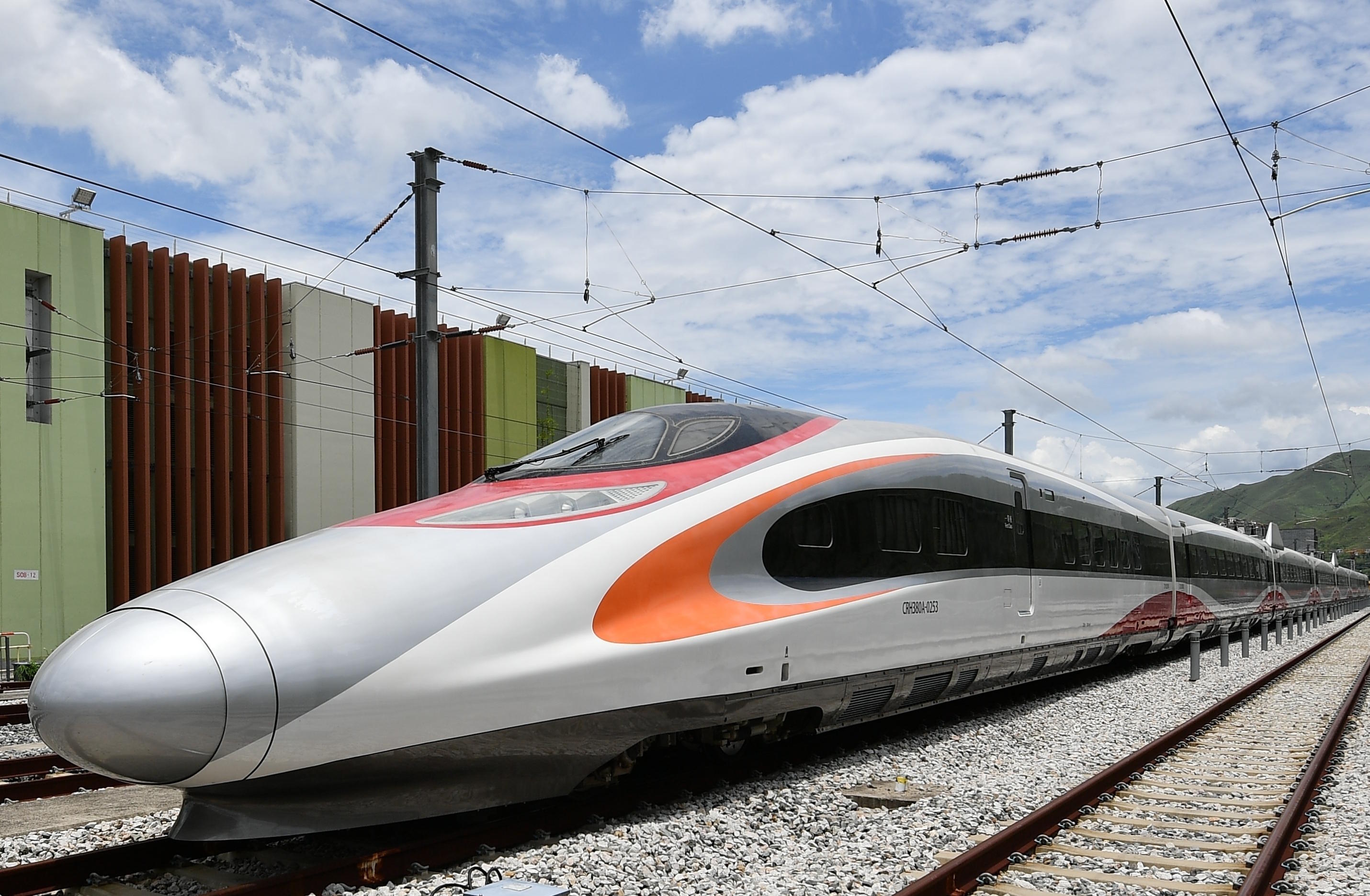
After the railway accident in Córdoba, Spain,, some users on social media shared videos contrasting the noticeable vibration sensation on some high-speed trains in Spain with the smoothness on Chinese trains, where the tremor is almost imperceptible to passengers and the rolling is extremely stable. A striking difference considering that in China trains run at much higher speeds.
The Asian giant arrived later than Spain in high-speed rail, but when it did, it entered an unprecedented scale, speed, and centralized planning. In 2010, China had 8,358 operational kilometers of high-speed rail. This January, that number surpassed the milestone of 50,000 kilometers. By a significant margin, it is the largest network in the world: connecting megalopolises like Beijing and Shanghai, but also medium-sized cities in the interior that for decades were left out of the major economic axes.
Towards the end of last year, Spain focused on Chinese trains after the Minister of Transport, Óscar Puente, suggested the possibility of buying trains manufactured in China to operate on the AVE services. An idea that angered a large part of the national industry, which does not understand why Puente has to look towards the East when there are renowned manufacturers at home like Talgo or CAF.
Additionally, the minister opened the debate on increasing the speed - up to 350 km/h on some routes, imitating the Chinese model - as a symbol of modernization and competitiveness. Although now, after the recent railway accidents in Adamuz and Catalonia, the official discourse has shifted towards caution. Statements about speed records have given way to temporary limitations, in some cases up to 160 km/h, as a preventive measure, fueling the sense of communicative shifts and lack of a clear roadmap.
In December, Puente traveled to several Chinese cities to firsthand learn about the advances in the country's railway network, with a view to strengthening bilateral cooperation in transportation. The socialist minister visited the headquarters of one of the world's largest construction and engineering companies, China Railway Construction Corporation (CRCC). He also visited the workshops where rolling stock and technologies that oversee the vast high-speed network are tested.
In the early hours at the Shanghai Hongqiao station, one of the largest in the country, when the platforms have emptied and the hustle and bustle fade, the choreographed technical supervision begins, which includes a mixed team of technicians and robots guided by navigation and positioning systems using laser radar. The robots move with millimeter precision between the rails. Two articulated arms, equipped with cameras and image sensors, rise and rotate to scan the underside of the train. Every screw, every cable, is recorded. The information is instantly processed by artificial intelligence algorithms, which detect anomalies and send the data to technicians for final validation.
This scene is repeated these days at stations throughout the country. We are on the eve of the so-called Chunyun, the largest periodic human movement on the planet due to the Chinese New Year holiday, which falls in mid-February this 2026. A record of 539 million passenger trips is estimated on trains that undergo complete inspections every three days of service.
The state newspaper China Daily details in a report that a standard high-speed train, with eight cars, has more than 10,000 components that must be checked one by one: from tightening the screws to checking the wear of key parts or possible fluid leaks. Until recently, this task was almost entirely carried out through manual inspection. Two operators needed at least two and a half hours to inspect a single train. With the introduction of robots, the inspection time has been reduced to less than an hour, and human intervention is limited to a final ten-minute check.
The automation commitment extends along thousands of kilometers of tracks, where drones equipped with infrared sensors, high-definition cameras, and AI-based analysis systems monitor the state of the tracks and fly over embankments and slopes to detect unstable rock formations, landslides, or geological risks that may affect circulation. Part of the inspection is also usually done by inspection trains equipped with cameras, radars, and sensors.
The core of the system in the Chinese railway network is the CTCS (Chinese Train Control System), developed with proprietary technology. Experts explain that it relies on satellite data with digital maps to improve location accuracy and journey safety, as well as real-time monitoring of train speeds, controlling the distance between convoys, and automatically activating braking in case of any incident.
To find the last major railway accident in China, one must go back to 2011 when a high-speed train collided near the city of Wenzhou with a stopped locomotive on a viaduct. Several cars derailed, leaving 40 dead. Last November, although not a regular service collision, a test train struck maintenance workers in Yunnan province, killing 11 people.
While China, home to more than 1.4 billion people, boasts of having consolidated a giant railway network that combines speed, stability, and obsessive risk control, Spain observes from a distance that model that Minister Puente intended to imitate. His trip to China, the controversy over train purchases, debates on speed increases, and the recent dramatic accidents have brought to light an uncomfortable comparison that goes beyond vibrations and speeds.