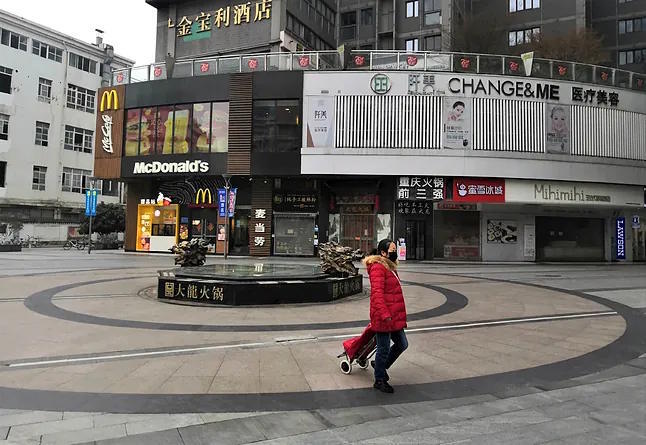
Wuhan, the first city in the world besieged by Covid, continues to carry the stigma as the place where a pandemic started, the origin of which we still do not know for certain. The epicenter of the initial outbreaks, a modern city with over 11 million inhabitants, has long moved on. The country where it is located, China, has also taken control of the narrative to try to convince the public, at least internally, that the virus originated elsewhere. But there is someone, the same person who initially exposed the lab leak theory, who still vividly remembers those fateful days of January 2020.
"I have always said that the virus came from Wuhan and that those bodies were in body bags. We saw it all through satellites. There were bodies everywhere in Wuhan, right around the building we mentioned earlier. The next day, someone told me to pay close attention because something strange was happening in China. That's how it all started. Eventually, we had the pandemic, and the whole world suffered a lot."
These are the words of the President of the United States, Donald Trump, this week during a speech at the World Economic Forum in Davos, Switzerland. The Republican, addressing the situation of the U.S. economy, mentioned the Covid-19 pandemic that erupted during his first term.
Trump did not specify which "building" in Wuhan he was referring to in his statement. On previous occasions, he has been more specific. "The virus leaked from the lab. I have said it from day one and have never changed my mind," he stated last year after the White House website released a note announcing that the Wuhan lab leak was the "true source of the Covid pandemic," although no evidence was presented.
This Friday marks six years since the whole world turned its attention to a then unknown city in central China, with more inhabitants than New York or London, which had closed all its doors due to a strange virus that did not even have a name yet. This newspaper was a direct witness to that unprecedented closure, which days later led to the first major lockdown.
Throughout these years, the prevailing theory among the scientific community has always been that SARS-CoV-2 originated in bats, jumped to another animal, and mutated in a way that later allowed it to spread among humans. Questions remain about who the missing link in that chain of transmission is, who the patient zero was, and when exactly the virus began circulating in Wuhan.
The first major official outbreak has always been located in the same place: Huanan market, where wild animals susceptible to the virus, such as raccoon dogs, civets, and hedgehogs, were sold. Many of the species came from southern China, where horseshoe bats, the likely primary source of infection, are found.
30 kilometers from the market is the Virology Institute, a 3,000-square-meter complex that includes a P4 laboratory, the highest level of biosafety because it studies the most contagious pathogens, such as bat coronaviruses. In 2024, the journal Nature published a series of data provided by virologist Shi Zhengli, a researcher at the lab, trying to demonstrate that none of the viruses stored in their freezers are "ancestors of SARS-CoV-2." However, doubts persist.
In March of last year, a joint investigation by the German newspapers Die Zeit and Süddeutsche Zeitung revealed that Berlin's intelligence services considered with high probability that the pandemic originated in the Wuhan lab. In 2020, Angela Merkel's government reportedly commissioned the Federal Intelligence Service (BND) to analyze the virus's origin, relying on public data and intelligence material obtained in an operation called Saaremaa, including scientific information from Chinese institutions like the Virology Institute.
According to these reports, the BND detected signs of high-risk experiments modifying natural viruses, as well as repeated breaches of biosafety regulations, and assessed the lab leak hypothesis as plausible with a probability between 80% and 95%.
Despite the strength of that assessment, the then head of the BND, Bruno Kahl, reportedly informed the Chancellery without making the conclusions public, a decision that, according to reports, was upheld by both Merkel and later by Olaf Scholz's government. At the end of last year, the current German government commissioned an external review of the findings, which have not been disclosed yet.
What was published last summer was the latest WHO report on the virus origins. A group of 27 international experts, after over three years of analysis, concluded that essential information is still missing to conclusively evaluate all hypotheses.
The document directly points to the Chinese government. "Much of the necessary information to fully assess all hypotheses has not been provided, limiting the scope of scientific conclusions," they state.
The report indicates that, based on the available evidence, everything points again to "a zoonotic spread," either directly from bats or through an intermediate host. However, the WHO emphasizes that no hypothesis can be completely ruled out. "In the current situation, all hypotheses must remain on the table, including zoonotic spread and lab leak," said the WHO Director-General, Tedros Adhanom Ghebreyesus, who once again urged China and other countries with relevant information to share it transparently to prevent future pandemics.
"Clarifying the virus's origin is not just a scientific effort but a moral and ethical imperative," stated the head of the research team, virologist Marietjie Venter. The WHO once again criticized Beijing for the lack of key data requested, such as genetic sequences of the first positive cases, detailed information on animals traded at the Huanan market, and data on biosafety at the controversial lab.