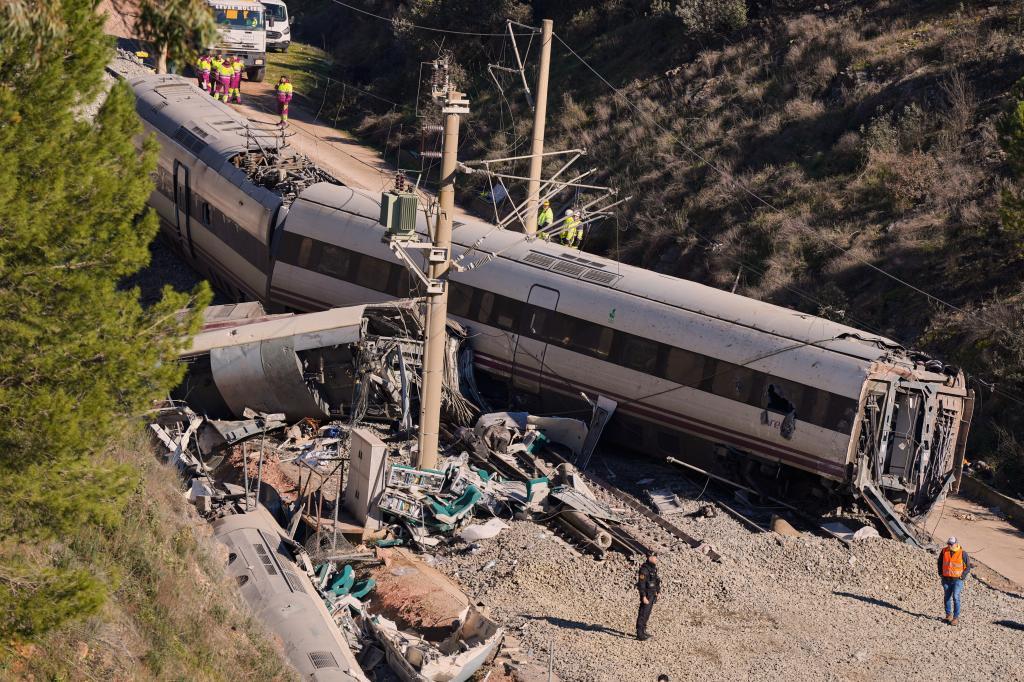
The Railway Accident Investigation Commission (CIAF) has released its initial findings on the railway accident last Sunday in Adamuz. The first technical report establishes the track breakage as the main reason for the accident and indicates that this breakage occurred prior to the passage of the Iryo, which resulted in a crash that claimed the lives of 45 people. The rear cars of the Frecciarossa 1000 derailed, partially invading the opposite track, which was crossed in a few seconds by a Renfe Alvia, which in turn derailed and crashed into an embankment.
The CIAF report confirms the information previously reported by EL MUNDO since last Monday, when it indicated that the investigation already pointed to track breakage as the most likely cause of the Iryo derailment. The Ministry of Transport only described the accident as "strange," ruling it out as a "decisive indication." Two days later, Minister Óscar Puente acknowledged that track breakage was an "undeniable" possibility.
"According to the information available at this time, the hypothesis can be raised that the rail fracture occurred prior to the passage of the derailed Iryo train and therefore before the derailment," states the report, adding that its current hypotheses are provisional and pending verification through additional tests expected to be carried out in the coming phases.
Today, EL MUNDO reports that these additional tests are already underway with the verification of the dynamic parameters of the trains that passed before the Iryo derailed at 7:48 p.m. on Sunday. Sensors installed in these vehicles detected anomalies in their movement as they passed the accident point. These anomalies were not reported by the train drivers but were recorded by the vehicles' measuring devices. The trains that passed through the section preceding the accident were Renfe Viajeros 130 at 7:09 p.m., Iryo 109-003 at 7:01 p.m., and another Iryo around 5:21 p.m., according to the investigating commission.
The CIAF explains that its investigation is shifting from the accident scene to the samples taken. Rail samples will be sent to a metallographic laboratory to determine the possible causes of the breakage. At this stage, new possibilities are emerging to establish responsibilities. The investigating technicians also point out that in the coming weeks, the downloading and analysis of the recorders of the trains involved in the incident will also be carried out. "Once the causes of the breakage are determined, new lines of investigation derived from them can be established," says the CIAF.
The initial thesis of track breakage as the cause of the accident was strengthened by the discovery of notches in the Iryo's wheels by the accident investigators, as reported by this newspaper last Wednesday.
The CIAF report indicates that notches were detected "in the tread of the wheels on the right side of cars 2, 3, 4, and 5" of Iryo 6189. "The notches have a uniform pattern in cars 2, 3, and 4 and are consistent with an impact on the rail head." Visual comparison between the wheel notches and the broken rail section at the derailment zero point presumably yields matching results.
According to the technicians, these wheel notches and the observed rail deformation "are consistent with the fact that the rail was fractured: with the rail continuity interrupted, the front part of the fracture would initially receive the total weight of the wheel, causing that part of the rail to descend slightly. As the part of the rail behind the fracture would not be acting in unison with the front part, a step would momentarily be created between the two sides of the fracture, hitting the wheel rim."
The technicians presume that the rail "tilted outward (right side according to the direction of travel) during the passage of car 5, causing car 6 to derail due to a complete lack of continuity in the rolling."