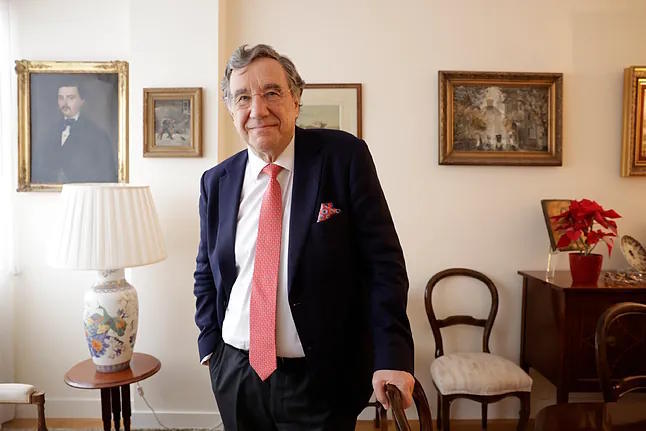
Ángel Losada, Spanish ambassador in Tehran until two years ago, recommends watching the movie The Seed of the Sacred Fig Tree (2024), by Iranian director Mohammad Rasoulof, to understand what is happening in the country in recent weeks, a movement that actually has not stopped since the death of Mahsa Amini in September 2022. "It shows the generational gap between those who participated in the 1979 revolution with Khomeini, who are their parents, and the young people of today, who have nothing to do with that," he emphasizes.
Losada, already retired, arrived in that destination right in the midst of that repression and there, after tough negotiations, he managed to secure the release of Santiago Sánchez, the Spanish tourist who was imprisoned in the high-security Evin prison for 15 months, accused of espionage, after visiting Amini's grave. "The regime reacted brutally by applying a criminal charge that surprises us all, which is 'war against God' that carries the death penalty. And it doesn't necessarily mean you killed someone, just blocking a street is enough." "They arrested 14 and 15-year-old girls... The women showed admirable courage. It planted a very important seed that we are seeing again now," he values regarding the current situation.
He describes a country very different from what anyone who has not set foot there imagines, with a population "much less religious than in any Muslim country I have been to, because the mosques are empty" and a very Westernized youth, "eager for freedom," emphasizes this diplomat.
"The ayatollahs, the mullahs, the Islamic theocracy that governs the country, have realized that if the youth are not attached to the system they have promoted, the future of the system is at stake," Losada emphasizes about an uncertain future and the threat of an imminent attack by Donald Trump, after the 12-day War against Israel last June and the bombings of its nuclear facilities by the United States.
In the protests that began on December 28, that system is once again in question, as it was in the Green Revolution of 2009, the Persian Spring of 2019, and of course, in the most recent one in 2022 with the slogan that reached every corner: "Woman, life, and freedom". And the reaction of the regime of Ali Jamenei, the Supreme Leader of Iran, is very similar to that: indescribable repression, deaths (several thousand, as acknowledged by Jamenei, although other sources claim more than 5,000), and an uncountable number of detentions.
"The testimonies I receive are of great concern. The children of the leaders are also in the protests"
"People are very scared," this diplomat assures based on what his contacts there convey to him. "The testimonies I receive are of great concern, but from all sides, because the children of many leaders are in the demonstrations," he states, as it happened four years ago when a deputy minister's daughter lost an eye from the pellets fired by security forces, and the family had to leave Iran.
The spark of the recent protests ignited amid rampant economic crisis, with the devaluation of the local currency, the rial, and in a very significant place from Losada's point of view: the Grand Bazaar of Tehran. "The bazaaris, very traditional and religious, who fought against the Shah, have realized that the Revolutionary Guard, which actually holds the power," is taking over all the commercial and economic elements of the country and they are left with nothing. From a control 15 years ago where the Revolutionary Guard had only about 5-10% of the country's economy, they have now risen to 70%," he explains to understand the importance of this reality. "The merchants declared a strike and closed the market, which is almost like closing the Stock Exchange."
"International sanctions, both from the United States for the nuclear issue and from the EU for human rights, have dealt a severe blow to the economy," he says, "but curiously, they have also been an element that has enriched a part of the population that is also in power." "Iran has fallen into a kind of autarky with China in which a trade almost of exchange, of barter, has been created," he points out.
"The Revolutionary Guard controls 70% of the economy and the sanctions have enriched a part of the population"
The response to the protests also involved an internet blackout, although VPNs and Elon Musk's Starlink satellites have allowed to somewhat bypass this measure. "It has a dual effect: its citizens do not know what is happening and neither do we outside, and the protesters cannot coordinate, but that is very difficult nowadays." A recent arrival from Iran in Madrid who visited him told him that, however, the television channels are still broadcasting. "He told me that what the television shows are the protests in Minneapolis against Trump."
Although the tone has lowered, the President of the United States threatened to attack again and even said on his social media that "the aid was already on its way." Losada considers several scenarios if the president ultimately fulfills his warnings: a new bombing of nuclear facilities -"which would mean admitting he didn't destroy them all in June as he claimed"-; attacking the production centers of supersonic missiles -"which are very important to Israel and have a very close cooperation with North Korea"-; going directly against the centers of power -"but Jamenei lives in the heart of the capital"-; or arming groups that are against the regime, such as the Baluchis on the border with Pakistan, the Arabs on the border with Iraq, the Kurds, or the Turkmens, "but that would create a big problem of civil war."
"Jamenei is not Maduro and Iran is not Venezuela. Iran is an old empire with very established power structures"
And the experience of Venezuela, by the way, an ally of Iran? "Jamenei is not Maduro and Iran is not Venezuela. Iran is an old empire with very established power structures and, although there may be internal betrayal, it is much more difficult," he analyzes.
"A major attack would also have consequences because Iran could respond brutally, they could attack US bases, as they did in June with the one in Doha, and other important American interests. The Foreign Minister said they would be legitimate targets for them and there are bases in Turkey. If Iran attacks Turkey, would Article 5 of the NATO treaty be applied?".
"And the closure of the Strait of Hormuz?," he points out about another possible response, "it would be terrible because 20% of the world's oil and 25% of the world's gas pass through there, and they could also mine it, causing an oil price hike that no one wants, China would be the first to lose with all this."
In case of the regime being overthrown, much has been said in recent weeks about Reza Pahlavi, son of the last Shah of Persia. According to this ambassador, his strategy is very intelligent because when he was in the country, he was barely even mentioned. He emphasizes that "he has made it clear" that "he does not aspire to be the president but rather wants to bring democracy." His rise is attributed to the lack of a clear leader in the opposition. "Now, I have been present in several transitions, such as in Chile, or ours, and transitions always happen from within. It is very difficult for someone from the outside to impose it from the outside."