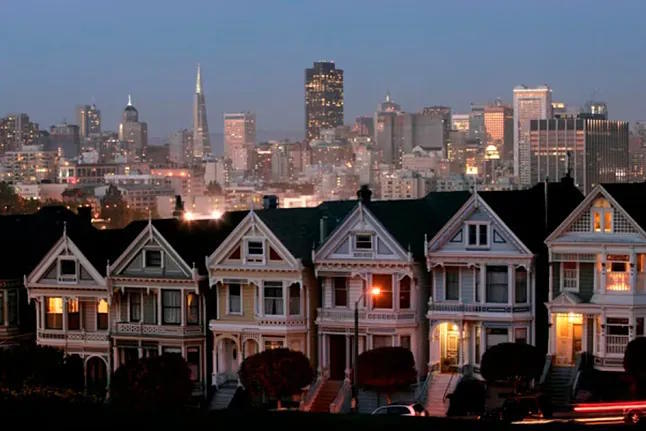
Who hasn't bought a dozen single-family homes to live off the rent when they retire? For Scott Bessent, former executive of George Soros' hedge fund and now Secretary of the Treasury under Trump (since Saint Paul fell off his horse, such a conversion had not been seen), everyone does it. As Bessent explained in Davos, "someone, perhaps your parents thinking about retirement, has bought 5, 10, 12 houses." And, to protect what the secretary calls "mom and pop" from funds buying thousands of houses, the Trump administration has limited the ability of the latter to continue acquiring... but with a trick. The restriction does not affect apartments, where funds are more active and where people with lower purchasing power live. Funds only own 1% of single-family homes in the US, but they own between 20% and 30% of apartments.
Mark Carney's words clash with Canada's mathematics
With his speech in Davos, Canadian Prime Minister Mark Carney has become the symbol of the resistance of US allies to Donald Trump's imperialism (who also wants to annex his country). And unlike, for example, Emmanuel Macron or Friedrich Merz, Carney does not just talk. However, his problem is the harsh reality because the US economy is too big. Thus, Ottawa's plan to double in 10 years the proportion of its exports not going to the US will only reduce Canadian exports to the US by fifteen points - from 75% to 60%, according to Reuters. And the alternative, which is China, is not optimal either, although Carney arrived in Davos 'emboldened' by the trade agreement he had reached the previous week in Beijing, under which Canada agrees to import electric cars from the Asian giant in exchange for the latter doing the same with Canadian agricultural products.
The 'Little Nicolás', on a Davos scale and selling access to Donald Trump
Does anyone remember Francisco Gómez, alias the Little Nicolás, who in 2014 was arrested for 'selling' access to public figures - including then King Juan Carlos I - to businessmen? Well, the kid was a visionary. In Davos, billionaires from around the world have been scammed with a similar but more shoddy system, through emails asking for fantastic amounts (which have not been made public) in exchange for access to Trump. The scam was uncovered on Tuesday, and the US House - Trump's operations center in Davos - posted a warning on its website that also showed who matters to them, as it began with a "Beware, billionaires." The US House itself is an example - albeit legal - of trading favors: although it is entirely private - funded by companies that have each contributed a million dollars - the entire US cabinet has been there. Davos needs its own Berlanga.
The war between Iran (with Russia's help) against Elon Musk
The wave of protests against the Islamic Republic of Iran and the regime's repression has had a technological aspect with, on one side, the ayatollahs and their Russian allies, and on the other, Starlink, the satellite telecommunications service from Elon Musk's SpaceX. Starlink is banned in Iran, and since the war with Israel in June, owning antennas from that network can be punished with the death penalty. But Iranians have defied this ban and have about 50,000 antennas, through which they access news from the rest of the world and communicate (and send images of repression) abroad. Starlink does not depend on fiber optics, making it very difficult to intercept. So Tehran has opted to bring in Russian experts to disrupt the emissions and confuse the GPS systems the network needs, all complemented by other more brutal measures, including drone bombings of the signal reception antennas.
18.5 trillion reasons not to break the transatlantic deck
One of the most curious things in the current transatlantic crisis is that there is relatively little talk about the possibility of Europeans selling their Treasury bonds and/or US private debt and stocks, which would cause a fall in the dollar (which Trump would like) and an increase in interest rates in that country (which would infuriate him). In reality, both sides could cause each other tremendous mutual harm. Europe is the largest holder of US financial assets, with about ten trillion in public and private debt and stocks, compared to the 8.5 trillion that the US holds in Europe. However, given that the vast majority of these portfolios are in private hands, it seems impossible that anything will happen regardless of the political tensions. In fact, Americans are increasing their investment in Europe, indicating that they trust the prospects of the Old Continent, despite our penchant for self-flagellation.
Greenland: a priority for a country that can't make ends meet
Trump's Greenland obsession - and, judging by his intervention in Davos, also Icelandic - is not only a geopolitical absurdity; it is also political and economic. 56% of Americans consider the cost of living their main concern in 2026, while 46% (including 37% of those who voted for Trump fourteen months ago) say they have never felt so distressed about their ability to live with the current price levels. In fact, the US is two countries. One, the top 10% of the population, is doing so well that it almost accounts for half of private consumption. The other, for the remaining 90%, is left with the rest. Although this is not new, what is new is that there are no signs of correction, despite being at record levels (see graph). With this scenario, it makes no sense to get involved in a mess like Greenland, a place the average American has never heard of in their life.