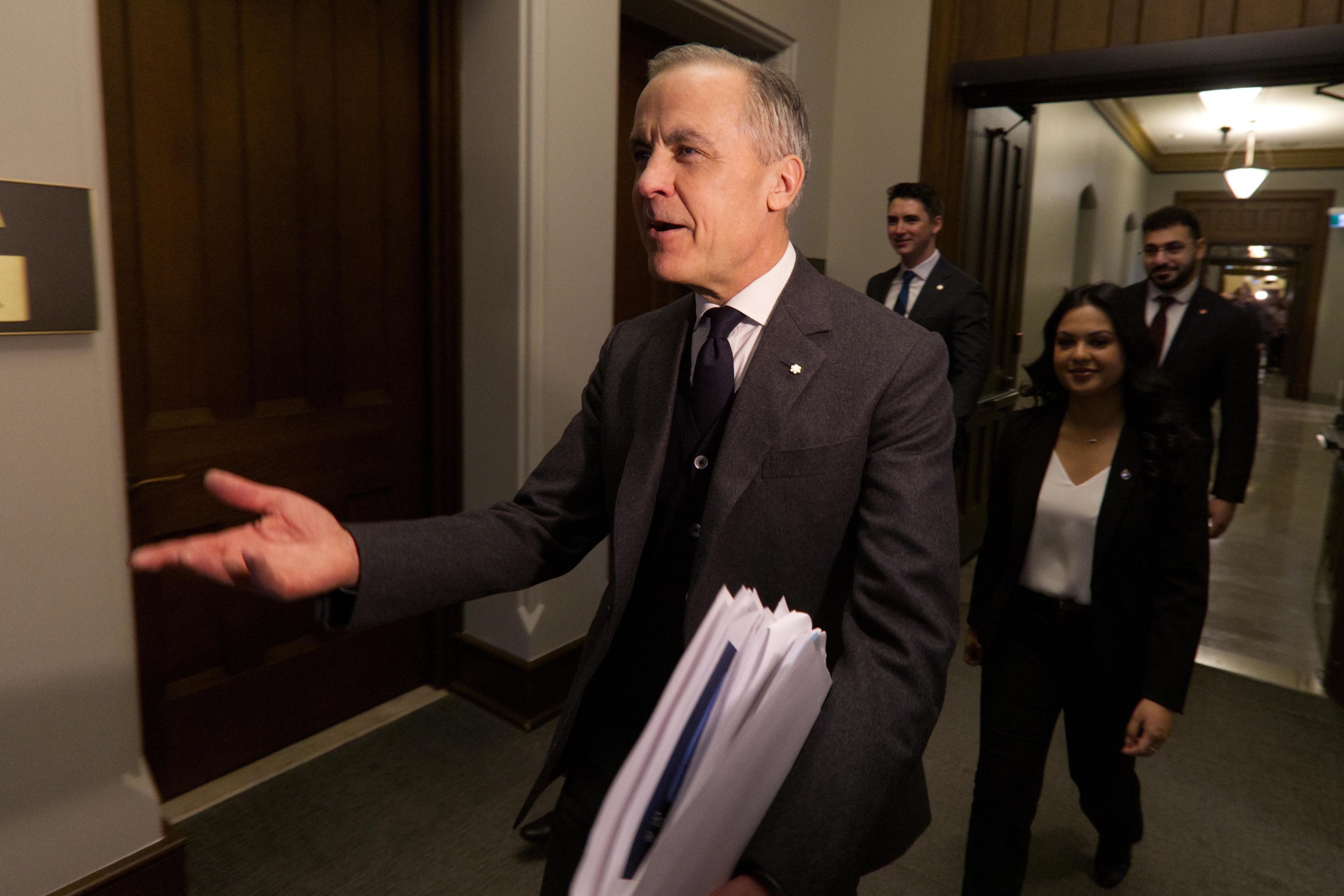
It was a moment of global clarity. Decisive, technical, and almost icy in tone, the Prime Minister of Canada, Mark Carney, delivered a speech on Tuesday at the World Economic Forum that not only caused political and business leaders to rise from their seats to applaud, something rarely seen in Davos, but also certified the death certificate of the rules-based international order. In just 17 minutes, he laid out his doctrine for a fractured world where "the great powers use economic integration as a weapon, tariffs as leverage, and financial infrastructure as a tool of coercion," with an unusual frankness for a sitting leader.
The message was twofold. First, evoking the famous 1978 essay The Power of the Powerless by the dissident and former Czech president Václav Havel, Carney argued that the "fiction" of the old world order - where the strongest exempt themselves from the rules when it suits them and the rest look the other way - erected after World War II, has ceased to function. Those who trust in the restoration of the American peace may do so in vain. As he warned, "nostalgia is not a strategy." A reality that all states, sooner or later, will be forced to accept.
And second, with a more hopeful tone, that although the great powers may act unilaterally, others - the "middle powers" like Canada - still have room to maneuver. How? By forging new strategic alliances, whether bilateral or multilateral, to avoid being subjugated by those - the United States, China, Russia - who act in their own interest. "Middle powers must act together because if we are not at the table, we will end up on the menu," warned the Prime Minister, amidst a geopolitical crisis over Donald Trump's annexation desires on Greenland, no matter the cost.
He speaks not from theory. As soon as he stepped into the White House in January of last year, the U.S. President began to openly fantasize about Canada becoming the 51st state of the Union and imposed punitive tariffs under the pretext of the fentanyl crisis to force Ottawa's hand, a trade offensive that has directly impacted key sectors such as automotive (25%) and steel (50%).
This threat from the southern neighbor acted as an electric shock, reactivating latent Canadian patriotism that would ultimately, paradoxically, propel Carney not only to the leadership of the Liberal Party after the resignation of Justin Trudeau, but also to the helm of the federal government last April. Not because he was a typical politician, but precisely because he was not.
Trained as an economist and a central banker by vocation, Carney steered the Bank of Canada during the global financial crisis in 2008 and led the Bank of England during another cataclysm: the Brexit. With that background as a pragmatic technocrat, he emerged as the most prepared figure to confront Trump's threats. "I am more useful in a crisis, I am not so good in times of peace. If there were not a major crisis, you would not be seeing me here today," he admitted to his supporters at a campaign rally held in February.
Born in 1965 in Fort Smith, in the remote Northwest Territories, Carney was raised in Alberta, the heart of Canada's oil industry. Son of a school principal, he earned a scholarship to Harvard University and obtained a doctorate in Economics from Oxford, with a thesis on competitiveness and competition. His career began at Goldman Sachs, where he spent thirteen years working in the firm's offices in London, New York, and Tokyo, before leaving the private sector in 2003 to join the Bank of Canada. Just four years later, he took over its leadership in the midst of the worst global depression since 1929.
Although central bankers are notoriously cautious, the Canadian was transparent about his intentions to keep interest rates low for at least a year after drastically cutting them, a decision that would be widely praised for sustaining investment even as markets plummeted. He would take a similar approach in 2013 upon returning to London, this time at the helm of the Bank of England, becoming the first non-British person to hold the position in three centuries. The then Chancellor of the Exchequer, George Osborne, described him as "the most outstanding governor of his generation."
This reputation as a crisis manager quickly placed him at the center of global power. Between 2011 and 2018, he chaired the Financial Stability Board, where he played a key role in the international response to Donald Trump's policies during his first term. In 2019, he was appointed as the UN Special Envoy for Climate Change, earning him the nickname of the green banker for his advocacy of environmental sustainability policies.
Carney did not enter politics until he was 60 years old, but he had been navigating it for two decades, moving between the economic and international diplomatic intelligentsia, in the corridors of the G-7, G-20, and the World Economic Forum. The original "Davos man" has attended the alpine meeting around thirty times, but this year he did so for the first time as Prime Minister, with a speech - written by himself, according to his office - in which he acknowledged, without mincing words, the new geopolitical reality.
"We are in the midst of a rupture, not a transition," he concluded, without mentioning the United States or the occupant of the White House. In this new world of authoritarianism, diversifying the client portfolio is no longer just an aspiration but a necessity. That is why Carney has just closed, much to Washington's dismay, a deal with Beijing to ease tariffs on Chinese electric vehicles imposed in 2024 in tandem with its southern neighbor. In exchange, China committed to reducing tariffs on key agricultural products for the Canadian economy. Trump threatened Canada yesterday with a 100% tariff if they ultimately sign this agreement.
While still dealing with food inflation and a hefty budget deficit at home, someone who just a year ago was an unlikely leader became, in just over 17 minutes, the moral opposition to trumpism and a beacon of hope for the West. It all boils down to one phrase: "We accept the world as it is, not as we would like it to be."