European countries, especially NATO members, have been strongly shaken by the U.S. President, Donald Trump's intention to take possession "by hook or by crook" of Greenland, the gigantic Arctic island that is an autonomous territory of the Kingdom of Denmark. In recent days, Davos has been the stage where negotiations have accelerated in search of a "framework for a future agreement," as announced by the White House tenant, which still raises more doubts than certainties.
The issue has caused most of the hard right European parties, so aligned with the Trump Administration on other fronts, to express their rejection of an aspiration that goes against a basic principle like territorial sovereignty. Voices like the French Le Pen have been very strong; in contrast, parties like Vox have remained on the sidelines.
Le Pen distances herself from the White House
Days after Donald Trump praised, at the end of last year, the work of "European patriotic parties" in the face of the "decline" of the Old Continent, the leader of the French far-right, Marine Le Pen, decided to stand firm and speak clearly to her American friend: "The sovereignty of States is never negotiable, regardless of their size, power, or continent".
And more recently, while the French President Emmanuel Macron wrote on social media that "the Venezuelan people can only rejoice" at the fall of Nicolás Maduro, the historic leader of National Rally (RN) reiterated the "inviolable and sacred" principle of sovereignty and pointed the way for other European leaders of her same ilk, to the surprise of the common voters. "He is very American, I am very French", Le Pen argued when highlighting her differences with Trump. She did not need to add much more, focused as she is on her own defense to try to overturn the five-year ban on holding public office for misappropriation of EU funds. Interestingly, while displaying a moderate image before the Appeals Court, her firm hand in foreign policy earned her points with the French at the most critical moment of her political life.
Her protégé, Jordan Bardella, took up the baton days later regarding Greenland and openly denounced "the imperialist ambitions" of the White House tenant. "Threats by Donald Trump against the sovereignty of a State, especially a European one, are unacceptable", he proclaimed.
Even Nigel Farage, once dubbed by Trump as "Mr. Brexit," dared to speak out from the other side of the English Channel. "Friends can disagree in private. But having a president who threatens with tariffs unless he can keep Greenland, is a very hostile act. I can't put it any other way," declared the leader of the ultra-British Reform UK party.
The leader of the Conservative Party, Kemi Badenoch, vying with Farage to win over hard-right voters, also criticized Trump's threats and warned that the UK risks becoming "the lapdog of the United States" if it does not distance itself from the American.
Italy: from bridge to tightrope walker between shores
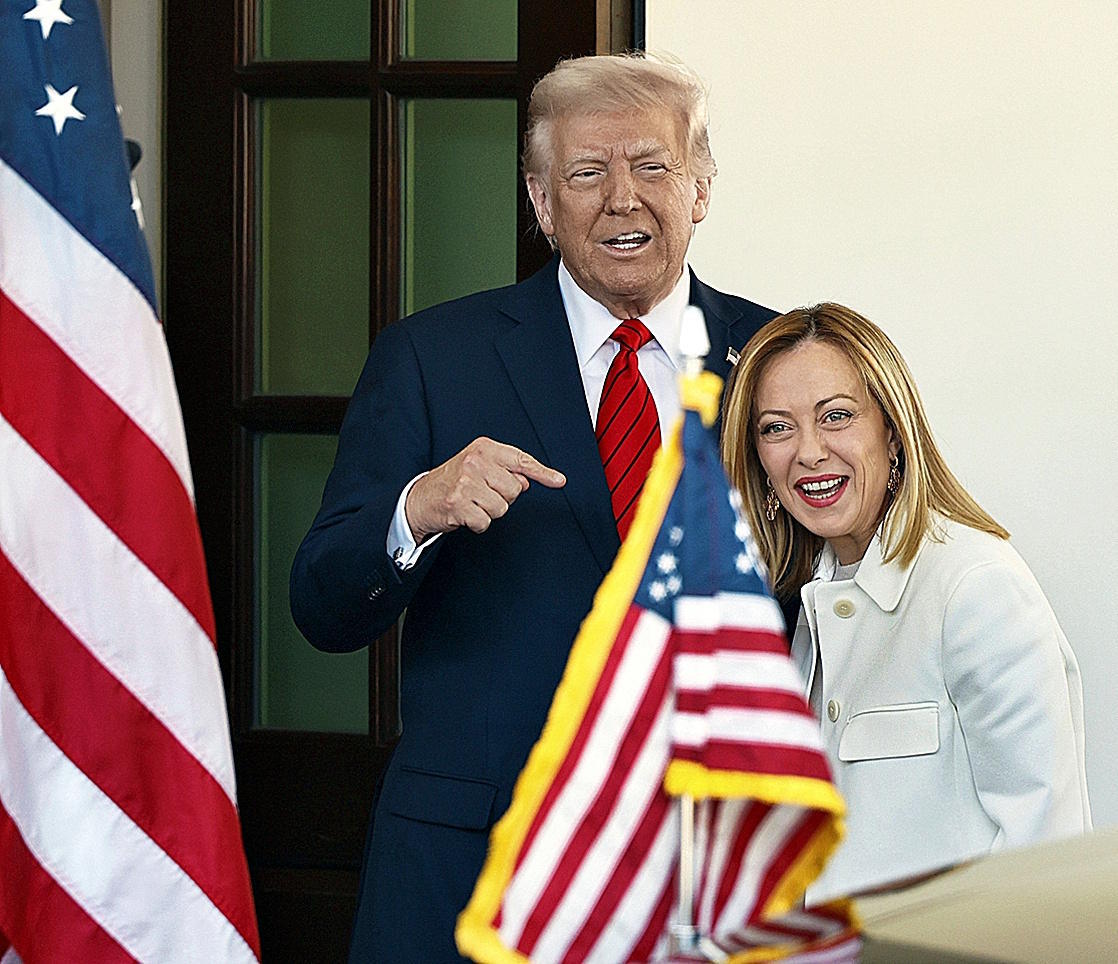
The Italian Prime Minister, Giorgia Meloni, stands out as a bridge between Washington and Brussels and, therefore, one of the main allies of Donald Trump within the European Union. The personal harmony between both leaders is evident, something that was evident since the Italian visited the American in the White House last April. Trump praised her and stated that Meloni is "an exceptional person".
Although the purpose of Meloni's trip to Washington was for Trump to change his mind about the application of tariffs and ultimately did not succeed. The Prime Minister did manage to subtly defend her position to Trump regarding Ukraine, aligned with the stance of the rest of the EU countries.
The issue of Greenland is solidifying Meloni's shift, who, even within her mediating attitude, is becoming critical and forceful against Trump regarding the world's largest island. While initially skeptical about the intentions of the U.S. President, she recently lamented that "the possible increase in tariffs towards countries that have decided to contribute to Greenland's security is a mistake". Very symbolic words, spoken with a serious expression, representing a turning point in her stance towards the United States: it was the first time she publicly criticized Trump.
The Prime Minister of the transalpine country argues that there is "a problem of understanding and communication" between the United States and Europe. She also tries to offer an alternative interpretation of the sending of troops from some European countries to Greenland, emphasizing that this should not be seen "in an anti-American light," but as a way to provide "greater security" against "other actors." At this point, Meloni, more than a bridge, becomes a tightrope walker between the two shores of the Atlantic.
Despite veiled criticisms, Trump still considers Meloni a valid ally and, in fact, has extended an invitation for Italy to participate in the Peace Summit for Gaza. "I believe that Italy can play a prominent role, we are willing to contribute to the peace plan," stated the leader of the Italian hard-right.
AfD, divided on foreign policy
The Greenland crisis has highlighted the bipolarity of Alternative for Germany (AfD) in foreign policy, torn between getting closer to Trump and the political universe he represents, and rejecting any interference in the sovereignty of other States. What seemed like a distant episode - a dispute between the United States and Denmark over an autonomous territory - has ended up revealing to what extent the party still lacks a defined line in international affairs.
Within the AfD, the debate has gone far beyond a specific reaction. Greenland has reactivated tensions that were already emerging on other fronts, from the war in Ukraine to relations with Russia, NATO, or China. The underlying question is always the same: should the AfD approach figures like Trump and transatlantic populism, or distance itself from any external power to preserve its own national discourse?
One faction has no doubts. Euro MP Maximilian Krah, a reference for AfD's MAGA populism and ousted as the lead candidate in the last European elections after several scandals, has argued on social media that Germany should not confront Trump on this issue. He even claimed that Greenland "is geographically America" and that Berlin has nothing to gain by entering a crisis he considers unrelated to European interests.