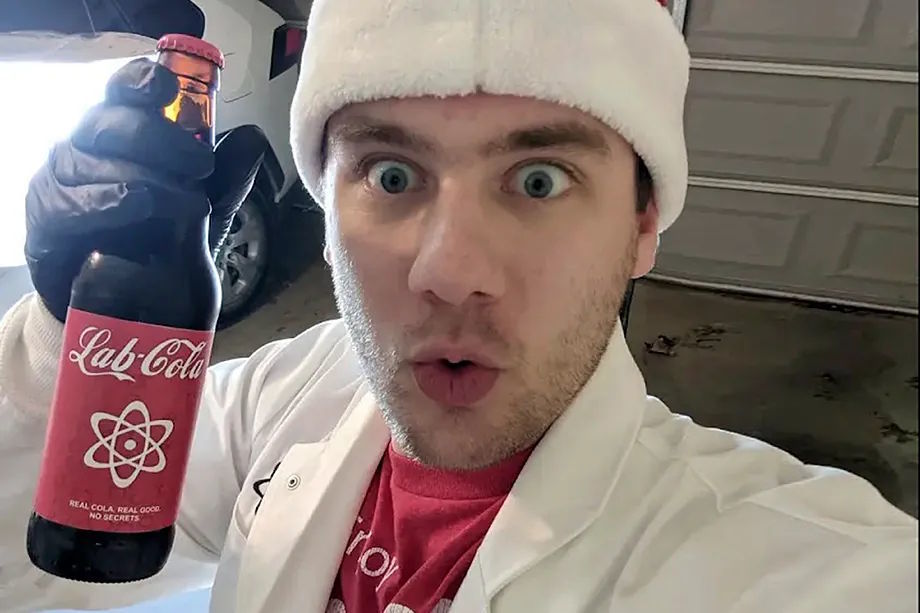
With 140 years of history, it is the most popular non-alcoholic beverage in the world, but only a handful of people know its recipe. The ingredients of Coca-Cola are one of the best-kept trade secrets. The company proudly displays this by hiding the original formula inside a giant steel vault that visitors can see at the World of Coca-Cola exhibition in Atlanta (USA). Therefore, no one expected a senior chemical engineering student to set out to steal the formula, create a chemically identical drink with the same flavor, and reveal it. But the science communicator Zach Armstrong, LabCoatz, has done it.
"Recreating Coca-Cola was always my goal. Two years before starting, I tried one of those simple colas made with fruits and spices, but it was so far from the traditional flavor that I gave up the idea. But I like to finish what I start," explains Armstrong to Chronicle as the video presenting his Lab-Cola has already surpassed five million views on YouTube.
The company transports all unlabeled ingredients to maintain secrecy worldwide. It prepares a concentrate that it then sells to licensed bottling companies. Leaks are impossible, a circumstance that added excitement to the project and freed it from legal issues: the company has not patented its recipe. "No company will reveal how it makes its most profitable product, but if Coca-Cola did, it is unlikely that serious competition would arise. And if it did, it would buy the competing company, as it has done before," he jokes.
Since pharmacist John Stith Pemberton invented the original Coca-Cola in 1886 by mixing coca leaf and kola nut in carbonated water and offering it as a medicinal drink, many have tried to replicate it without success. "Many DIY colas are based on Pemberton's original version, a recipe rich in floral flavors like neroli, spices like nutmeg and cinnamon, and citrus components. It also uses a large amount of blended aromatic oils. Recipes based on that formulation will be very different from the modern one," details the science communicator, who believes that the current composition is marked by economic factors: "It uses more lemon and lime, which are cheap and refreshing, and reduces spices like neroli, which are extremely expensive."
Armstrong has named his drink Lab-Cola.Chronicle
Armstrong narrates his research like a suspense movie, with scientific articles, chemical analyses, and family and friends trying his experiments. The turning point comes when another communicator provides him with a mass spectrometer, a device that allows determining the distribution of a substance's molecules based on their mass and which was already identified as crucial in a 2006 paper.
LabCoatz meticulously details all the ingredients: 110 g of sugar; 0.64 g of phosphoric acid; 9.6 g of caffeine; 320 ml of caramel color... Until reaching the key to everything, the "natural flavors." "That's where the real battle begins," he recalls. Although the big revelation leads back to the starting point: the coca that gives the drink its name. From 1886 to 1903, Coca-Cola contained cocaine alkaloid. Today, it uses decocainized coca leaf extract produced by the Stepan company. Coca-Cola is the only company on the planet authorized to import, process, and commercially use coca leaves in its drink. Armstrong tried to obtain alkaloid-free coca leaf extract from Bolivia and Peru, without success.
He then felt that it was impossible to replicate the flavor without coca leaves. He was about to give up until tannins appeared. "I hoped they were the missing piece, and I was even more excited when I realized that coca leaf extract contains them. Luckily, my intuition was correct," he recounts. Coca leaf extract is a type of tea, and teas contain tannins. With a dry astringent taste, as they are not volatile, they were hidden in gas-based mass spectra.
Adjusting the proportions took him months. "If anything was unbalanced, seemingly random aspects like sweetness or acidity would be off," he remembers. With the tannins, he managed to make his Lab-Cola stop tasting like a light soda. In blind tastings, many confused his drink with Coca-Cola. His favorite reaction was from a university colleague, Nile. "He told me that mine resembled the classic one more than the actual bottled version of the soda," he says.
Coca-Cola is consumed in 200 countries, and the brand points out that depending on where it is manufactured and the raw materials used, differences in flavor are detected. This was highlighted in July when Donald Trump suggested using cane sugar instead of corn syrup in the USA. In Europe, sugar is used as a sweetener in the original flavor. "Its taste has changed over time. So there is enough room to say 'this tastes like Coca-Cola.' Mine is a recreation of the 2025 drink in the USA. It is more similar to what you are served in a restaurant fountain," he explains.
The communicator is not worried about the company taking retaliatory actions. "Attempting any legal action would be admitting that my formula is valid, and the public would realize it. I am not a serious concern for them: their terrible AI Christmas ads did more harm to their brand than I ever will," he argues.
What has affected his daily life is that he can no longer enjoy a Coca-Cola. Or any other soft drink. "Every time I have one, I start analyzing and breaking down its flavor. Some part of my brain is still working on this project, and I think it always will," he concludes.