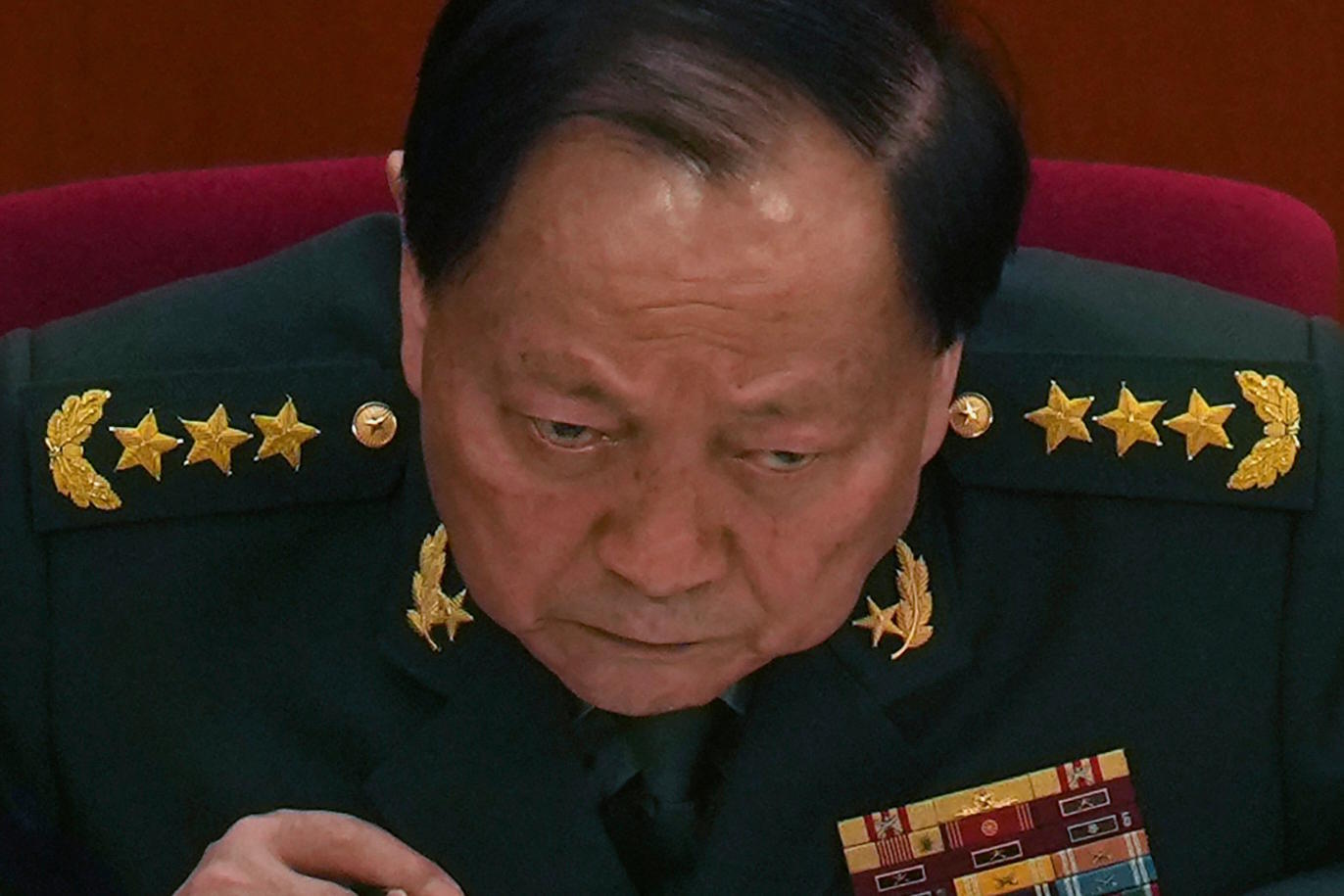
Son of a founding general of the People's Liberation Army (PLA), a veteran of the 1979 war against Vietnam, and an ally of President Xi Jinping since childhood, the figure of Zhang Youxia represented a blend of revolutionary lineage, combat experience, and political loyalty. Therefore, his fall is not just another episode of the long anti-corruption campaign but a turning point in the reconfiguration of military power in China.
The official statement, released last Saturday by state media, was brief and neutral: Zhang, 75 years old, Vice Chairman of the Central Military Commission (CMC), the highest command body of the army, was under investigation for "serious violations of discipline". It is the same euphemism that has accompanied the downfall of dozens of senior military officials in recent years.
A day later, in an especially harsh editorial, the 'PLA Daily', the army's official newspaper, accused Zhang of "seriously trampling" the ultimate responsibility system that falls on the CMC president, the ever-present Xi Jinping, and of fueling problems that threaten the Communist Party's (CPC) absolute leadership over the armed forces.
No further details were disclosed until the secrecy surrounding Beijing's military purges was broken by an exclusive report from the 'Wall Street Journal': Zhang, the highest-ranking general of the Asian superpower, allegedly leaked secrets about China's nuclear weapons program to the United States. He is also under investigation for accepting bribes and for forming "political cliques," a phrase often used to describe plots that seek to build influence networks undermining the Party's unity from within the powerful CMC.
According to reports, authorities are also investigating Zhang's role as a supervisor of the agency responsible for the development and acquisition of military equipment, which has a huge budget to meet Xi's longstanding obsession with having a modern and combat-ready military. The veteran general reportedly accepted large sums of money in exchange for promoting promotions in the offices managing these purchases.
"These reports theoretically come from leaks by Party officials or military leaders who are aware of the investigation. But the truth is that in China, especially at such a high level, no one leaks anything, especially to foreign media. Everything is tightly controlled, so these news reports must always be questioned," said a Ministry of Foreign Affairs official.
Since 2023, when Xi launched an anti-corruption campaign within the military, dozens of military commanders and defense industry executives have been investigated or removed. Until now, Zhang was seen as the guarantor of the PLA's operational continuity, the only trusted man of the president who held his own weight within an increasingly personalized system.
Additionally, state media had recently praised him as the architect of the cleanup within the armed forces, which has taken down "corrupt" and "unpatriotic" individuals, especially within the Rocket Force, which handles the nuclear arsenal.
Zhang's last public appearance was on December 22, when he participated with Xi in a ceremony appointing new generals. His profile helps understand why his fall is now shaking the foundations of the Chinese military apparatus. His father, Zhang Zongxun, fought alongside Mao Zedong in the Autumn Harvest Uprising of 1927 (an armed insurrection led by the communists) and was a key general on the northeastern front during the civil war against the Kuomintang nationalists.
Zhang during a meeting at the Ministry of Defense in Hanoi, Vietnam, on October 24, 2024.LUONG THAI LINHEFE
In 1947, while commanding a PLA corps, his political commissar was Xi Zhongxun, the father of the current Chinese president. Both clans also share roots in Shaanxi province. It was a biographical, almost familial connection between two lineages of the famous Red Army.
Unlike Xi, whose military experience is limited to a brief administrative stint at the PLA headquarters in his youth, Zhang was a respected soldier after fighting on the Vietnamese border and leading special operations and training. Xi trusted him from the beginning of his tenure: he placed him in 2012 at the helm of the then General Armament Department, kept him in key positions during the major army reform of 2016, and elevated him to Vice Chairman of the CMC in 2017. Additionally, Zhang is one of the 24 leaders of the exclusive Politburo, the Party's core group.
Several analysts have pointed out in recent days that Zhang was the only senior commander with enough accumulated authority to truly counterbalance Xi within the regime. Traditionally, control of the army has been the decisive factor for the political survival of Chinese leaders. "Zhang's dismissal suggests that Xi wants to ensure his absolute authority. Technically, Zhang was the only one who controlled the military authority that gave him the power to effectively challenge Xi," says Yun Sun, director of the China program at the Stimson Center think tank in Washington.
After the last CPC congress in 2022, the CMC started with seven members. Since then, five have been purged. As the first vice chairman of this body, Zhang concentrated powers that in other countries would be divided among the Defense Minister, the Chief of the General Staff, and the National Security Advisor. He controlled promotions, budgets, strategic planning, and operations. He answered only to Xi. His dismissal, as experts point out, removes any ambiguity: military power is now completely centralized in the hands of the supreme leader.
Over the weekend, Beijing also announced the dismissal of another key figure within the CMC, General Liu Zhenli (61 years old), another veteran of the Vietnam War who was the head of the Joint Staff Department, directly responsible for overseeing operations, intelligence, and training.
"Zhang and Liu, as high-ranking Party and military officials, have seriously betrayed the trust placed in them, fueling political and corruption problems that threaten the Party's absolute leadership over the armed forces and undermining the basis of its governance. They have seriously harmed efforts to strengthen political loyalty in the military and overall combat readiness, which has had a serious negative impact on the Party and the country," reads the PLA Daily editorial.
Xi's purges within the military began to make noise with the expulsion of two Defense Ministers, Li Shangfu and his predecessor, Wei Fenghe. Both cases were linked to irregularities in arms purchases. Mid-last year, the dismissal of another CMC general, Miao Hua, was announced. A few months later, the second-highest-ranking general, He Weidong, also fell, who was then the CMC's second vice chairman. His position was taken by General Zhang Shengmin, the only active-duty military officer still part of the powerful commission.