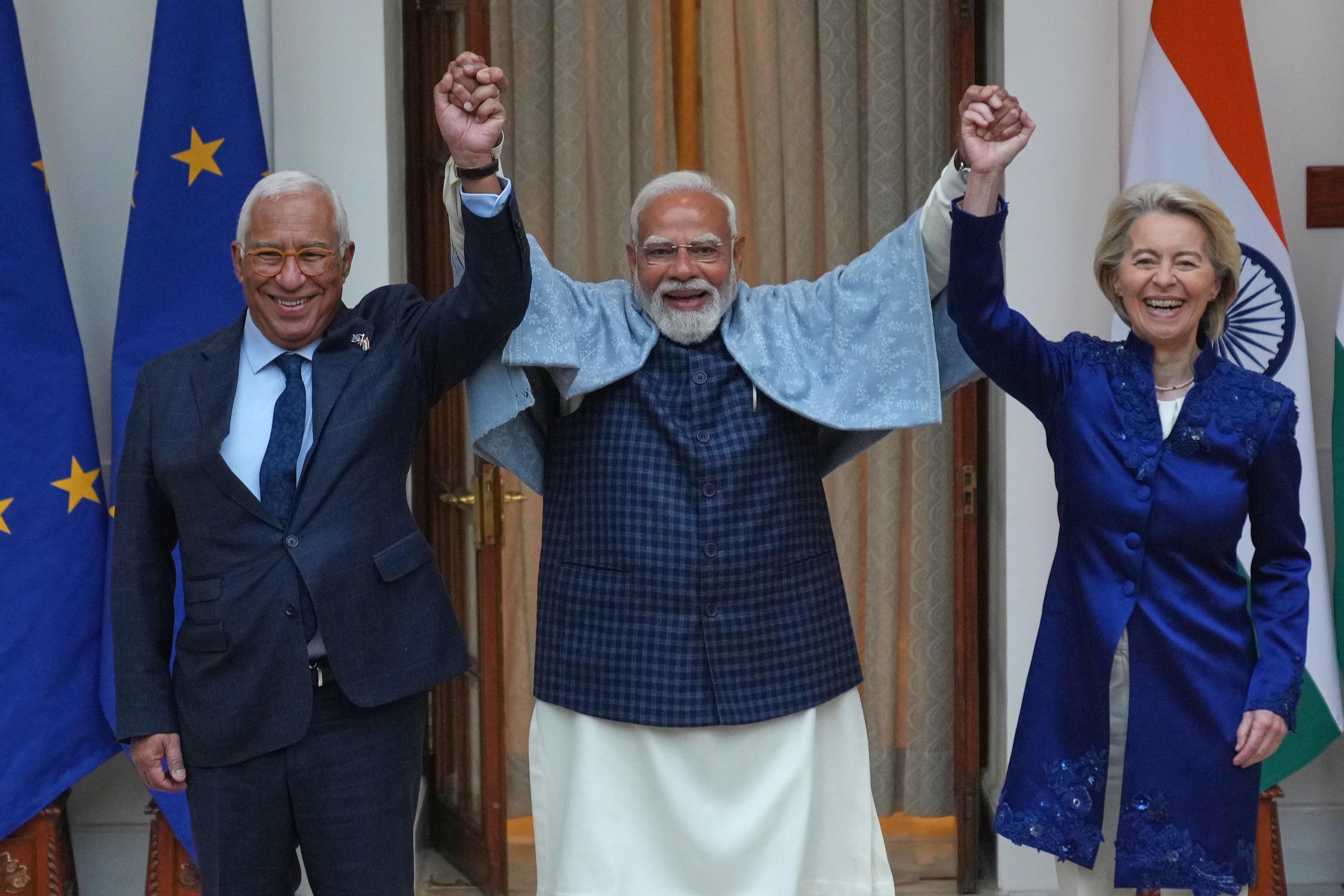
The European Union and India have finally closed an ambitious free trade agreement that redefines the map of global economic alliances, for which nearly twenty years of intermittent negotiations and long periods of political deadlock have been necessary. "The mother of all trade agreements," as both parties, and especially Ursula von der Leyen, have wanted it to be baptized and known.
The partnership between "two giants," also according to the Commission President, will create "a market of 2 billion people"; it includes a tariff reduction that "will result in savings of 4 billion euros for European products"; and, very importantly, represents a geopolitical victory for Brussels and for the head of the European Commission
The return of Donald Trump to the White House shook the world and imposed rules for which the EU is not designed. Trade threats, military demands, and even a certain rupture of Atlanticism are pushing Europe to its limits, which also has to deal with its difficulties, internal contradictions, and slowness. A clear example is, precisely, another trade agreement: that of Mercosur, which in this case has required 26 years of negotiations and has now been postponed again due to pressure from the European Parliament.
For all these reasons, the EU needed a move of this kind, and the agreement was signed in New Delhi, where this week the President of the European Commission, Ursula von der Leyen, and the President of the European Council, Antonio Costa, traveled. There they have closed a pact that opens wide access to a combined market of nearly 2 billion people, responsible for approximately a quarter of the world's GDP. However, for everything agreed and outlined to become a reality, the agreement must now be approved by the Council and the European Parliament, which considering the aforementioned precedents may not be particularly easy.
"Yesterday, a great agreement was reached between the European Union and India. Worldwide, this is considered the biggest agreement of all. It will provide great opportunities for the 1.4 billion inhabitants of India and millions of Europeans," explained Indian Prime Minister, Narendra Modi, the first to officially announce the completion of the historic agreement.
The mentioned tariff reductions for European products include, for example, "Indian tariffs on wine will be reduced from 150% to 75% upon entry into force and subsequently to as low as 20%; tariffs on olive oil will decrease from 45% to 0% in five years, while processed agricultural products such as bread and confectionery will see tariffs eliminated by up to 50%."
And according to the Commission President, "sensitive European agricultural sectors will be fully protected, as products such as beef, chicken, rice, and sugar are excluded from liberalization in the agreement." "All Indian imports must continue to comply with the strict sanitary and food safety standards of the EU," she emphasized from New Delhi.
The automotive sector is also one of the big beneficiaries: India commits to lowering tariffs on vehicles imported from the EU, which in some cases reached 110%, to levels close to 40%. Although the figure remains high, it marks a turning point in a historically closed market, with huge opportunities for European manufacturers such as Volkswagen, Renault, Stellantis, or Mercedes-Benz, who have been demanding fairer access to the Asian giant for years.
The benefits for the European industry are not limited to the automotive sector. The agreement includes tariff cuts and greater regulatory predictability for key sectors such as automotive components, chemicals, plastics, and industrial machinery. For India, the agreement represents a strategic opportunity to establish itself as an industrial and export platform alternative to China. New Delhi gains preferential access to the European market for labor-intensive sectors such as textiles, jewelry, and footwear, as well as for pharmaceuticals and machinery.
In a context of partial decoupling between the West and China, the Modi government aspires to position the country as a reliable partner in global supply chains, relying on its vast population (over 1.4 billion people live in India), sustained economic growth, and an increasingly aggressive industrial policy.
One of the most sensitive chapters of the agreement was related to labor mobility. But Brussels and New Delhi have launched a new cooperation framework that will facilitate the arrival of qualified Indian workers to the EU, as well as seasonal workers in sectors facing labor shortages. For Europe, increasingly aging and with structural difficulties in covering certain professional profiles, the South Asian giant emerges as a key talent pool that has traditionally ended up in the United States.
And precisely in Washington, they do not seem very pleased with the agreement signed by the EU and India. Treasury Secretary, Scott Bessent, criticized that Brussels is "financing a war against itself" by signing the agreement with Delhi, arguing that it undermines Washington's efforts to penalize the Modi government for continuing to buy Russian oil.
"We have imposed a 25% tariff on India for buying Russian oil. Guess what happened? Well, the Europeans signed a trade agreement with India," Bessent said, pointing out that the sanctioned Russian crude was being sent to India, where it was refined and then sold to Europe.
On Monday, just before the formal closure of the agreement, European leaders were honored guests at the celebrations of the Republic Day of India, a date full of national symbolism. The parade included a massive display of military capability, with missiles, planes, and next-generation weapon systems, some of which were used during the conflict with Pakistan last year after the attack in the Kashmir region administered by India. Alongside mechanized columns, cavalry units on horseback and camels paraded, a choreography designed for both domestic consumption and to send messages abroad.