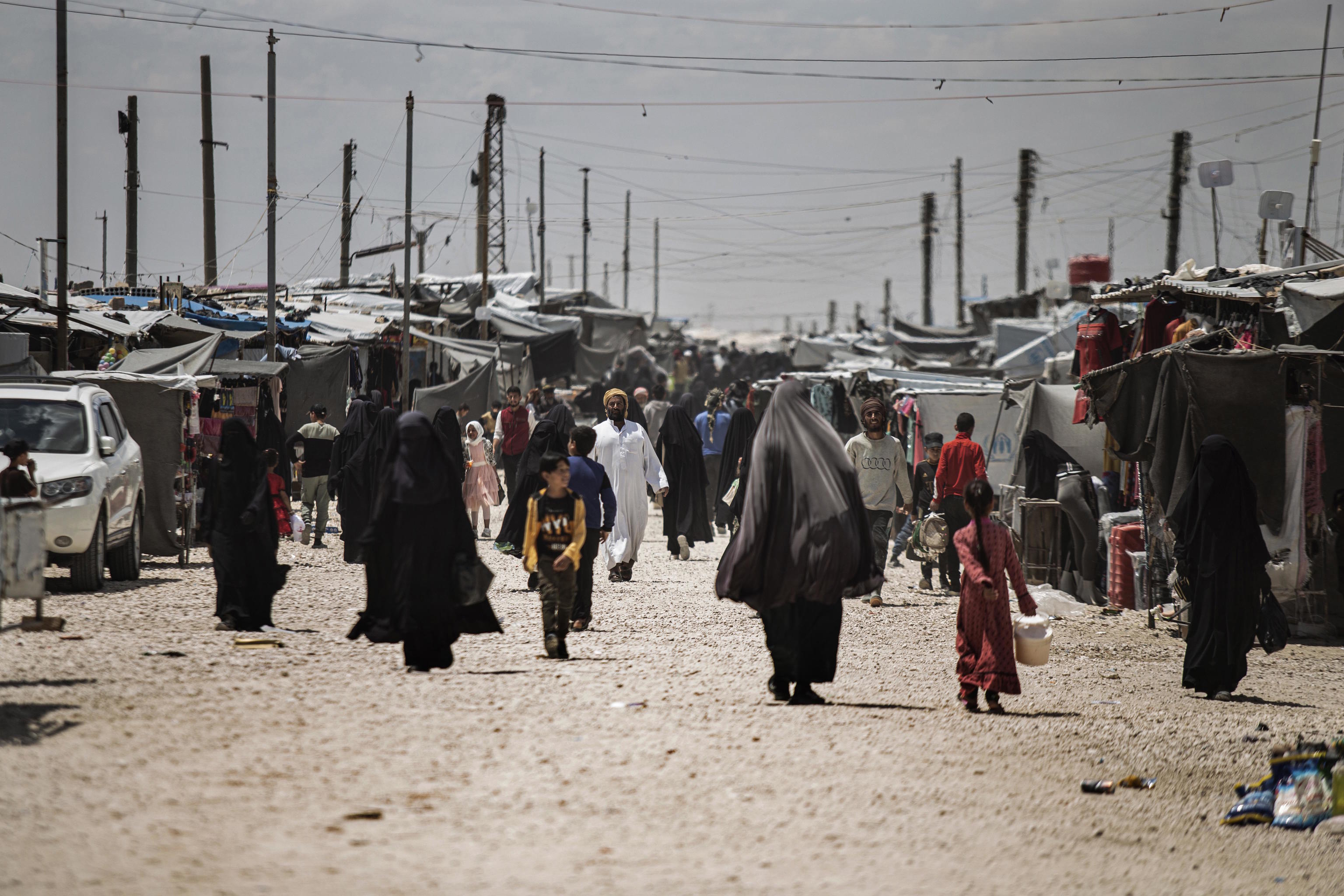
The former head of Al Hol camp, Jinan Hanna, claims that for years she kept one of the "swords" made by one of the children in that complex on her office desk. She also has another example of the handmade weapons the residents of the camp used, including a unique tricycle reinforced with blankets-covered panels to mimic an armored vehicle. "It even has a turret with a hatch," says the Kurdish official.
Her counterpart in Al Roj, Hukmia Brahim, admits that in this enclave, the children have not managed to equip themselves with firearms like in Al Hol, but they do have all kinds of "knives." She also shows a video of a trio of boys training to throw Molotov cocktails. One of her followers -who identifies herself with her "war" nickname, Chabre- places several wooden "rifles" on a table, which she says the minors use for "military training."
Al Roj is the last camp for women and children of Islamic State (IS) fighters still under the control of the Kurdish forces of the almost extinct Autonomous Administration of North and East Syria (DAANES). Its 2,200 residents used to be considered "moderate" when compared to the extremism that seemed to dominate among the over 23,000 -these are the official figures provided by Kurdish officials- in Al Hol.
However, the officials of these facilities warn that the difference has almost disappeared in recent months. "Radicalism is also spreading in Al Roj," asserts Sheikhmus Ahmad, the head of the Kurdish department dealing with IS camps. "In Al Hol, we even seized AK-47s, pistols, explosives, tunnels, and swords," he adds in a phone conversation.
To reach Al Roj, one must travel the road that connects Qamishli -the "capital" of DAANES- to the mountains near the Iraqi border. A journey full of Kurdish militia checkpoints determined to defend the little territory they have not yet lost to the Syrian army.
The proliferation of fundamentalism comes as no surprise when observing the precarious conditions in which the residents of Al Roj have been living for years. Just walking among the rows of plastic-covered bunkers, wading through mud and snow, and seeing the walls and barbed wire surrounding the space is enough to understand that religion may be the only way out for those who suffer from this situation daily, even if it was a consequence of their parents' choice.
Al Roj camp where women and children of IS fighters live.GETTY
The children have fun throwing frozen water balls while shouting "Allahu Akbar!" ("God is great!"), the same cry their parents used in combat.
Here, even girls of barely five or six years old walk hidden under the niqab, the most extreme version of the Muslim veil. Some have opted directly for the burka, which does not even allow their eyes to be seen. "Before, they only wore the hijab [the normal veil]," comments a frequent visitor.
The main gathering is seen in the market, a simple succession of several shops where women and their children go to buy food.
Most residents refuse to speak with visitors. Only a group of English speakers agrees to talk to newcomers, but they remain anonymous.
"On Tuesday [when Al Hol fell to the Syrian army], we heard gunshots. There is a lot of unrest. 70% want to return to their countries, but there are different positions in the camp. We cannot speak publicly because we would endanger our children," clarifies one of them in perfect English.
Al Roj hosts citizens from over 40 nationalities. Several Spanish women married to jihadists lived here for years. The last one was repatriated to the European country last December, as confirmed by Brahim.
The Kurdish officer also keeps on her phone images documenting the progression of fanaticism in this enclave. From IS black flags drawn on the walls to increasingly explicit graffiti. "Infidels, we will massacre you!" reads one. "Did you think we would be eliminated? No, we will remain here forever, loyal to the Islamic State!" asserts another.
The landscape of Al Roj does not differ much from the misery prevailing in any refugee camp in the region. But, according to Brahim's account, the location resembles the tragic utility that Iraqi prisons monitored by Americans, such as Buca or Abu Ghreib, had in training future IS members.
According to the International Center for Terrorism, 60% of those detained in Al Hol and Al Roj are children, mostly under 12 years old. A conglomerate that has been locked in this environment since the past decade, feeding their education with the same jihadist ideology their parents held.
For years, Kurdish authorities have demanded the repatriation of part of this contingent to their countries of origin, repeatedly insisting that the children were undergoing a rapid radicalization process. "It was obvious it was a time bomb. We said it. It's too late. It has already exploded," points out Jinan Hanna.
The recent Damascus army offensive against Kurdish autonomy has allowed them to take control of several IS prisoner's jails and the aforementioned Al Hol camp, but the chaos generated by the fighting has also enabled the escape of several dozen fighters from that group and an undetermined number of their relatives.
According to the think tank Rand Corporation, Kurdish forces held thousands of IS-linked prisoners in 14 jails in the north and east of the country. Raed al Ahmed, an IS expert, believes that "the most important one is in the Ghuwayran neighborhood, in the center of Hasakah city. It houses approximately between 4,000 and 5,000 IS members, including key leaders."
The United States has announced the transfer of around 7,000 of these jihadists to Iraqi prisons, a decision that, according to Raed al Ahmed, is based on Washington's lack of trust in "the Government's [of President Ahmed al Sharaa] ability to prevent escapes."
"The United States fears the infiltration of IS elements or extremist ideologies into the security forces and the Syrian army. But the Government will not release them because IS could represent the main threat to its authority," he expressed in a WhatsApp conversation.
Although the Kurds argue that the current Syrian President shares the jihadists' ideology -recalling that he was part of that nebula for years-, the IS members dedicate almost the same epithets and disqualifications to Al Sharaa as to any of their other adversaries.
The latest editorial of the magazine Al Nabaa, one of the IS propaganda platforms, maintained this weekend the hypothesis that the current Syrian government is a group of renegades and that the change in control of Al Hol is only part of "a plan by Jews and Crusaders."
"Trump has found a more obedient dog," read the radicals' text, referring to Al Sharaa's followers with this insult -they also call them "scum."
Sitting in her office, located in a section of Al Roj protected by fences and guards armed with M-16s, Hukmia Brahim warns that many of the children who arrived here in 2017, amid the decline of the messianic movement, are now teenagers who have replicated within the walls "the same system in which they were born and raised: the Islamic State."