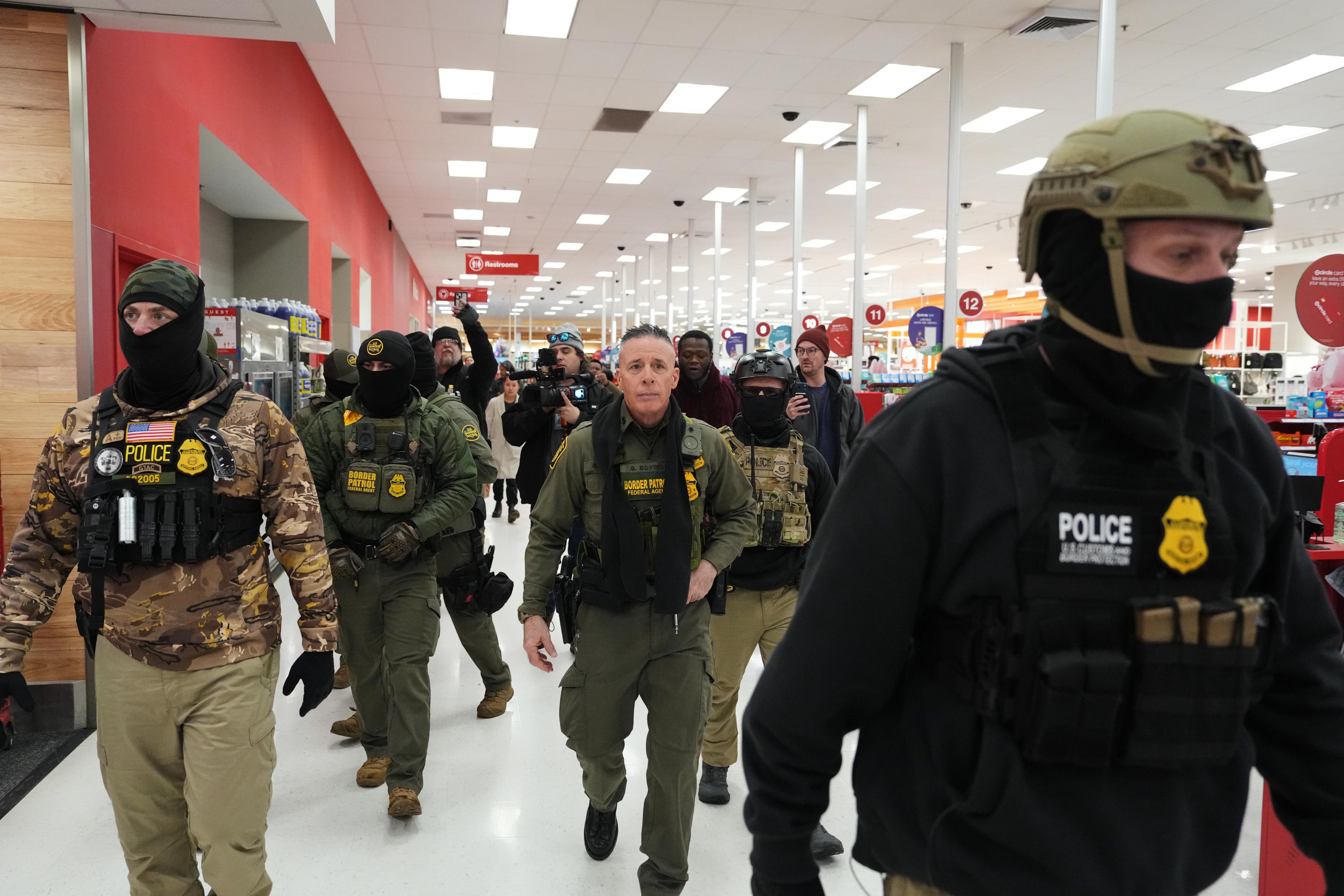
The long military-style coat does not create authoritarianism, but it evokes it: it is a garment designed to impose presence, erase the individual, and emphasize obedience to the State. Commander Greg Bovino, great-grandson of an Italian undocumented immigrant who arrived in the US by boat in 1909, chose to wrap himself in his great coat (as he calls it) that he has been wearing since he began his active service in the border patrol 25 years ago and will now abandon after being dismissed. He will return to his former position in California, "where he is expected to retire soon," as reported by 'The Atlantic' this Monday, citing a National Security official and two individuals with knowledge of the change.
With the body of Renee Nicole Good, shot dead by one of his agents, still warm, Bovino and his ICE agents stormed the streets of Minneapolis with his 1930s-style haircut and that garment, in olive green, with epaulets and a double row of golden buttons, reminiscent of photographs of Nazi SS soldiers wearing their similar but black leather offiziersmantel. The formal resemblance to the SS coat does not imply moral equivalence, but it explains why certain garments trigger a historical memory associated with authoritarian power.
The choice of that garment at that moment of great tension in the streets, where many voices are beginning to warn of the authoritarian turn of the Trump Administration, was not random. He also added a Sam Browne belt secured by a leather strap diagonally across the shoulder, similar to those used by Gestapo officers and with a clear "fascist aesthetic," as described by German writer Arno Frank in Der Spiegel: "It is the distinctive style" of "authoritarian intervention." "It is not surprising that figures like Greg Bovino resort to proven models," writes Frank. "While the other federal agents seem to wear whatever they have on hand, he stands out among this mob of thugs as an elegant SS officer stands out among the riotous SA mob. The haircut is also perfect; only a monocle is missing for the perfect disguise."
Although the most obvious visual reference is linked to the Nazi period in Germany, in reality, it is a much older garment, inherited from medieval war cloaks, perfected over centuries until reaching the Prussian or French armies during the Napoleonic wars. Its aesthetics were refined in World War I, with the Kaiser's army and their feldgrau coats or the sky-blue ones of the Gauls.
With the 1930s great coat, more intended for the barracks than the trench, we are no longer talking about clothing, but about the language of power. It was popularized by the Germans but also by the Allies, including the Soviets, who named it shinel and chose it to dress the Red Army officers and the agents of the fearsome NKVD (predecessor of the KGB). In the USSR, the shinel did not distinguish between war and power: it was worn by those who fought, those who watched, and those who commanded, including Josef Stalin himself.
Something similar happens with the offiziersmantel coat as with the peaked cap, a complement that seeks to add height and verticality even to short officers, although the great coat pursues something complementary but deeper: it creates a solid silhouette that covers the waist, hides the legs, and eliminates personal features.
Tricia McLaughlin, Deputy Assistant Secretary for Public Affairs at the Department of Homeland Security, clarified that the coat is part of the "standard winter uniform of the Border Patrol," although The New York Times cites a 2025 document detailing the Border Patrol Uniform and Grooming Standards, in which the coat in question is not listed as part of any official uniform.