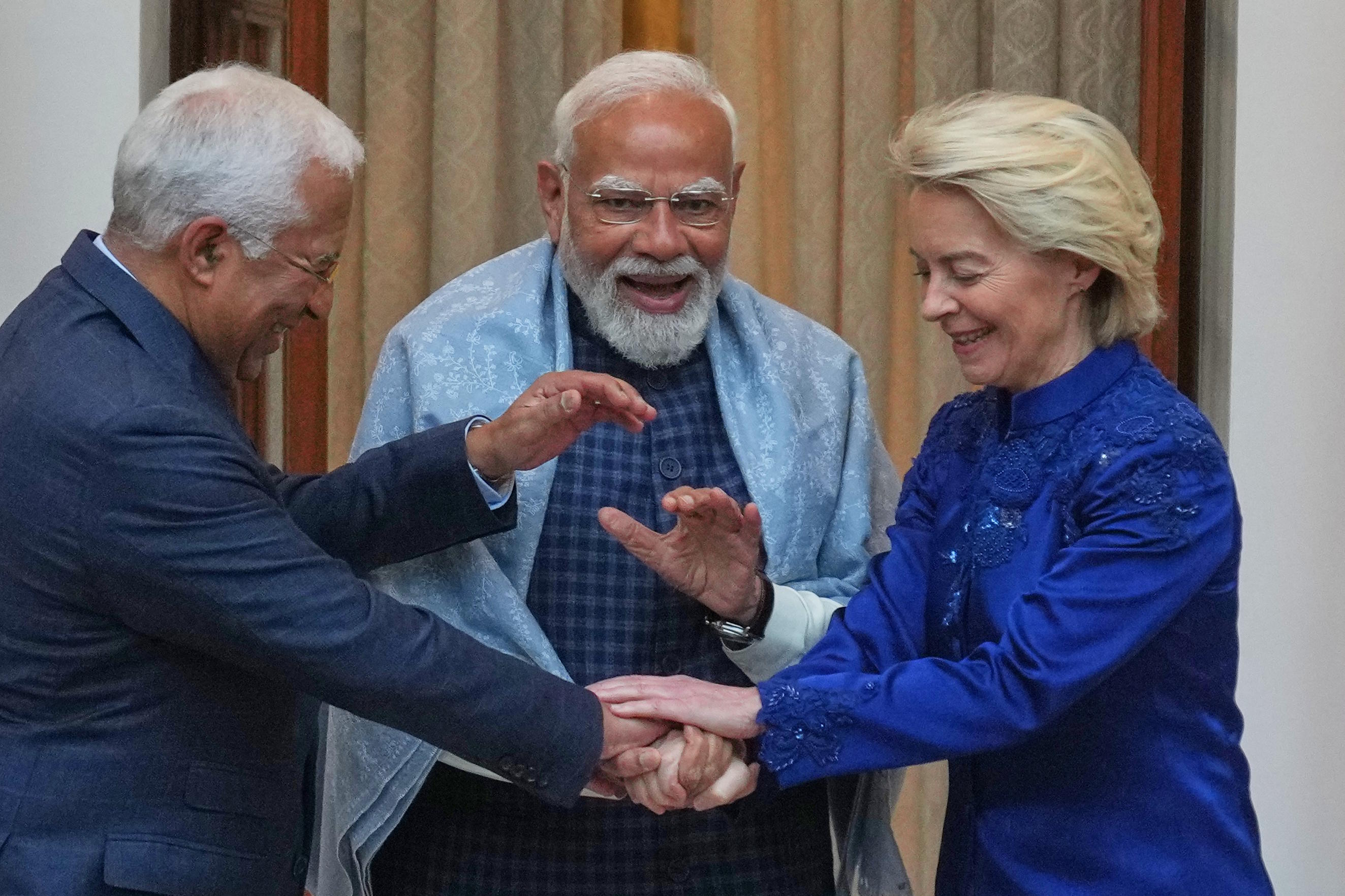
Brussels was clear that Donald Trump's return to the White House would unleash a trade war or, at the very least, a significant increase in tariffs. The former was managed to be stopped, but the latter, obviously, was not. At the moment their fears were confirmed, the EU also realized that it needed to seek new trading partners. The direct consequence of all this is the agreement that the European Union has just closed with India, which will create a market of 2 billion consumers and which, especially from the European Commission, has been dubbed as "the mother of all trade agreements."
Commission sources confirm that "tariff threats from Washington" were key in the turnaround. And also, the feeling of "humiliation" that, they claim in Brussels, the Indian leaders felt when, despite the alleged closeness between Trump and Prime Minister Narendra Modi, they realized that there would actually be no trade agreement between the two parties even though at different times it seemed close. India felt that the United States did not respect them.
"It's a turning point," emphasize from the European Commission in defining the agreement. "The entire College of Commissioners traveled to New Delhi in February of last year and decided that the negotiations should be concluded before the end of the year. I thought it was impossible, but we finally achieved it," they continue from the Commission referring to the trip that, almost a year ago, all the commissioners along with the president made to India.
At that moment, indeed, many in the EU bubble doubted the possibility of reaching an agreement. Because the negotiations had been going back and forth for almost 20 years; because Trump's pressure was growing at that time and demanded a lot of attention from European authorities; and because the precedent of Mercosur did not inspire optimism.
Today, the agreement with Argentina, Brazil, Paraguay, and Uruguay has still not fully materialized after the European Parliament has hindered its implementation, but it is very likely that the Commission will decide to apply it provisionally within a maximum period of two months. And although the agreement with India will also have to wait a few months, it seems feasible that by the end of this year or the beginning of 2027 it will be up and running.
"It still needs to complete several procedures before coming into force," explained yesterday by the Ministry of Economy. "In the coming months, the legal review and translation of the final texts, which have not yet been published, will be carried out. Subsequently, the formal adoption procedure by the European institutions and the Member States will begin, a process that is expected to take place throughout the second semester," added from Carlos Cuerpo's department. Here, unlike what happened with Mercosur, there does not seem to be as strong opposition as shown by France or Poland. Therefore, everything seems simpler.
When fully in force, the agreement "will reduce up to 4 billion euros annually in tariffs for exporters of all sizes," as explained yesterday from New Delhi by the President of the Commission, Ursula von der Leyen. Particularly important will be the savings obtained in wine, oil, and cars.
"Indian tariffs on wine will be reduced from 150% to 75% upon entry into force and subsequently to as low as 20%; tariffs on olive oil will decrease from 45% to 0% in five years, while processed agricultural products such as bread and confectionery will see tariffs of up to 50% eliminated," stated by the Commission.
The battered European automotive industry, on the other hand, will see the current 110% tariff gradually reduced to 10% for a quota of 250,000 units annually. Of that figure, 160,000 will be combustion cars and the remaining 90,000 electric.
And, very importantly, all of this represents a significant geopolitical achievement for Brussels and, especially, for Von der Leyen. The President of the Commission is having a very challenging second term, with the President of the United States shaking the world, Russia's threats to Europe, and her loss of power and control within the EU. So much so that motions of censure are piling up in the European Parliament against her, and many prime ministers and presidents no longer trust her voice and judgment as much. Therefore, from the European Commission, there is a great sense of satisfaction and they are making sure to promote the benefits of this agreement.