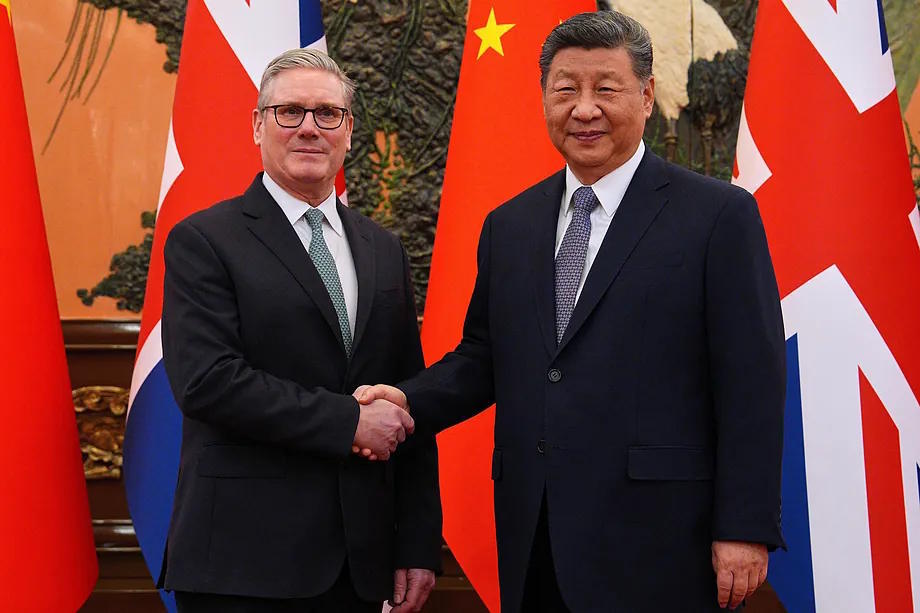
British Prime Minister, Keir Starmer, met with Chinese President, Xi Jinping, in Beijing for over an hour on Thursday, achieving a long-awaited diplomatic thaw that London sought to boost commercial ties with the Asian giant.
Starmer, accompanied by a large business delegation representing over fifty major British companies and institutions, is the first UK Prime Minister to visit China since 2018.
In his opening remarks during the meeting at the Great Hall of the People, Starmer described China as a "vital player on the global stage" and emphasized the need to build a "more sophisticated" relationship. The Prime Minister stressed that a stable and pragmatic bilateral relationship would result in mutual economic benefits. "Let's engage in meaningful dialogue on areas where we disagree," he emphasized.
Xi Jinping, in his brief on-camera speech, noted that the relationship had experienced "ups and downs in recent years that did not serve the interests of our countries." In a "turbulent world," he added, strengthening dialogue between London and Beijing is "imperative," both for global stability and the health of both economies.
"China is willing to develop a strong and lasting strategic partnership with the UK," Xi said, urging his British counterpart to "overcome differences and uphold mutual respect."
Chinese and British analysts have explained that Starmer's visit culminates a reunion strategy driven by London in a context of global order fragmentation, with trade and economic growth as priorities. Since taking office in July 2024, the Labour leader has sought to recalibrate a relationship that deteriorated during the Conservative government years.
"The Labour Party must navigate the dilemma facing the UK: how to balance between an increasingly coercive Washington under US President Donald Trump and a Beijing long considered a national security threat," says diplomat Shi Jiangtao in the South China Morning Post.
China is the world's second-largest economy and the UK's third-largest trading partner. Starmer's trip comes just a week after British authorities approved Beijing's plans to build a mega-embassy near London's financial district. The project had been stalled for months due to concerns from lawmakers warning of potential security risks, given its proximity to fiber optic cables carrying sensitive data from financial entities.
Chinese state media extensively covered statements by Starmer before the trip, where he stated that the UK will not be forced to choose between China and the United States. An editorial in the Global Times interpreted these words as a sign of a more "rational" British diplomatic approach in a changing international environment. "Even within the West, bloc confrontations are losing strength," it stated.
"Starmer's refusal to take sides reflects a rethinking of outdated security and international relations concepts," the newspaper added. "More and more voices in the West understand that blindly following a hegemonic power undermines their own development and prosperity. This Cold War mentality has severely eroded global stability and cooperation."
In this context, a Chinese official noted this month that while Donald Trump intensifies economic coercion and threats, many traditional US allies are reassessing their relationship with China. These comments mainly referred to the recent visit to Beijing by Canadian Prime Minister, Mark Carney, who stated that bilateral ties are at their best and have generated "enormous opportunities for both peoples."
Prior to Carney's trip, South Korean President, Lee Jae-myung, visited Beijing to strengthen ties with Xi Jinping. Irish Micheál Martin also visited the Chinese capital this month, and in December, the most prominent visit was by French President, Emmanuel Macron. On Tuesday, Xi met with Finnish Prime Minister, Petteri Orpo. Two days later, it was Starmer's turn. In February, Beijing expects to host German Chancellor, Friedrich Merz.
Inside and outside the transatlantic alliance, China, backed by promises of trade agreements and access to its market, is attracting an increasing number of Washington's partners. Some approach cautiously, while others, like Canada, openly acknowledge that one of the goals is to reduce their dependence on the United States.
Last week, Chinese Vice Premier He Lifeng used his speech at the Davos Forum to denounce "growing unilateralism and protectionism" and present China as a reliable partner. "China is a trading partner, not a rival," he stated. "Its development represents an opportunity, not a threat, to the global economy."
In terms of sympathy, the UK is not among the European countries best viewed in China. In the Asian superpower, there is still a memory of grievances and defeats inflicted by British forces during the imperial era, a reminder of a past marked by colonial domination and "national humiliations."
During the 2010s, London and Beijing experienced what was then described in Westminster as a "golden era" of economic rapprochement. Conservative Prime Minister David Cameron enthusiastically promoted the City of London as the gateway for Chinese capital into Europe, a reciprocal investment strategy symbolically sealed in 2015 with the famous photograph of Xi Jinping having a pint in a pub with Cameron.
The London-Beijing diplomatic bridge began to crack when several trade disputes and China's repression in Hong Kong, the former colony handed back to China in 1997 by the UK, came into play. The latter led then-Prime Minister Boris Johnson to offer British citizenship to up to three million Hong Kong residents.
The dispute escalated in 2020 when the Conservative government banned Huawei from the UK's telecommunications infrastructure, a decision interpreted by Beijing as hostile. Three years later, Xi's government canceled Chinese funding for one of the ongoing nuclear energy projects in British territory.
This accumulation of disagreements, along with human rights concerns - including repression of minorities like the Uighurs and the detention of pro-democracy activists like media tycoon Jimmy Lai - and accusations of espionage through Chinese technologies and companies, kept relations very cold in recent years.
Now, however, that dynamic shows signs of pragmatic reconfiguration. Starmer's visit, experts point out, symbolizes an attempt to manage differences while exploring areas of mutual cooperation, especially in the commercial field.