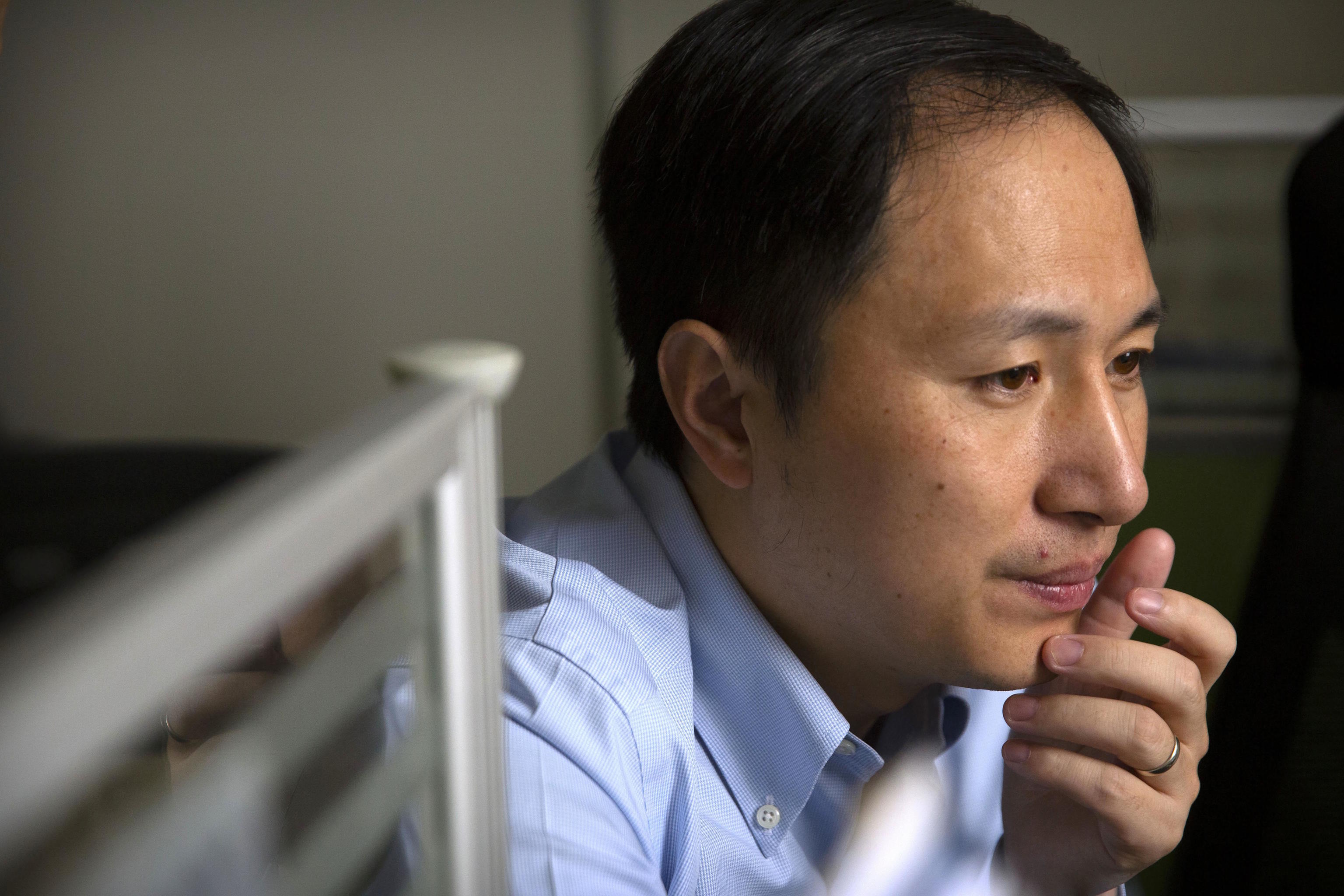
He Jiankui agrees to this interview with one condition: to be presented as the "world pioneer of genetic editing." For the past few months, he has not left his apartment in Beijing without the company of two bodyguards. "They are preparing an attack against me, as I am the most important scientist on the planet," he claims.
He avoids directly answering the questions he finds uncomfortable. He knows he lives in an ambiguous space within China's scientific power: a country that publicly punishes extravagant profiles but needs them because they are the only ones capable of taking risks beyond any limit. And he is one of the most prominent: the researcher who shook the world by announcing the first genetically modified babies.
In secret, He used CRISPR technology - the famous "molecular scissors" that allow cutting and modifying DNA sequences with great precision - to edit human embryos and implant them in uteruses. This led to the birth in 2018 of two twins - Lulu and Nana - and later, a third girl, Amy. The stated goal was to make them resistant to the HIV their parents had.
While the world was still digesting the news, He disappeared. It was later revealed that he had been in the black hole of forced disappearances, the RSDL, which refers to "residential surveillance at a designated location." It is an extrajudicial prison system that allows the Police, under the Criminal Procedure Law, to isolate individuals accused of endangering national security for up to six months, excluding lawyers from the process. The scientist reappeared in 2019 in a Shenzhen court, where he was sentenced to three years in prison for illegal medical practice, deliberate evasion of state supervision, and falsification of documents to deceive regulatory authorities.
Dubbed by international media as the "Frankenstein of China," he was released in mid-2022. As soon as he stepped out, he announced that he was back at it: he initiated several research projects involving genetic editing of embryos, although this time he claims the clinical trials are being conducted with mice. "I am going to a church to discuss my projects with the priest. I want to hear his opinion on what I am doing," he comments.
This 42-year-old biophysicist lives in a luxury apartment complex in northern Beijing, near the research center where he works, supported by the same Chinese government that confiscated his passport to prevent him from leaving the country. The apartment expenses are covered by a mysterious benefactor who, according to rumors, is connected to his wife's work, a Chinese-Canadian biotech entrepreneur named Tie Ying. She is the founder of Manhattan Genomics, a company researching genetic editing therapies in human embryos to prevent hereditary diseases. The company is funded by private investors, mostly Americans, who remain anonymous. "China thinks I am a CIA spy, and the US thinks I am a spy for the CCP," Tie wrote on her social media.
Unlike other Chinese scientists, He maintains anything but a discreet profile. Strangely, he has the freedom to grant interviews to international media blocked in China and publishes all kinds of inflammatory messages on X. "I am recruiting scientists with a doctoral degree to work on genetic editing of human embryos," he recently announced. He shows no remorse. On the contrary, he is convinced that he was ahead of his time.
Meanwhile, China has heavily invested in leading global biotechnology. State programs fund cutting-edge laboratories and startups incubators led by scientists repatriated from the US. Every advancement translates into prestige, resources, and strategic power, and researchers are constantly under pressure to produce results. In this environment, profiles like He's are as dangerous as they are necessary: they risk what no one else dares to touch.
To understand He, one must delve into his biography. He was born into a poor rural family in Hunan province, one of China's inland regions. His parents were farmers. From a young age, he stood out as a brilliant student, especially in science. He earned a scholarship to study Physics at the University of Science and Technology of China (USTC), one of the country's most prestigious universities. He then moved to the United States, where he obtained a Ph.D. in Biophysics from Rice University and completed a postdoctoral stay at Stanford. There, he learned the CRISPR genetic editing technique.
"I don't care what the scientific community thinks of me. I am only interested in my patients and being left alone," he says.
Back in China, he set up his laboratory in Shenzhen, the Silicon Valley of the giant Asian country. According to biomedical professor Benjamin Hurlbut, a key voice in discussions about the risks of editing the human genome, He consulted dozens of Western scientists about the experiment he was conducting. Many advised against it.
The ethical boundary was blurry, and He decided to cross it: in November 2018, during the International Human Genome Editing Conference in Hong Kong, he revealed that he had created his edited babies and claimed to have modified the CCR5 gene to make Lulu and Nana resistant to HIV. The ethical shock was global, with almost unanimous rejection from the scientific community. However, initially, there was hesitation from Beijing. The People's Daily, the official spokesperson of the CCP, published an article praising the "historic breakthrough." The text was later removed. After He's conviction, Chinese authorities tightened regulations, prohibiting the implantation of genetically modified embryos and strengthening ethical standards.
He explains that he is now working on another ambitious project: preventing Alzheimer's through inheritable genetic editing. He says he wants to mimic a mutation discovered in Iceland, associated with a protein that protects against Alzheimer's. The idea is to introduce that mutation into embryos so that future generations are born protected. The motivation for this project is personal: his mother suffers from the disease and no longer recognizes him. He is also researching Duchenne muscular dystrophy, a hereditary neuromuscular disease. He claims that all the funding he receives comes from private funds, but the Chinese government is aware of all his progress and plans. "We have developed a new technique that allows simultaneously modifying ten genes in embryos, so that in the future our children will be born free of diabetes, cancer, Alzheimer's, and AIDS. In 2018, we modified the CCR5 gene; the babies born are resistant to HIV. Now, we have improved our technology and can modify 10 genes in an embryo."
"If we still do not understand the genetic basis of diseases like Alzheimer's, how are we going to play with a person's genes?" questions Alfonso Martínez Arias, senior researcher in Experimental and Health Sciences at Pompeu Fabra University. "He's case was very impactful because, in 2018, no one thought a scientist would modify humans when the technique was not well developed. Now, many people are in favor of it. I don't see the reason for genetic modification. When you have a series of embryos to implant, let's put it this way, because there is a genetic disease at play, you can select the embryos you use for that. If you have 10 embryos in a dish and five are bad and five are good, you can keep the latter."
Martínez Arias mentions that in Silicon Valley, several millionaires are linked to genetic editing projects, although they do not support - at least publicly - the creation of edited babies. From Beijing, He insists that he is only using monkeys for his trials, although he hopes that laws will change - editing embryos for reproductive purposes is prohibited or heavily restricted almost worldwide - and he can resume his mission: to explore the limits of this technology "in a controlled and ethical manner."