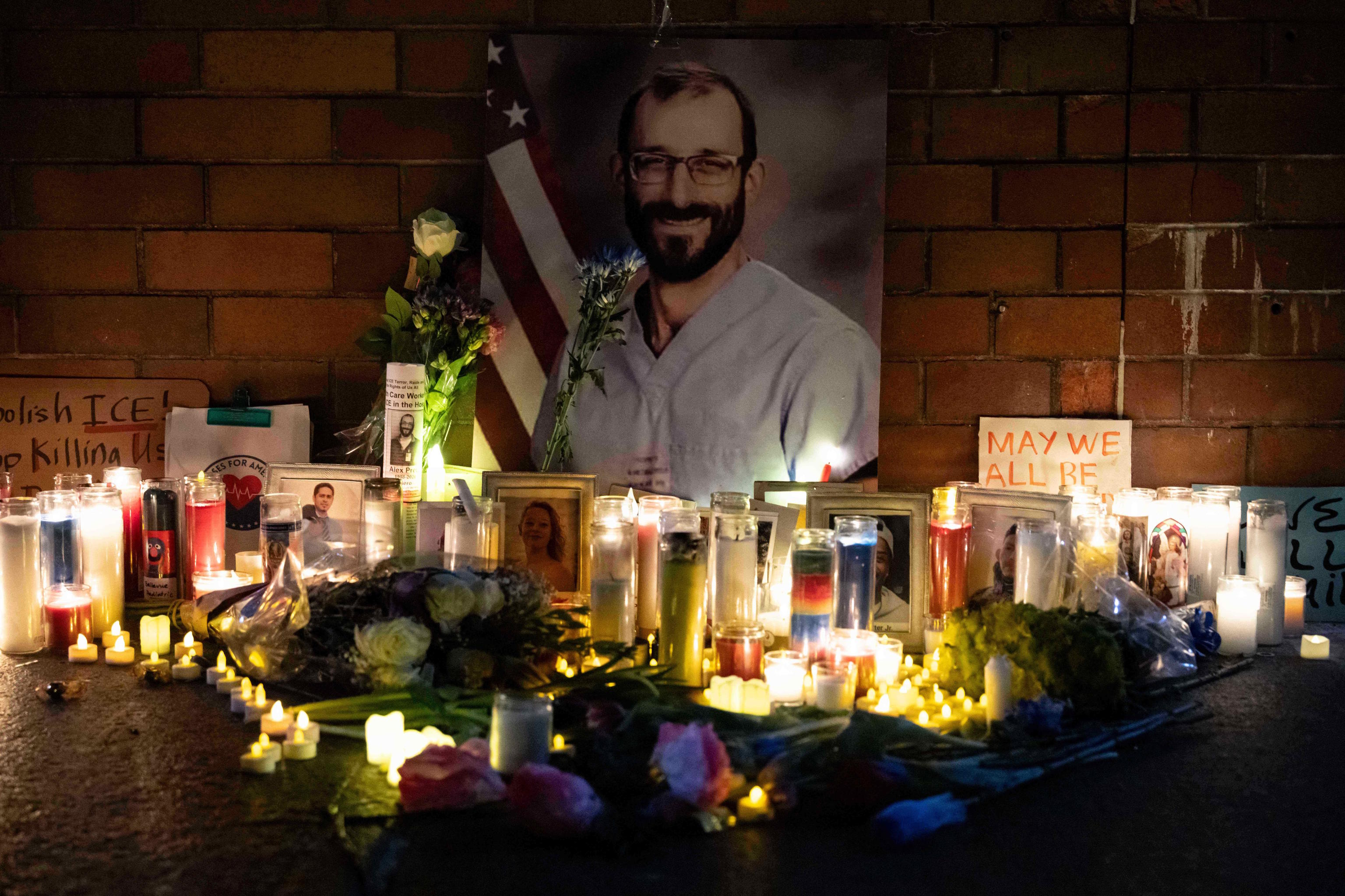
Thirty-two people died in the custody of the U.S. Immigration and Customs Enforcement (ICE) in 2025 (and two more while fleeing from them), and eight more "have died, or have been murdered," in incidents related to ICE just this month. Data unprecedented in the last 20 years. Since December, ICE and the Border Patrol have arrested around 3,500 children and adults in Minneapolis, Minnesota and have killed two local citizens, Renee Good and Alex Pretti, in addition to injuring a third with gunshots. Not to mention the hundreds of cases of abuse of power, gratuitous violence, wrongful captures, and their forced transfer to the other end of the country, including children under two years old.
In recent weeks, the streets, with temperatures of 20º to 30º below zero, have been filled with memorials, points of remembrance, and increasingly enraged people. They protest in churches, at the sites of the shootings, and in front of public buildings where federal agents work. And this Friday, they will take to the streets again, called to a general strike and hundreds of events to demand the freedom of detainees, immigrants, and protesters and the disappearance of ICE, or at least its removal from the state. "It must be abolished, the moment requires it," urged yesterday the congresswoman most hated by Trump, Ilhan Omar.
Activism in the U.S. is not like in Europe. It tends to be much less massive and much more scattered and decentralized, but also more constant. Especially in places like Minnesota, "where citizens are unusually committed to their community. They vote and volunteer more than residents of almost any other state, reflecting Scandinavian roots characterized by citizen participation and collectivism. They support a strong ecosystem of local media to foster community and oversee the government. They care about their neighbors and are willing to help," wrote yesterday in the city's main newspaper, the Star Tribune.
Throughout Thursday, dozens of tireless people took turns at the doors of Bishop Henry Whipple, a complex near the airport where Trump's border czar, Tom Homan, was located, to boo, insult, and confront any car and worker entering the federal compound. "Cowards," "murderers," "pieces of shit." "You have to be a bad person for someone from Minnesota to hate you," could be heard amid the noise of whistles, megaphones, and horns, especially when immigration agents, from their vehicles, mockingly greet or make obscene gestures to the gathered crowd.
It was right there where last week hundreds of pastors sang hymns and prayed on their knees in the road asking Trump to withdraw the 3,000 federal agents deployed in the area before being arrested. And where today, at 8:00 in the morning local time, citizens and media have been called to the protest demanding the release of those who have been baptized as "the 16 of Minnesota," the detainees from two days ago whom Attorney General Pam Bondi identified on her social media by posting their photos and names, seeking to make an example of them. "If these 16 are guilty, then all those with a conscience are too," says the Ice out of Town slogan.
Protests before going to work
The Whipple is one of the mandatory appointments to understand what is happening. There on Thursday were, faithful to their appointment, Rose, Margaret, or Andrew. Most already know each other, but newcomers, trying to remember names, say that "maybe it's better not to know them, in case we are interrogated," half-jokingly, half-seriously. "I come every day before work, and if for some reason I can't, I feel bad," explains one of them. "I live an hour and a half from where Alex Pretti was killed and couldn't be there, but since then, I never miss it," he says with his banner criticizing Stephen Miller, Trump's deputy chief of staff and the brain behind immigration operations and the rhetoric that labels those who are booed and whistled at as "agitators" and "insurgents" and those who have been shot as "domestic terrorists" and "murderers."
Also present was Nate, a man who has traveled 1,500 kilometers from Montana in his car, loaded with 1,000 Bibles, which he offers to each protester. "This is a place filled with hate, anger, and rage right now, and the only thing that can save us is love, being united. That's why I bring the Bibles," he points out before estimating that he has distributed about 45 since Monday and saying a prayer for journalists. "I don't need a Bible, those inside need it," says one of those present. "We all need it, brother," Nate replies.
Hundreds more keep a permanent vigil in the Eat Street area, where Pretti was gunned down last Saturday. Or in shopping centers, like the Richfield Target, also near the airport, where three weeks ago two workers were forcibly taken away. And they attend gatherings at social centers or the University Baptist Church of Minneapolis to prepare for the weekend's movements. Also in front of courthouses, police stations, and city hall. "They communicate really well," said with a mix of admiration and helplessness a few days ago, before being dismissed, Gregory Bovino, the on-the-ground leader of the agents.
Activism is incredibly active and dynamic. Through social networks and chats where the government tries to infiltrate every day. But above all in person. In small venues, restaurants, and shops in the neighborhoods. "It is a deeply moving experience to see how a community that has been so divided comes together. It is the most powerful collective experience I have ever been a part of," said on Tuesday the former mayor of Minneapolis, R.T. Rybak.
Many of these groups will seek a massive halt today, or at least a powerful one. The students at the University of Minnesota have coordinated a "national strike" to "Not work. Not go to school. Not buy. Stop funding ICE." Not all participating associations call it a "general strike," but they do seek to "paralyze the economy" to send a message. The Somali Student Association, the Black Student Union, and the Graduate Student Union at the University of Minnesota will lead the sit-ins. The next day, the organization 50501, which prompted the protests known as No Kings, the most massive against Trump, has outlined the "National Day of Action to expel ICE from everywhere," with planned events from coast to coast.
"The entire country is shocked and outraged by the brutal murders of Alex Pretti, Renee Good, Silverio Villegas González, andKeith Porter Jr. at the hands of federal agents," states the National Shutdown website. "While Trump and other right-wing politicians defame them as 'terrorists,' video evidence unequivocally shows that they were gunned down in broad daylight simply for exercising their right to protest against mass deportations, protected by the First Amendment."
The general strike sought by National Shutdown, a decentralized grassroots movement, does not have the support of everyone, but it has been endorsed by 50501, CodePink, the Campaign for Immigrant Families Defense, the Council on American-Islamic Relations (CAIR), the Poor People's Campaign of North Carolina, the North Texas Area Labor Federation, the Los Angeles Tenants Union, or the Palestinian Youth Movement, among others. It follows the lead of the previous strike attempt, last Friday the 23rd, supported by some unions and organized by the local chapter of Indivisible, a group of volunteers "dedicated to fostering civic engagement and education on progressive policies" that brought out tens of thousands of people and closed hundreds of businesses in freezing temperatures.
There is no real expectation of a massive strike that would paralyze the city or the state, It has not happened before and it will not happen now. But the movement has gained traction and visibility, thanks in part to the support of Hollywood figures like Ariana Grande, Mark Ruffalo, Jenna Ortega, Hannah Einbinder, Edward Norton, Jamie Lee Curtis, or Pedro Pascal, who have used slogans and phrases like "Pretti Good reason for a national strike" on their social media, playing on the last names of the two individuals killed by immigration agents in Minneapolis.