The four astronauts of the historic Artemis 2 mission started their two-week quarantine in Houston on Monday to be ready to travel to the Moon. It is not a strict quarantine like in the old days of the space race, but a relaxed one where Reid Wiseman, Christina Koch, Victor Glover, and Jeremy Hansen cannot frequent public places but can stay in touch with family and NASA personnel who take the same precautions to prevent them from traveling to space while sick. Meanwhile, they continue their preparation for this 10-day manned mission that will orbit our satellite but will not land on it.
The launch window was set to open on February 6, but due to the latest setback, it will not lift off from NASA's Kennedy Space Center in Florida until Sunday, February 8 at the earliest.
Adverse weather conditions - cold and intense winds - have forced the US space agency to postpone the final major test of the Space Launch System (SLSOrion spacecraft, originally scheduled for Saturday, January 31. This is the so-called wet dress rehearsal: the mission's dress rehearsal, during which all countdown steps are performed, including the very delicate phase of filling the cryogenic fuel tanks (liquid hydrogen and liquid oxygen), which are at extremely low temperatures.
This rehearsal will allow ground technicians to verify that all systems function together correctly under actual launch conditions and ensure that the rocket can be safely loaded and drained without astronauts on board.
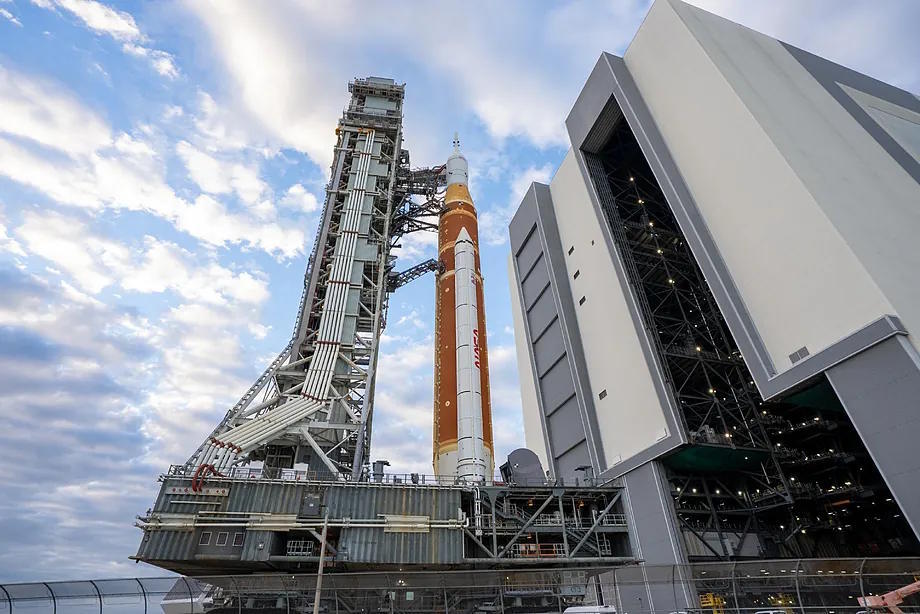
On January 17, NASA moved the assembled spacecraft on the rocket from the Vehicle Assembly Building to Launch Pad 39B at Kennedy Space Center, where the general rehearsal will take place. A 6.5-kilometer journey that took almost 12 hours to complete, given the slow pace at which the impressive crawler-transporter vehicles (CT-1 and CT-2) that transport the rocket must move.
Over the past few days, technicians have carried out a long checklist for preparations on the launch pad, such as connecting ground support mechanical equipment, like power lines and fuel supply connections. They have powered up integrated systems on the platform for the first time to ensure that the flight hardware components function correctly.
To protect the spacecraft from the effects of the cold wave also affecting Florida, they have kept the Orion spacecraft powered and configured its heaters for the lowest temperatures. They have also adapted other parts of the rocket and spacecraft to prevent damage.
Everything is set for the final major test, the rehearsal before launch during which the fuel tanks of the rocket's two main stages are filled. Technicians will demonstrate the ability to load over 2,650,000 liters of propellant, conduct a countdown to launch, and practice safely draining the rocket's fuel without crew present on the platform.
The 'SLS' rocket is transported to the launch pad from the Vehicle Assembly Building.NASA
The test will start by setting a time for the simulated liftoff and initiating a countdown 49 hours before. As detailed by NASA, the wet dress rehearsal with cryogenic fueling will include several "hot fire" tests to demonstrate the ability to stop, resume, and restart operations at various different moments within the final 10 minutes of the countdown.
If failures occur or issues are detected, the process will be halted, and it is likely that the rocket will need to be returned to the Vehicle Assembly Building to address them. In 2022, during the preparations for Artemis 1, an unmanned 25-day mission to test the rocket and spacecraft, the rocket had to be returned to the Vehicle Assembly Building three times due to numerous fuel leaks during the general rehearsal. NASA technicians are confident in the lessons learned from that mission and hope to address any issues more efficiently this time.
Another aspect they will pay close attention to is "checking the recently updated procedures to limit the amount of gaseous nitrogen that accumulates in the space between the Orion spacecraft crew module and the launch abort system hatches, which could pose a problem," as noted by NASA.
Once the fuel test is successfully completed, the mission management team will assess the readiness of all systems before determining the launch date.
Artemis 2 astronauts - Reid Wiseman, Christina Koch, Jeremy Hansen, and Victor Glover - pose next to a simulator in Houston on their first day of quarantineRobert MarkowitzNASA
If all goes well in the test next Monday, the launch could be approved for this same month. After ruling out February 6 and 7, it could take place on February 8, 10, or 11.
If everything is not ready by those dates, the launch will have to be postponed to March. During that month, there are launch opportunities on the 6th, 7th, 8th, 9th, and 11th. If that is not feasible either, possible launch dates in April are the 1st, 2nd, 4th, 5th, and 6th.
The reason why the mission can only be launched on certain days is that, due to complex orbital mechanics, only a few days each month allow the spacecraft to follow a trajectory that meets the mission's objectives and plans.
The four Artemis 2 astronauts will travel from Houston to Florida six days before the launch.