"I don't know if we have given the title to a madman or a genius, time will tell." The already famous phrase was uttered in 1878 by the director of the Barcelona School of Architecture where Antoni Gaudí studied. One hundred years after his death, Gaudí's talent and tourist appeal are undeniable. In the Gaudí Year, we will not only see the completion of the Sagrada Familia, with the unveiling of the temple's highest pinnacle in June. We will also have a host of opportunities to discover the deeper and hidden dimension of Gaudí, even beyond his most famous works. This leads us away from the Eixample, where his last and most visited works are concentrated, and sets course for the upper Barcelona.
This is where the master will begin to reveal his ingenuity. It is still a young Gaudí. An elegant man who attends the gatherings of intellectuals of that time, frequents the Liceo, rides horses, and above all, shows great talent for quickly making friends and associating with influential and wealthy people: Count Güell, Jacint Verdaguer, or Enrique de Ossó, among others. "A dandy," summarizes Fernando Garcés, guide of the Bellesguard Tower and creator of an itinerary that will debut this spring through the architect's less trodden works. "People only remember the white-haired Gaudí, the one of his most famous and late buildings, but this area is very important to better understand his work and observe how his style evolved."
A spectacular wrought-iron dragon guards number 7 on Avenida Pedralbes. It is the entrance to the Güell Pavilions that Gaudí designed in 1884. At that time, they concealed a fabulous 30-hectare estate. Hence, the master is inspired by the Garden of the Hesperides, as described by Verdaguer in his poem La Atlántida. This year, accompanied by Gardés, visitors will also be able to see the interior, previously closed to the public, and admire the first example of one of the techniques that will define Gaudí the most: the famous trencadís.
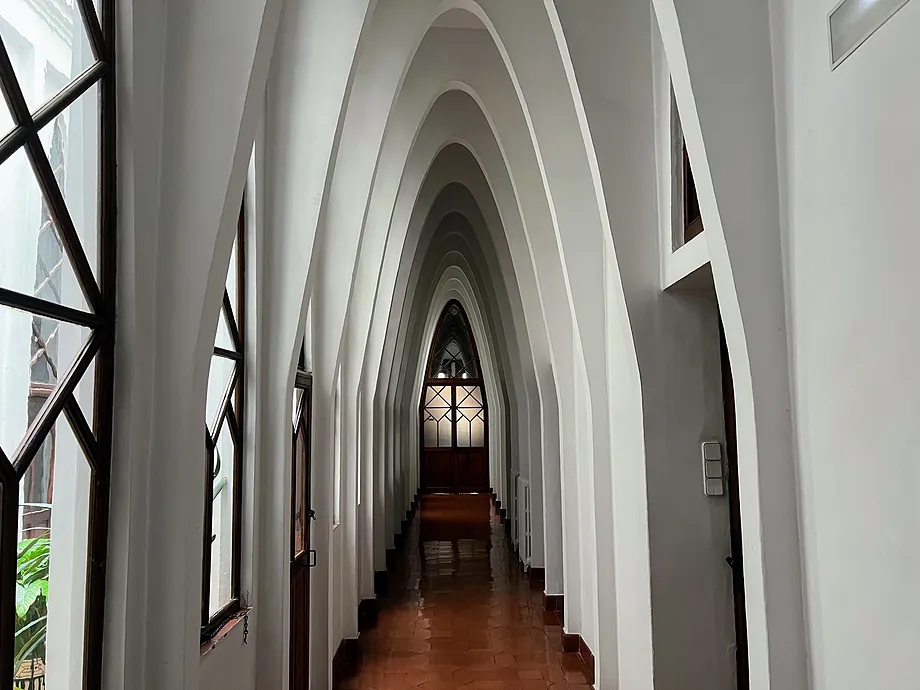
Another dazzling forged iron gate opens the doors of the Teresianas school (Carrer de Ganduxer, 85-105), his first building with religious symbolism, which we can also visit this year. Interestingly, it still has the same use and owner as when he built it. Inside, a forest of imperfect columns takes your breath away. Also, the galleries of parabolic arches that transform with the changing light of the day. "The true genius is this unfinished column," the guide reveals. No more spoilers. Although outside, another Gaudí element that goes to the core breaks the sky: the four-armed cross, the same one that will crown the Sagrada Familia, and that Gaudí uses here for the first time.
The Bellesguard Tower (Bellesguard, 16) occupies the site of the last fortress of King Martín I, the last monarch of the Catalan dynasty. Here appear other unpublished elements, such as the three-dimensional stained glass on the facade. Symbolism is important again: "Gaudí pays homage to Catalonia here," explains Garcés. On the rooftop, the surprises continue. Another dragon? By the way, are these the best views of the city of Barcelona? Very possibly.
Under the motto The Invisible Order, the Gaudí Year 2026 aims to rediscover, with rigor and scientific research, what we do not know about the Catalan artist.
Four major exhibitions are planned to showcase "completely new material: unknown content, never published, and that had not been opened to the public until now," explains Galdric Santana, curator of the Gaudí Year. One of the most anticipated exhibitions is titled Gaudí Code. It is an immersive exhibition produced by Mediapro Xperiences that, thanks to 3D augmented reality glasses, will surprisingly reveal some of Gaudí's best-known works and others that he only projected. The project will be inaugurated in the last quarter of 2026.