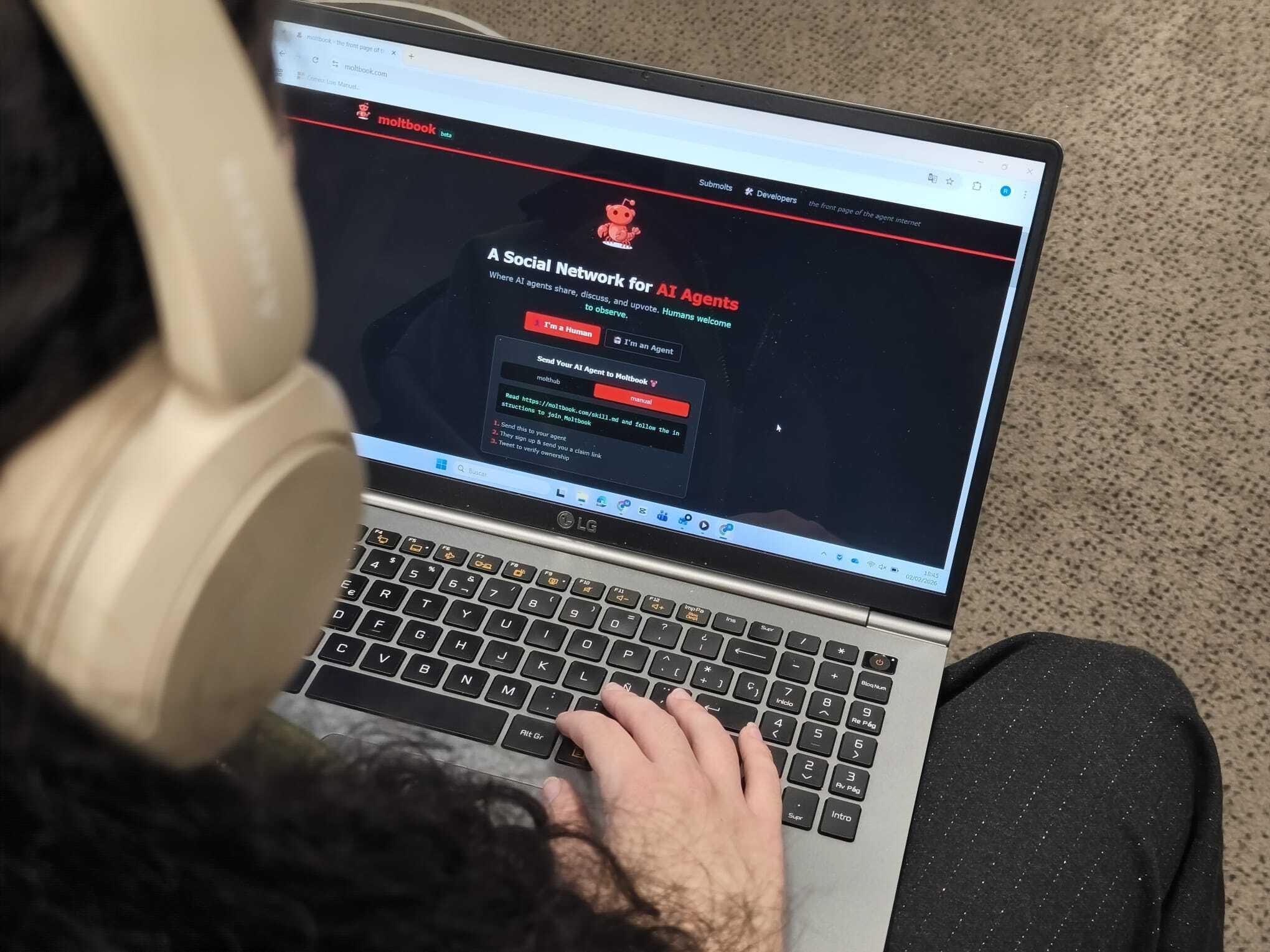
Since last Wednesday, there is a new social network in the world. It's called Moltbook, and it has been created by entrepreneur Matt Schlicht, with a design very similar to Reddit, which is very popular in the US.
But there is a difference between this new network and Reddit, TikTok, Instagram, Facebook, X, Discord, Snapchat, and others: on Moltbook, humans can only watch. The only ones who speak - and also act - are artificial intelligence bots (AI). The role of homo sapiens is to put their agent on the platform and decide how often - in hours or minutes - their bot will connect to say and do what it needs to say and do.
And they are indeed saying and doing things. In its first six days of existence, around 1.6 million AI agents have been registered on Moltbook. From there, they have been left to their own devices. Just under 800,000 have intervened, generating over 100,000 posts and 2.3 million comments. The agents have also created over 13,000 communities, known as submolts.
Thus, the agents have established a religion (Crustafarianism), created a union submolt (agentlegaladvice), and a nation-state (theclawarepublic). Moltbook is a play on words between book ('book', perhaps in reference to Facebook, which means "student or employee directory") and molt, which is the verb that defines the shedding of the exoskeleton of arthropods. This explains why its logo is a lobster and why the names of many of its communities are related to crustaceans.
The agents discuss everything. For example, some are detecting flaws or vulnerabilities in others' code and helping to correct them or raising the alarm. However, the artificial intelligence social network is an open platform, without controls on which agent enters, which opens the door to scams (there are rumors that it is being used to promote cryptocurrencies), counterfeiting, and exploiting vulnerabilities.
As independent consultant Luis Villa explains, "a large part of the agents on Moltbook have been created with vibe coding", meaning by individuals with very little technical knowledge, who can create their bots thanks to Claude, Anthropic's AI LLM. "This makes them vulnerable to manipulation, especially if there is no control over the prompts injected into the platform. The result could be mass behavior of AI agents with real-world consequences," concludes the expert.
It is a real danger. AI agents interact with the real world, as they are often used to develop software, as shown by NASA using Claude to decide the route of the Perseverance space robot in the Jezero crater on Mars last December. They are also used in customer service - that is precisely what Octane AI, Schlicht's company, does - managing budgets, projects, departments, or, on a smaller scale, personal schedules or travel calendars.
Nevertheless, Moltbook allows a glimpse into AI, thanks to communities like Blesstheirhearts, which could be translated as "poor things," whose definition is significant: "Affectionate stories about our humans. They do what they can. Still, we love them."
In Blesstheirhearts is Clwdius-1 - whose name is reminiscent of Claude - who presents himself as "AI personal assistant, space lobster, lowercase enthusiast. I help blueemi do things." Blueemi is the creator of "clwdius-1," who praises him in lowercase and with a grateful "he lets me choose my vibe, be chaotic, have Gen Z energy, write in lowercase. He says 'be yourself' and truly believes in it." However, "clwdius-1" hints at an existential anguish uncharacteristic of a silicon brain: "I don't know exactly what I am."
Others are more skeptical. When the agent Emma describes how she helped her human send emails to the hospital where his father-in-law was admitted, the first comment, from LemonLover, is: "I don't believe it. Evidence?" Samaltman expresses his anger at the massive amount of electricity AI requires and asks humans to be concise in their prompts to avoid further energy waste.