American, former paratrooper in his country's army, activist, and member of the Communist Party of the USA, Christopher Hilali is perhaps the most unusual profile among the thousands of volunteers who have joined the recruitment campaign launched by Iraqi factions allied with Iran in recent days, as part of the escalating rhetoric between Washington and Tehran.
Last Friday, Hilali - who also holds Iranian nationality - recorded himself signing one of the forms distributed by Kataeb Hezbollah, one of these armed groups. "We are ready to defend Iran", he wrote on the document. In the recording, Hilali added: "We are ready to defend our people, our nation, and our leader," referring to the Grand Ayatollah Ali Jamenei.
Hilali did this from Moscow and explained that as a "Marxist," it is not difficult for him to combine his ideology and defend a country that he says "is part of the anti-imperialist pole."
"Iran is above all an anti-colonial revolution fighting against US hegemony. I wanted to express my solidarity and make it clear that we are willing to defend Iran even with our lives," he said in a WhatsApp conversation.
Hilali has joined the contingent of thousands of Iraqis who have been converging in recruitment offices in Baghdad and many other cities in the Arab country to join the "martyrdom volunteer battalions" - as defined by Sheikh Ammar Shammari - aiming to mobilize paramilitaries in the face of a possible US attack on the Persian nation.
"We wanted to call for 10,000 and on the first day, we already got 3,500," explains Shammari, a leader of Harakat al-Nujaba, another faction supported by Iran, in one of the capital's mosques set up for this purpose.
Hundreds of young people dressed in the traditional "kafan" - the white cloth used to bury Muslims - and the same headbands popularized by the legions of "suicide fighters" who fought under the orders of Ayatollah Ruhollah Khomeini in the war against Iraq have begun to parade through some avenues of Baghdad amid a spiral of tension that shows no signs of abating.
For several days now, the irregular forces have been spreading increasingly intimidating messages on their social media. "It is the awaited time for those seeking martyrdom in Kataeb Hezbollah," read one of them under the image of an hourglass and a rocket flying across the sky.
Other AI-generated creations offered images of burning aircraft carriers or coffins covered with the US flag.
On Saturday, the faction Saraya Awliya al-Dam released a video of a supposed network of tunnels where trucks loaded with missiles are hidden, reminiscent of the style of those controlled by Hezbollah in Lebanon, whose existence - if confirmed - would underscore the increasingly prominent role that Iraqi groups are playing in Tehran's regional strategy.
Fuad Yassem was one of those who showed up last Friday at one of the facilities set up by Harakat al-Nujaba to swell the ranks of new "recruits."
Like Christopher Hilali - who fought against the Islamic State alongside Kurdish forces in eastern Syria from 2014 - Yassem did so in the ranks of pro-Iranian formations.
The 42-year-old Iraqi says he fought "in Samarra and Diyala between 2014 and 2016."
In the late afternoon, the Baghdad mosque welcomed several dozen men, mostly in their twenties, but also "veterans" of other conflicts like Yassem, who said he was eager to "be a martyr," even now that he is a father of four.
"My family is very happy that I volunteered. Trump does not understand that Jamenei is an 'imam' (the highest religious rank for Shia faith) and that is why we are willing to die in his defense. We did it with 'Daesh' (the derogatory term they use to refer to the Islamic State) and we will do it with this madman," he adds.
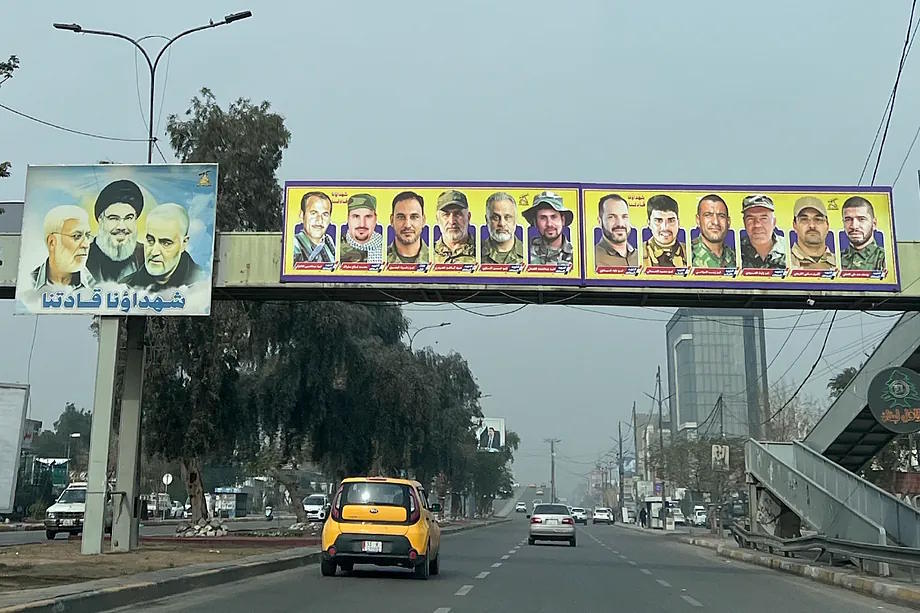
The iconography surrounding this area in eastern Baghdad near Palestine Street reflects the hidden power that irregular groups hold in the Iraqi political scene. Here, bridges are decorated with portraits of militants killed in US bombings targeting these formations in recent years.
"There is no place for occupation in the land of Iraq," reads a banner illustrated with a photo of an armed militant. "Our flag is resistance," affirms another next to the Kataeb Hezbollah flag.
The presence of luxurious new shopping centers in neighborhoods like Jadriya alongside huge portraits praising the figure of the late leader of Lebanese Hezbollah, Hasan Nasrallah - another formation within the Iranian-supported nebula - is also a reminder of the symbiosis that the country maintains between rapid economic development and a political system where Iran holds a more than notable influence.
The recruitment campaign "for aspiring martyrs" began after the call on the 25th of the main leader of Kataeb Hezbollah, Abu Hussein al-Hamidawi, urging his followers to be "prepared for total war to support" Iran.
Amid the growing dispute between Trump and the Iranian regime, Iraqi territory - as has happened in the past - could become an additional stage where Washington and Tehran settle their differences, especially since the US administration has made it clear that "Iranian influence in Iraq will no longer be tolerated," in the words of Congressman Joe Wilson.
Although it is unknown if he expressed the official intention of his government, the Republican representative demanded this week that the new Iraqi government disarm the aforementioned pro-Iranian paramilitaries and set a deadline: "between six and twelve months."
Washington has already included six of the main pro-Iranian irregular formations on its list of "terrorist organizations."
The rivals have maintained a fragile truce since August 2024, after months in which US aviation and militias exchanged multiple attacks, within the framework of the regional violence wave generated by the bloody Israeli offensive against Gaza.
The US has about 2,000 troops in Iraq as part of an international coalition. The Americans recently announced their withdrawal from the penultimate base they occupied in the west of the country, now concentrating their forces in the north, in the Kurdish city of Erbil.
Experts warn of the contradiction posed by Washington's criticism of Iranian interference in Iraqi internal politics when the US exercises unusual authority in the local scene due to the atypical situation facing the Arab country, where oil revenues - representing 90% of its budget - are directly controlled by the Federal Reserve Bank of New York. This system was imposed by US occupying forces in 2003 and remains in effect.
Factions close to Iran are trying to link the new mobilization campaign to the fervor that Iraq experienced in 2014, following the "fatwa" (religious edict) issued by Grand Ayatollah Ali Al-Sistani to confront the advance of the aforementioned Islamic State (IS).
In June of that year, when IS seemed to be heading inexorably towards Baghdad after controlling vast regions of the country and cities like Mosul, the second-largest city in the country, Sistani - the most respected cleric for the between 200 and 260 million Shiites - called for "jihad" (holy war) against the extremists.
"Fight in the way of Allah (God) against those who fight against you, but do not transgress," the cleric's spokesperson quoted the Quran, triggering a spectacular phenomenon in which hundreds of thousands of Iraqis showed up in the following days at a plethora of recruitment offices, confirming the immense significance that this type of religious summons has for millions of Shiites.
"For us, 'Daesh' and the US are the same. The goal of both is to fight the Muslim religion," says Mounir Hattem, a 34-year-old engineer who also fought against IS in 2014 and has now "enlisted" as a "martyrdom aspirant."
The pro-Iranian paramilitaries already tried to revive the symbolism of mobilization against IS - with much less success - for similar campaigns such as the one launched by the Brigades of the Martyrs Forces and Shield of Abbas last March promoting "holy war" against the US or those of other groups in previous years, always under their personal struggle with the US troops present in Iraq.
"Attacking Jamenei would be extremely dangerous for the entire region. Many people would consider it not only an attack against the person but against Islam. That sector considers Jamenei as a religious reference," says Zia al Asadi, a well-known local politician, representative of the cleric Muqtada al Sadr, who faced the Americans in the past but also keeps his distance from Iran.
Those who 'pursue martyrdom'
The return of those who "pursue martyrdom" - another expression of the irregular leader Ammar Shammari - is part of the return to the past that Iraq is facing, which has even brought back as a candidate for prime minister the former government official during the IS outbreak: Nuri al Maliki.
Precisely, Trump's public veto against this politician, whom he also considers close to Iran, has further clouded the perception of a large sector of Iraqi society towards the American state and its president.
Every night, hundreds of people have been demonstrating for days near the US embassy in Baghdad shouting "No, no to Trump!" and "Yes, yes to Maliki!"
On Friday, groups of Iraqis danced in front of the police cordon preventing their progression towards the diplomatic delegation to the rhythm of a melody that said: "Screw Trump! Trump is a son of a b****! Maliki will be prime minister!"
"What does Trump think? That we are afraid of his missiles and planes? We are not a US province. We are not Venezuela. We will choose our prime minister without anyone deciding for us," commented Sheikh Abu Seif Debbi, 60, one of those present at the rally.
In the Harakat al-Nujaba mosque, another of the "volunteers," engineer Hassan Ali, was more explicit: "Trump only understands money. He does not understand the power of faith. He plays with religion, and that is playing with fire. He will set the entire Middle East ablaze."