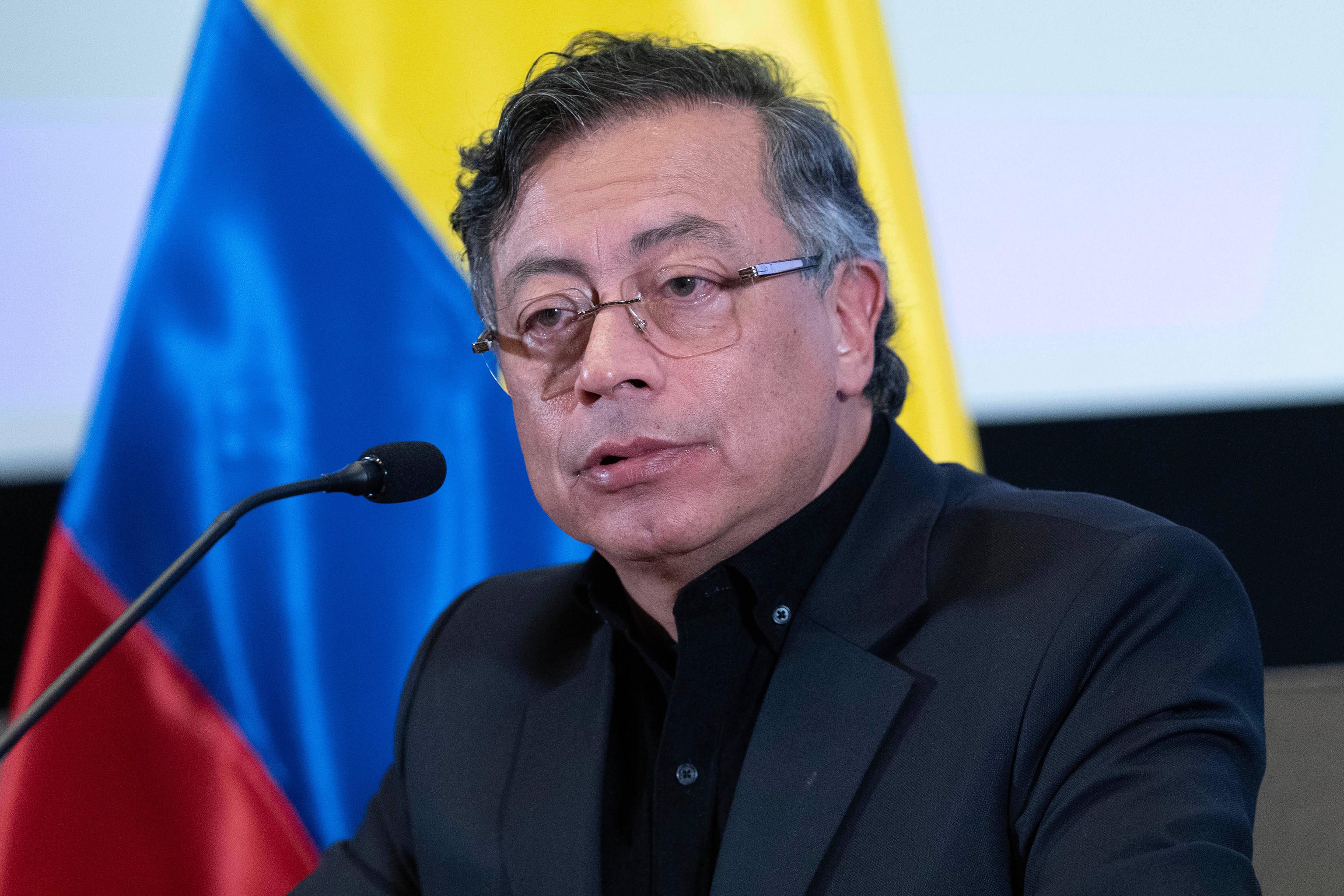
The President of the United States, Donald Trump, welcomed Colombian President, Gustavo Petro, at the White House on Tuesday. The meeting, the first serious attempt to reopen broken bridges, comes after months of clashes, cross-insults on social media, reciprocal tariffs, physical threats, and even sanctions, after the Treasury Department punished Petro, his family, and collaborators, following his participation in demonstrations on the streets of New York against Benjamin Netanyahu and urging US soldiers to "disobey Trump's orders and obey humanity's orders" during his last visit to the country to attend the United Nations General Assembly.
"It has been a very good meeting," said the American hours later, downplaying previous disagreements. "He and I were not exactly the best of friends, but I was not offended because I had never met him. I didn't know him at all. We got along very well. And we are working on that. We are also working on other things, including sanctions," he explained from the Oval Office, after signing the law that will allow the federal government to reopen after a few days of technical closure.
"Today a path is born, or rather it is strengthened, because it never disappeared (...) I left with an optimistic and positive air," coincided from his embassy President Petro, who in a radio interview gave the visit a "nine out of ten." "I like frank Americans," he added before a press conference where he spoke mainly about his usual obsessions and with his poetic language. "It was a meeting without humiliations. He told me 'I like you'. I don't understand English very well but I commit to learning it later," the politician joked, explaining that he has asked the US to declassify all documents they have on two bloody historical events in Colombia's history.
"I saw confusion around the reality that occurs with drug trafficking, energy. Different ways of seeing the problem. Some aggressive, others less. My first sentence when I met President Trump today for the first time... we were looking at the photos of US presidents, Lincoln was there, and my sentence was about freedom. We can be very different, but freedom unites us, and that's where the conversation began. We can make a pact for life and freedom, that's where we can come together (...) When the president gave me a red Make America Great cap, I added an 's', making the Americas great. And that can only be done from respect for different civilizations. With a pact for lives. It's a small step but it eases the possibility of a great human bonfire in the heart of the world," Petro added in his usual rhetorical style.
The meeting takes place amid an unprecedented geopolitical transformation in the region. With Washington appealing to the Donroe Doctrine, an updated version of the 19th-century Monroe Doctrine. With a trade war and escalation between Ecuador and Colombia. After Nicolás Maduro ended up in a New York prison, his successor (Delcy Rodríguez) is obediently following Trump's orders one after another and amid suffocating pressure on Cuba. A pressure that Colombia is not immune to. The United States recently suspended all its aid to the Andean country, an amount that under Joe Biden was close to 750 million dollars. It did so accusing Petro's administration of not making efforts to curb drug production and pointing to the government's silence on the real figures of production and seizure, which are a political dispute in the country.
Petro stated that he had shown not only maps and data but also videos of farmers destroying drug crops. And he expressed his concern about the borders, especially with Ecuador, where, he said, drug traffickers are moving. Trying to shift the focus away from himself and his country. "The conversation was with Trump and he said he does not believe in sanctions, he does not see them as rational here. And I see it the same way," he said.
"Since President Gustavo Petro came to power, cocaine production in Colombia has skyrocketed to its highest level in decades, flooding the United States and poisoning Americans," said Treasury Secretary Scott Bessent in October when imposing personal sanctions. "President Petro has allowed drug cartels to flourish and has refused to stop this activity. Today, President Trump is taking strong action to protect our nation and make it clear that we will not tolerate drug trafficking in our country."
A long but unceremonious meeting
Petro, who is finishing his term in a few months, arrived at the White House shortly before 11:00 local time (17:00 Spanish peninsular time), without the usual pomp reserved for international leaders and authorities. The visit, lasting about two hours, was held without the press, just like with María Corina Machado recently or with Syrian President Ahmed al Sharaa before Christmas. There were official photos of both together, but no questions or interventions. According to the Colombian delegation, the former guerrilla brought as a gift a box of chocolates and Colombian coffee, and a poncho for the First Lady, Melania Trump.
"Gustavo. A great honor. I love Colombia," reads the card with the White House letterhead accompanying a photo of both leaders smiling, a memento of the visit that was posted on the X social network by the Colombian. "What did Trump mean in this dedication? I don't understand English very well," Petro boasted in a second message with another photo showing how the American billionaire dedicated his book 'Trump, the art of the deal' to him, "The Art of the Deal."
Alongside Trump were Vice President, JD Vance, Secretary of State, Marco Rubio, and Republican Senator Bernie Moreno, born in Bogotá and naturalized American. On the Colombian side, the Foreign Minister, Rosa Villavicencio; the Defense Minister, Pedro Arnulfo Sánchez, and the Ambassador in Washington accompanied Petro. "He received a Latin American president and we talked about specific problems and joint paths. He did not change his way of thinking, neither did I. But agreements are not made between twin brothers, but between opponents who can find the paths of human brotherhood," said the Colombian, stating that he did not explicitly ask him to remove him and his family from the Treasury's list of sanctioned individuals. "But I told him that you cannot work under blackmail. Neither did he talk to me about his businesses nor did I talk to him about mine, which I don't have. But I invited him to Cartagena, a very beautiful place. But we did not talk about the Clinton List," he affirmed.
At the beginning of January, just after the operation that led to the capture of Nicolás Maduro in Caracas, Trump broadened the focus and said that Colombia is "governed by a sick man who likes to make cocaine and sell it to the United States, and that is something he will not continue doing for much longer." When asked directly if he was implying that he would do something similar in Bogotá, the American said "that sounds good to me." Words that Petro himself has confessed caused him enormous concern, fearing he would be next on the special forces' list.
In recent days, however, relations seemed to have eased. On Monday, Trump stated that Petro had been "very kind for the past two months. Before, undoubtedly, he was critical, but somehow, after the raid in Venezuela, he became very kind. His attitude changed a lot... I am looking forward to seeing him," he added, saying they were "going to talk about drugs because huge amounts of drugs are coming out of his country... So we are going to have a good meeting."
Shortly before, Secretary of State Marco Rubio had a phone conversation with Colombian Foreign Minister Rosa Yolanda Villavicencio. A "cordial chat," according to the parties, in which they discussed "the fight against organized crime, especially in border areas. Regional security issues and joint economic opportunities."
In a message posted from Washington, the Colombian president announced a gesture of goodwill, a gift to try to soften relations and get the U.S. to remove the president's family from what is called the Clinton List in Colombia. "Mr. alias Pipe Tuluá, leader of one of the most bloodthirsty gangs in the center of Valle del Cauca, has been extradited, according to my order. He tried to buy officials and buy peace. Peace is not bought, it is made if the heart accepts it as the way to end violence," emphasized the president. The leader of the criminal group La Inmaculada is just one more. According to the Bogotá Executive, there have been 809 extraditions, "6.3% more than the Duque government and 7.6% more than Uribe's second term." The current sanctions imply that all property and property interests of designated or blocked persons located in the United States or in the possession or control of U.S. citizens are blocked and must be reported to OFAC (the Office of Foreign Assets Control). In addition, any entity that is owned, directly or indirectly, individually or collectively, by 50% or more by one or more blocked persons is also blocked. Unless expressly authorized by a general or specific license issued by OFAC, or exemption, OFAC regulations generally prohibit all transactions by U.S. citizens or within (or transiting) the United States involving property or property interests of blocked persons.