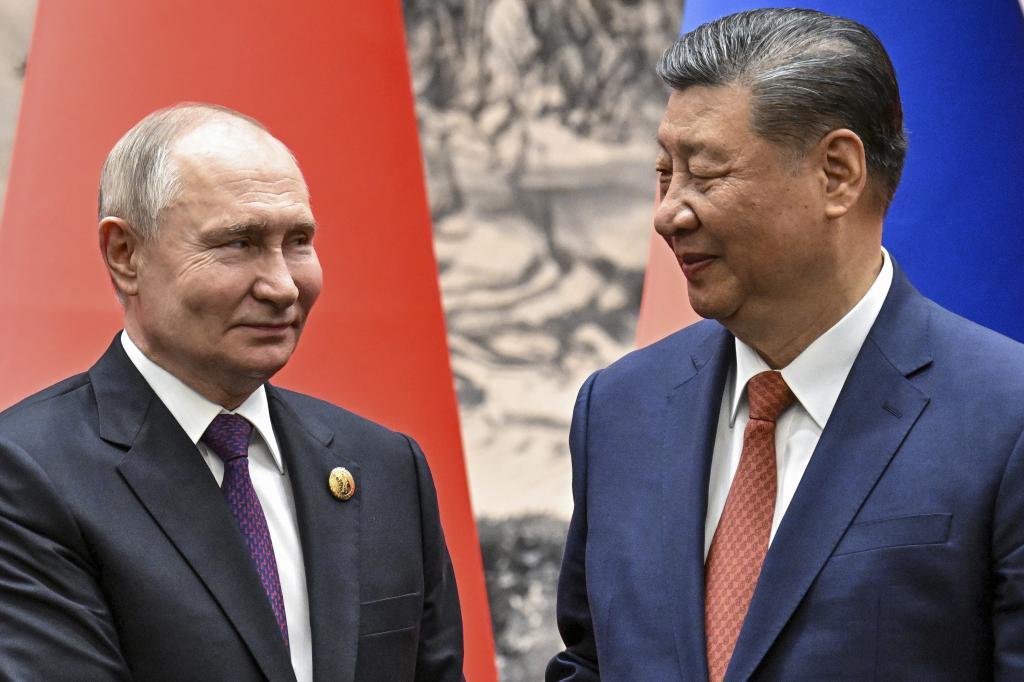
Vladimir Putin once again presented the relationship with China as one of the pillars of stability for the Kremlin in an increasingly volatile world. In a video call with Xi Jinping, the Russian president praised on Wednesday the economic, political, and security ties between Moscow and Beijing, which he described as a "stabilizing factor in turbulent times globally." Putin emphasized that "the comprehensive alliance and strategic interaction between Russia and China are exemplary."
The Russian version of the conversation also highlighted Xi's initial words, who emphasized the qualitative leap in bilateral cooperation. "We have taken our cooperation to a new level," stated the Chinese leader, framing that relationship within a broader goal: to promote a "more just and equitable" global governance system within a multipolar world order, a common formula in Beijing's diplomatic discourse against U.S. hegemony.
The Chinese state news agency Xinhua added further comments from Xi stating that the relationship between both countries needs a "grand plan" to continue deepening ties. These have been the first conversations between the two leaders this year. The Russian and Chinese leaders seek to intensify the strategic alignment they sealed shortly before the Russian invasion of Ukraine in 2022.
During the conversation, Putin praised the energy trade with the Asian giant, recalling that Moscow is China's main energy supplier. The Xi Jinping government has provided economic support to the Russian regime by buying large amounts of discounted oil in recent years despite Western sanctions.
"Our energy partnership is mutually beneficial and truly strategic," emphasized Putin. "We are actively engaging in discussions on peaceful nuclear energy and promoting high-tech projects, including in the industry and space exploration."
The call took place at a time of intense political coordination between both countries and amid global geopolitical tension, with the U.S. military shooting down an Iranian drone approaching its aircraft carrier Abraham Lincoln in the Arabian Sea on Tuesday. Russian, Ukrainian, and U.S. officials are holding talks in the United Arab Emirates on the possibility of a ceasefire in Ukraine.
Just three days before the conversation between Putin and Xi, the Secretary of the Russian Security Council, Sergei Shoigu, traveled to Beijing to meet with the Chinese Foreign Minister, Wang Yi.
In that meeting, Wang warned that the world faces "the real risk of returning to the law of the jungle" and called on China and Russia, as permanent members of the UN Security Council, to uphold multilateralism and defend "an international system with the UN at its core."
Shoigu, on his part, highlighted that the relationship between Moscow and Beijing "has withstood the abrupt changes in the international scenario" and reaffirmed Russia's support for China. Both countries, he noted, will intensify their coordination in forums such as the United Nations, the Shanghai Cooperation Organization (SCO), and the BRICS, with the declared ambition of advancing towards a multipolar world and an "indivisible" Eurasian security architecture.
Wednesday's conversation between Xi and Putin also comes on the eve of the expiration of the New START treaty between the United States and Russia, the last major existing agreement on nuclear arms control between the two main atomic powers.
Meanwhile, Beijing has reiterated its refusal to join trilateral disarmament negotiations with Washington and Moscow, despite persistent calls from U.S. President Donald Trump.
Lin Jian, a spokesperson for the Chinese government, reiterated on Wednesday that Beijing's position is clear. "China's nuclear forces are not at all on the same level as those of the United States, and it is neither fair nor reasonable to ask China to join nuclear disarmament negotiations at this stage," he said at a press conference.
China consistently emphasizes that its nuclear arsenal is much smaller than that of the United States and Russia, both in terms of the number of warheads and launch capacity.
According to the Stockholm International Peace Research Institute (SIPRI), in 2024 China had around 600 nuclear warheads, compared to over 3,700 operational warheads in the United States. Washington and Moscow together account for nearly 90% of the world's nuclear weapons, a fact that Beijing uses to justify its refusal to enter the current framework of negotiations.