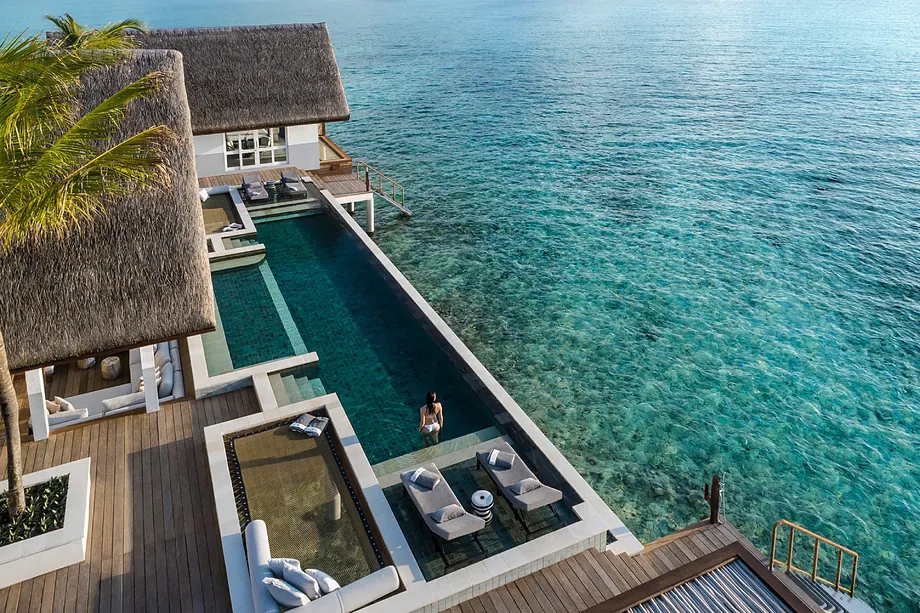
When it comes to luxury travel, it is no longer measured in terms of square meters of mega-suites, 24-hour butlers available to fulfill the most eccentric requests, and solid marble bathtubs in the middle of the room of a classic five-star hotel in true Elizabethan style. No, today exclusivity is related to "well-being, authenticity, and purposeful experiences," in the words of Xandrá Falcó, president of Círculo Fortuny, the association of cultural and creative industries of excellence that promote the high-end sector linked to the Spanish brand.
And what does this particular combination translate into? Into a completely tailor-made itinerary based on the tastes and interests of the traveler. Into a yoga retreat in a remote location in India taught by the best masters in the discipline. Into a traditional meal at a local family's home in a remote village in Guatemala. Into chatting with artists after attending an opera at La Scala in Milan or with NBA players after a game at Madison Square Garden in New York. Into making your own hat in a haute couture workshop in Paris. Into a getaway designed to leave the smallest carbon footprint possible. Into a private visit to the Prado Museum under the cover of night. Into accompanying the chef to the hotel's garden to pick oranges for breakfast juice.
These are some of the proposals that make up the day-to-day of premium tourism, a typology that is increasingly on the rise both in Spain and internationally. The numbers speak for themselves. In 2025, the segment represented 10% of the Gross Domestic Product (GDP) worldwide, generating over 350 million jobs and reaching an economic volume close to 2.5 trillion euros. And it could reach 4.8 trillion in the next decade, according to the latest data from the World Travel and Tourism Council (WTTC).
Not surprisingly, it is one of the key trends when it comes to traveling the globe in 2026, along with urban beauty tourism and screen tourism—following the footsteps of successful movies and series—, sustainable and wellness practices, immersions with locals, attending major global events (from the Monaco Formula 1 Grand Prix to the Winter Olympics in Italy or the solar eclipse on August 12), solo trips, and those planned with the help of artificial intelligence. And all of them have their version designed for the most exclusive travelers, with the main emitters being the United States, China, the Middle East, and Germany.
Spain, on the other hand, is one of their favorite destinations, just behind classics like France, Italy, and Switzerland. Among the reasons for choosing it is its ability to adapt and innovate by combining culture, gastronomy, nature, and fascinating cities. Hence, it has experienced a 6.2% growth in this field in the last year, according to the Executive Summary of Luxury in Spain 2025 report, prepared by the Spanish Association of Luxury-Luxury Spain, composed of over 150 national and international sector companies. Its president, Cristina Martín Blasi, is clear that the key lies in tourism "increasingly qualitative, with a more sophisticated offer and a country-level strategy that reinforces its position as a destination of excellence."
And it's not just about luxury anymore, but about "intelligent ultra-luxury," a concept that moves away from the size of a room or material purchases to focus on other aspects such as time, coherence, and memorable experiences. "The big shift is that luxury is no longer measured in square meters but in well-lived minutes," says Cayetana Vela Sánchez-Merlo, partner at the luxury brand agency Luxurycomm.
David Hernández, CEO of the agency Pangea, shares this view, emphasizing personalized trips guided by authentic experts among his many proposals. From the boreal winter in Finland with popular meteorologist Fernando Brasero to the Space Journey through Florida and Texas with astrobiologist Josep Calatayud and space engineer Sergio Hidalgo, two of his major bets for 2026.
His colleague Nuba also opts for different plans for the new year, specializing in exclusive and tailor-made trips. Exotic destinations like Botswana, Maldives, Saudi Arabia, Bhutan, Namibia, Mauritius, or South Korea make it to their list for being "natural spaces, ancient cultures, and places that reinvent themselves without losing their essence."