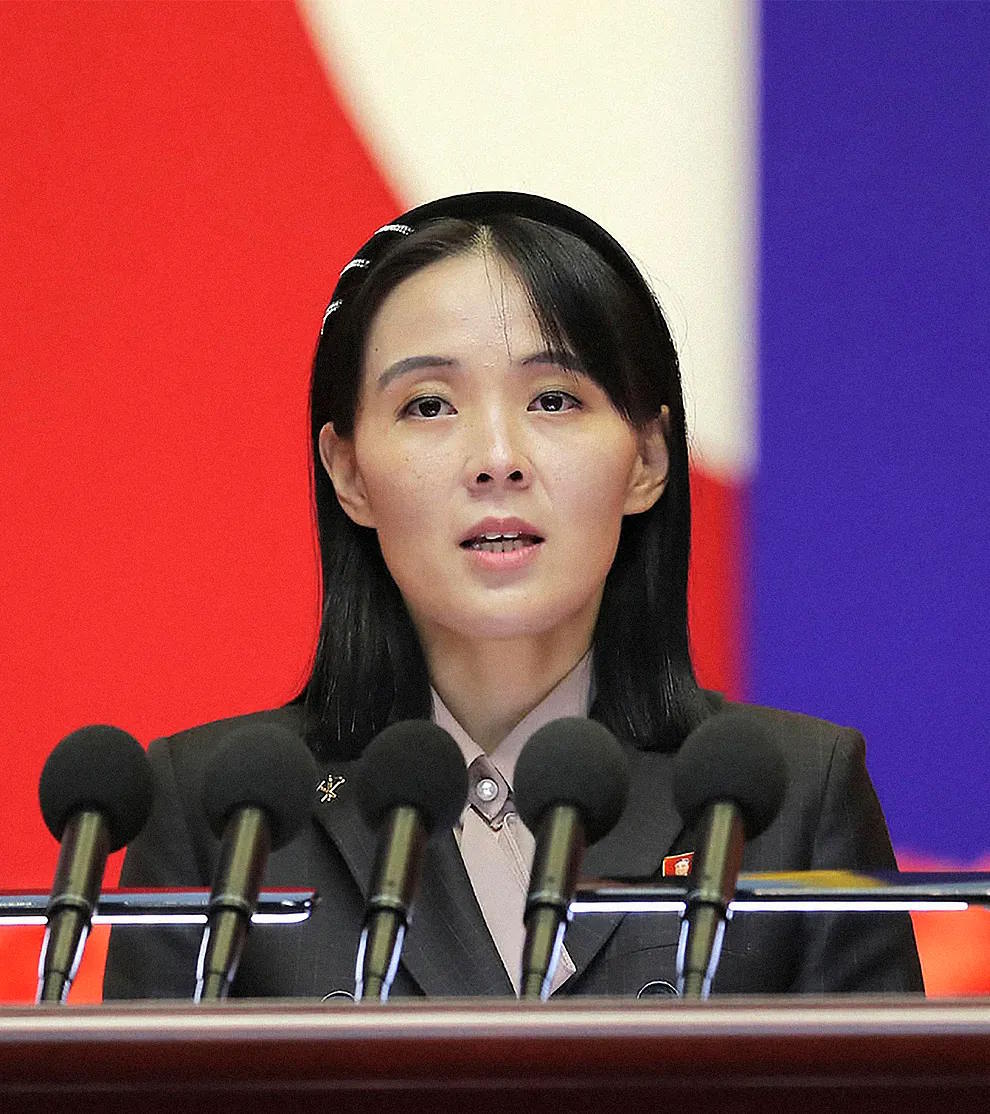
2018 Winter Olympics. Scenario: Seoul International Airport. For the first time, a member of the Paektu Mountain lineage set foot in South Korea since 1950, when the dynasty's founder crossed the border to invade the neighbor. The visitor was not the ruler of the North Korean regime, Kim Jong-un, but a young woman, with an upright posture and a serene gaze in a context that did not invite calmness.
Over the years, that calm silhouette that passed through the airport has taken on another form in Pyongyang's power structure. Today she is pointed out as the country's number two: the one who operates in the shadow of the dictator. More cold, more astute, and often more violent. She has repeatedly reprimanded the South Korean president, calling him everything from "insolent" to "shameless," "deranged," "scared dog," "imbecile," and "fool." In short, a man who, according to her, "has tied the noose of pro-American servility around his neck."
This is Kim Yo-jong, the younger sister (and right-hand woman) of Kim Jong-un. She was the last of the three children that Kim Jong-il, then the supreme leader of North Korea, had with his favorite consort, a dancer named Ko Yong-hui. She has been adored with devotion since her childhood. Both her father and mother called her "my sweet princess Yo Jong."
At family banquets, Yo-jong was the one who sat next to her father. When she was eight years old, the ruler of the hermetic kingdom appointed the current top North Korean singer, Jong-nyo, as her daughter's official playmate. But in a childish tantrum, she fired her. That strong character has always accompanied Yo-jong, who, as an adult and with almost unlimited power, no longer dismisses servants but orders the execution of high government officials.
Unlike other Kim clan relatives, her power is not decorative: it is said that since 2014 she has been the deputy director of the Propaganda and Agitation Department of the Workers' Party of Korea. It is said because only fragments of what happens inside North Korea leak out. The information that reaches us is a jumble of puzzle pieces that researchers and analysts, like Sung-Yoon Lee, piece together from leaks, propaganda, and drip-fed data.
Untangling the Paektu Mountain lineage is not easy, much less creating a profile like the one signed by this specialist from the Woodrow Wilson International Center for Scholars in The Sister, a book published this week by Malpaso Ediciones and that closely follows the woman considered the "most dangerous woman in the world".
"Yo Jong represents one of the most ruthless and evil dictatorial regimes in history. She has her own agenda and is in a better position to manipulate her adversaries than her brother, who seems angrier and more sullen. She disarms because she is a young, calm, and attractive woman," admits Sung-Yoon Lee in a Zoom conversation. It is nine o'clock in Seoul, but he speaks to this newspaper to share his main concern: "That North Korea -through the princess- tries to deceive the world with a false charm offensive." "She is an unprecedented diplomatic weapon," he adds.
The youngest is unique in many ways. "She is the first woman of the ruling family with real power to execute her nation's policies, including foreign policy, that is, towards the United States, South Korea, and many other countries," warns the researcher.
The sister wants it to be clear who is in charge. And she doesn't hold back. When she speaks, Yo-jong does so with deliberate sharpness: a acidic, sarcastic, sometimes openly rude tone, as if insult were also a form of protocol. The first time she put her name on an official statement was on March 3, 2020, at the start of the Covid era. It was a harsh reprimand against the then South Korean president, Moon Jae-in, the same one who had welcomed Kim Jong-un and his delegation cordially during the 2018 Winter Olympics. Those diplomatic efforts went awry. Since then, her messages to Moon -also in writing- have been escalating.
According to Sung-Yoon Lee, much of that (un)controlled talk is allowed because she is a young, attractive woman, and ultimately a mysterious princess from a nation and a regime that are practically inscrutable. "We had never seen a woman from the ruling family in North Korea with real power," reiterates the researcher.
She appears harmless, avoids heavy makeup, and dresses modestly, but she has earned the nickname devil woman. Her gender does not translate into positions in favor of dismantling the North Korean atomic program, but rather the opposite.
"She has a finger on the nuclear button", Sung-Yoon Lee asserts. He says this based on a statement like the one in April 2022 when the princess threatened a nuclear attack against South Korea if it struck first. If the South Korean army "even slightly violated our territory -she stated- our nuclear combat force will inevitably fulfill its duty." "She plays God and decides who lives and who dies," writes Lee in his book.
Some consider her "the most dangerous woman in the world." This is how the subtitle of Lee's work in its American edition defines her. Does the expert in North Korean politics believe this? Absolutely, yes. "There are no precedents, except perhaps Thatcher, of a woman with real capacity to trigger a nuclear war," he emphasizes. And yet, he qualifies, the Iron Lady had restraints: alliances, checks and balances, structures that limited the scope of a single person. In Pyongyang, he argues, such obstacles do not exist: "In North Korea, they do not exist: the supreme leader acts without anyone stopping him."
Hence his conclusion: if Kim Yo-jong has the complete trust of her brother Kim Jong-un and, as she has suggested in her statements, can "press the nuclear button," today "there is no other woman in the world with such absolute and lethal power." This trust, the analyst comments, is evident. In public events -summits with South Korean presidents, with Donald Trump, or with Xi Jinping- she is almost always by his side: "They constantly look at each other, make eye contact, communicate; they do it often." And that, he concludes, reveals an unusual complicity in the North Korean leadership.
"There are no precedents of a woman with real capacity to trigger a nuclear war"
Very little is known about her private life, only what the regime hints at. Is she married? There is no information on that. It is believed she has two children: an older girl and a young boy. There is no family photo or official announcement: only intuitions. In the last two years, propaganda has shown her entering public events with two children by her side. "We cannot affirm with 100% certainty that they are her children: they could be nephews, but it is very unlikely," admits the researcher.
There lies the difficulty: how do you investigate a country so jealous of privacy? Reading between the lines. North Korea publishes hundreds of texts a day - "most of them very boring," jokes the researcher - and specialists have learned to pay attention to both what is said and what is left unsaid. This is complemented by books, reports, and, above all, a key human archive: the nearly 35,000 North Koreans who have defected to South Korea. Their voices, from different social classes and corners of the country, repeat the same: oppression, surveillance, neighbor denunciations, and prison camps.
You are a public figure very critical of the regime. Are you concerned about your safety?
(Laughs) I am nobody, I am a small fish in an ocean of whales. I don't think North Korea would want to waste resources or reputation on someone like me. It would probably help sell more books, especially the Spanish edition that is coming out now. I'm not really worried, although of course, with what I say, they advise me not to visit North Korea...
In recent weeks, the communist country has once again done what it does best when it wants the world to pay attention: move in military terms.
January has left a trail of weapons tests.
On the 27th, they once again launched several short-range ballistic missiles towards the Sea of Japan. The question arises on its own: does this smell like war? According to the researcher, not so much. Not yet, at least. We are witnessing a demonstration of power in the only area where North Korea can compete without shame. "There are indices to measure the power of a state: military, economic, territory, population, soft power... North Korea performs poorly in almost all, except in the military," he explains. And that is the key: "Projecting strength to intimidate and mark territory" in front of Seoul, Tokyo, and Washington.
For now, Lee's forecast is that this year Kim Jong-un will "sing a much friendlier tune." His strategy, in essence, is not linear: "North Korea goes through cycles of bellicosity... and that is usually followed by a cycle of peace." In this ebb and flow, he makes his prediction for this 2026: "There is a 50% chance he will meet with Donald Trump. Perhaps even with the Japanese prime minister or the South Korean president." In that scenario, he also believes that The Dear Leader's Sister will once again show her friendlier side: "The next time they extend a hand, she will be the one to step forward." In other words, she will be the friendly face of a diplomatic approach.
There is an irony in all these predictions. Lee constructs a narrative about a woman who is still alive, decides, appears, disappears, and to whom he has not been able to ask a single question face to face. His reconstruction includes the regime's cycles and measured gestures in parades, but not a direct response. That's why, when faced with the what if..., the researcher does not go for the nuclear button.
If you had her in front of you, where would you start?
I would ask her why the North Korean government does not decide to allocate a tiny fraction of its wealth to import food and alleviate hunger. It's not that difficult: maybe 200 or 300 million dollars, depending on the grain. I wouldn't tell her: 'You have to do this or that.' I would ask a question: 'What plans do you have to alleviate malnutrition?'