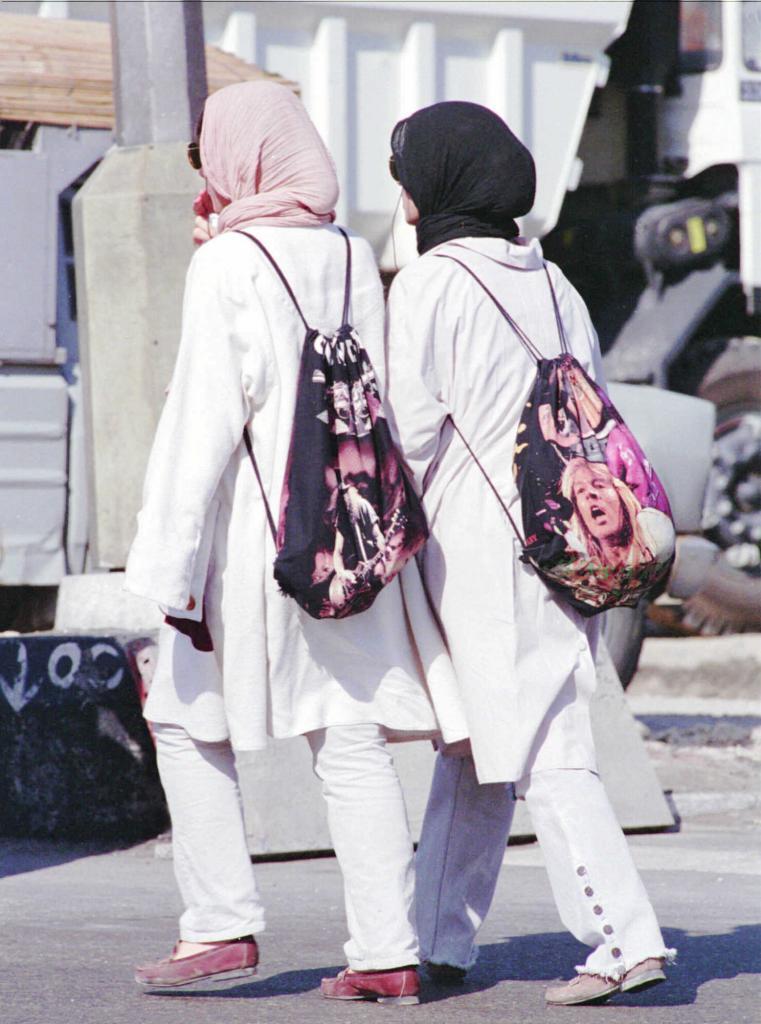
Without veils, wearing short or long dresses, polka dot or geometric prints, miniskirts and blazers... That's how women in Iran debuted their right to vote in 1963, even though the elections under the Shah's regime, without real political parties, were more of a formality. That 1963, when Martin Luther King delivered his famous "I Have a Dream" speech in Washington about freedom and equality, began in Tehran with the celebration of the anniversary of the anti-veil law, which in 1936 had banned the use of the chador and other traditional Islamic garments (although it would barely be enforced for five years). In the photos of the time, Iranian women appear to be French or American: dressed in fashion with vibrant colors, elegant designs reminiscent of Jackie Kennedy, a British mod touch, or very Parisian glamour. Some even exude a yé-yé vibe, as Concha Velasco sang, with tousled hair and colorful stockings: fun, liberating looks with thigh-high boots, flashy earrings, and sophisticated hairstyles... But the dream of women's freedom, who already lived under male guardianship even if they were nuclear physicists (there were some: around 25% of the scientists working in the Iranian nuclear program were women, as highlighted by the newspaper Etela'at in 1968, wondering, "How can a husband reconcile with atoms?"), would abruptly end in 1979 with the arrival of Ayatollah Khomeini and the establishment of his brutal theocracy that stripped them of their rights.
To contemporary eyes, the modern aesthetics of the 60s and 70s in Iran are surprising, a period of great cultural effervescence despite the dictatorship of Shah Mohammad Reza Pahlavi, whose heir, the prince who never reigned, Reza Pahlavi, is now being called back by a part of the citizenry. From the White Revolution of 1963 to the fateful Islamic Revolution of 1979, Iran experienced a New Wave of cinema (closer to Italian neorealism than the French Nouvelle Vague), a powerful existentialist movement in literature, the formation of musical groups flirting with rock or jazz while adding Persian influences, an avant-garde theater that blossomed at the Shiraz Arts Festival held in the summers amidst the ruins of ancient Persepolis... And women were also protagonists of that cultural Renaissance or resistance, marked by the censorship of the Pahlavi monarchy.
Iran, 1979: the infamous story of the destruction of Tehran's red-light district
Speech by Marjane Satrapi at the Princess of Asturias Awards: "Among mammals, man is the only one who kills his female"
"It was the time of the Cold War, communist ideas were spreading, and there was much discontent with the Shah. The Soviet Revolution had the same impact in Asia as the French Revolution in Europe. The people demanded freedom, bread, and work; in reality, as it is now..." summarizes political scientist Nazanin Armanian, born in Shiraz in 1961 and exiled in Spain since 1983. She is the author of several essays on the Middle East, such as the enlightening Iran. The Constant Revolution. Between Modernity and Traditional Islam (Flor del Viento), co-written with Martha Zein, a review of the country's complex history from the late 19th century to the establishment of an Islamic Republic, which would end a millennia-old monarchy and lead to a massive exodus of Iranians. "If today we are surprised by the modernity of Iran in the 60s and 70s, it is because Khomeini eliminated all the rights we had achieved in a century with a stroke of the pen. But under the Shah, we lived in a very repressive dictatorship that maintained Sharia in the Family Code, polygyny, and male guardianship over women. His reforms were superficial, a facade," Armanian explains. She herself experienced that repression, first under the Shah, then under Khomeini; she ended up escaping the country through the mountains of Pakistan with other university colleagues.
To alleviate the growing popular discontent, the Shah promoted a series of measures to industrialize and westernize the country, looking towards the then prosperous capitalism of the United States. The White Revolution -the color farthest from communist red- brought women's suffrage and a profound agrarian reform involving expropriations from the clergy and landowners to redistribute the lands, but it did not yield the expected results. For democrats, it was too little, for conservatives and religious groups, it was an outrage introducing decadent and dishonorable foreign customs, something that a young and unknown cleric, Khomeini, began to criticize, inciting revolts in Qom, the main center of Shiite Islamic studies. That 1963, Khomeini would end up in prison for his inflammatory speeches against the Shah.
The westernization of Iran had a clear limit: rock music. When the psychedelic rock band Tak Khalha, with Persian songs bordering on ska or covers of Play With Fire by the Rolling Stones, began to attract masses of young people, especially university students, the authorities deemed it too subversive, pursued it, and relegated it to an underground circuit while supporting traditional music or light and harmless pop groups. The documentary Tak Khal Ha 50 Years Later (2022) recounts the story of the group led by Bahman Bashi, who went into exile in New York in 1978 when protests against the Shah intensified. Months later, Khomeini went further and banned rock music as a "corrupting influence."
Although it was the trendy music worldwide, it also had no place at the Shiraz Arts Festival, a summer festival held for a decade (1967-1977) at the archaeological ruins of ancient Persepolis and the city of Shiraz. It was an ambitious international gathering that sought to unite East and West, sponsored by Empress Farah Diba herself, the Shah's third wife, the only one who bore him male heirs and whom he proclaimed, with a certain Napoleonic delirium, Empress instead of Queen. The Shiraz Arts Festival showcased the folklore of various Middle Eastern countries while serving as a showcase for the most innovative foreign productions, focusing mainly on theatrical experimentation and featuring mythical productions like the Persepolis by the Franco-Greek artist Iannis Xenakis, a commission to inaugurate the 1971 edition and still performed in museums and auditoriums worldwide (CentroCentro programmed it in 2024, in Madrid). Xenakis conceived an electroacoustic and multimedia piece on the ruins of Emperor Darius II's fortress. The show had Olympic dimensions: lasers and projectors were deployed, with 92 light beams and large bonfires scattered on the surrounding hills, as well as a parade of 150 children with torches descending the slopes.
"The festival allowed for a certain opening, yes. But it was also a whitewashing operation for the dictatorship. Progressive Iranian musicians were never allowed to participate. They were all persecuted...," emphasizes Armanian. In recent years, several Anglo-Saxon universities have analyzed the impact of that ephemeral festival in meetings and publications like A Utopian Stage by Vali Mahlouji, curator and advisor to the British Museum.
If there was a female icon in Iran in the 60s, it was the poet Forugh Farrojzad (1935-1967), whose premature death at the age of 32 helped solidify her myth. Beyond making headlines for her tumultuous love life, young Farrojzad emerged as the great rhapsodist who revitalized the rich Persian tradition, with poetic works as lyrical and beautiful as they were transgressive. With her verses on women's freedom and desire, she broke taboos and circumvented censorship.
But she didn't limit herself to poetry. In 1962, Farrojzad released an acclaimed short documentary that was ahead of the New Wave movement: The House is Black. A female director venturing into a leper colony with close-ups of their wounds and suffering? Pure experimental cinema in which she slips in quotes from the Old Testament, the Koran, and her own verses, and which the Venice Film Festival recovered in 2019 with a restored copy. "After years of oblivion, the figure of Farrojzad is resurfacing," says Armanian, who has translated her complete poetry into Spanish, republished by Gallo Nero in 2025 in the exquisite volume Eterno anochecer (Eternal Twilight).
Although Farrojzad was the precursor of the Iranian New Wave, the film that officially launched the movement in 1964 was Hajir Darioush's Snake Skin, based on D. H. Lawrence's Lady Chatterley's Lover. Darioush would be awarded at the Berlinale the following year with Face 75 -75, a critical look at the Westernization of Iranian rural culture. But Abbas Kiarostami, who began shooting his first films in the 1970s, would become the most visible face of that New Wave. And in 1997, while living in France like most of his colleagues, he became the first Iranian director to win the Palme d'Or at the Cannes Film Festival for Taste of Cherry.
Did Iranian cinema have more impact outside its borders than within the country? "In Tehran, going to the movies was very expensive, only a certain elite could afford it," Amranian points out. He recalls his student days: "Suddenly, the USSR embassy, which was in a huge building, announced very cheap movie screenings. And there were long lines on the street to see Battleship Potemkin and other Soviet films. It was unthinkable that the Shah would allow such propaganda, but it served to identify leftists or communists. And the next day, the SAVAK, which was like Pinochet's political police, would knock on your door to find out what you were doing watching that movie..."
Because in police repression there was gender equality. In 1971, Pahlavi opened the first prison for female political prisoners, and in his already dying days in 1979, he had the activist Iran Sharifi hanged, accused of kidnapping and killing her husband's children. "Sharifi's murder was shocking to the Iranian people, as the only previous case of this type had occurred in 1860, when the Bahai feminist Taheré Ghorrat-ol-Ein was accused of heresy," Armanian points out.
Unfortunately, executions of women have multiplied since 1979, whether by torture, stoning, or firing squad. And they would continue to do so for decades, until the murder of 22-year-old Mahsa Amini, who was arrested by the Morality Police for not wearing her veil properly and who shocked the entire world in 2022, sparking a wave of protests in Iran. "Khomeini brought hell. In comparison, the Shah's dictatorship may seem glorious, but it was not. That's why I'm afraid when I see protesters with the photo of his heir asking for the Shah to return. Iran needs true democracy, a republic without any adjectives," sighs the political scientist. And she recalls a popular saying about the Iran of the Shah and the Iran of today: "Before, Iranian men prayed at home and went to cabarets to drink. Now they drink at home and go to the mosque to pray."