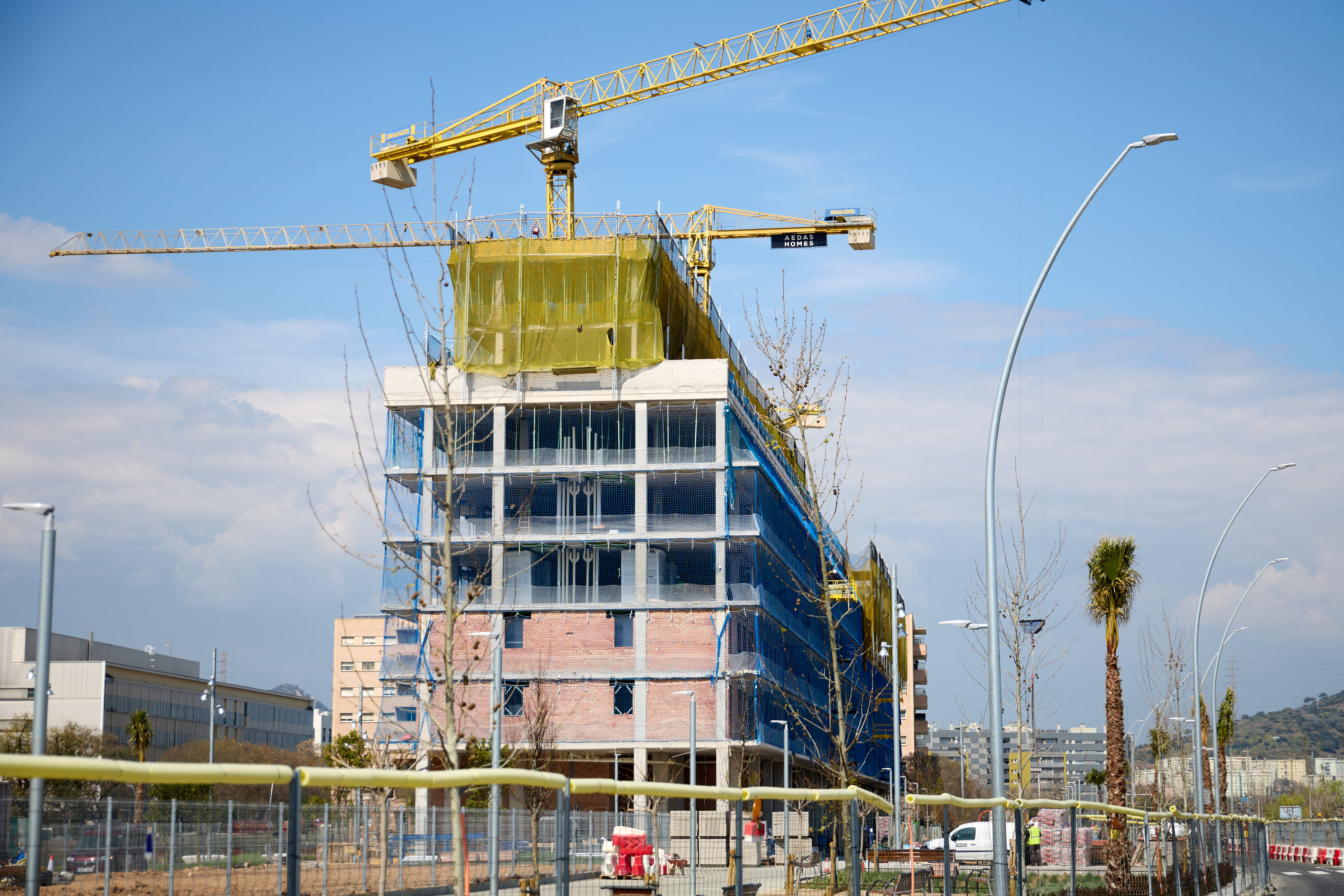
Let's do an exercise. If you have been able to buy a house at some point in your life, your first home, think about how you made the decision: how many houses did you visit; what budget did you manage and how much did you deviate from what you paid in the end; also think about how you financed it, how many banks did you consult, if you had enough savings for the down payment or if you needed family help. Now calculate the time it took you to carry out all these operations.
Now listen to what happened in 2025. The price of housing has broken its historical ceiling this year, above pre-bubble burst levels, after rising another 9.5% on average annually (the increase in the last quarter has exceeded 16%).
Secondly, the number of property transactions has taken an exponential leap, with 705,357 operations, 10.7% more than in 2024, and a record since 2008. Seen in another way: 2,833 houses sold each working day; 354 per hour, or almost 6 houses per minute.
Third factor: despite the rising costs, more money has been financed through mortgages than ever before. 505,741 have been signed, far from the historical maximum of 2006, when 1,300,000 were recorded, but the cost of houses has raised the financed amount to its highest level in the historical series, with an average of 171,177 euros. However, the average monthly installment has risen to 796.6 euros, which for an average citizen, means allocating 33.8% of their salary only to the loan payment. In regions like the Balearic Islands, the situation is critical, with an effort that reaches 55% of income, followed by 43.7% in Madrid.
That's for those who needed to go to the bank, of course. 28.3% of the operations in 2025 were financed in cash, outright.
Summing up: record prices, record property transactions, record financing. Virtually everything that is put up for sale is sold, aided by the lack of supply and the explosion of rental prices, ruling it out as an option for those who can afford a property. Rising prices make the buyer accelerate the pace of their decision; we live in the era of FOMO, what is expensive today, may be even more so tomorrow.
This is reflected in the data presented this Thursday by the College of Registrars, in their statistics for the fourth quarter of 2025 that allows a complete overview of the last year, and paints a picture in which house prices are already 29.3% above the peaks of the 2007 bubble.
79.35% of the transactions correspond to used housing, which remains the main driver of the market, while new housing, although with less volume, has also reached its own historical highs exceeding 2,500 euros per square meter.
The average price in Spain has consolidated at 2,354 /m², a figure never seen before, although with very different geographical realities. Madrid leads the price ranking by region with 4,241 /m², closely followed by the Balearic Islands, with 4,101 /m². Going into detail in the capitals, San Sebastián (6,107 /m²), Madrid (5,283 /m²) and Barcelona (4,800 /m²) form the triangle of the most expensive cities in the country.
But, how is it possible to sell six houses per minute while prices rise in double digits? Registrars point to several factors: the scarcity of supply, the strength of foreign demand (which already accounts for 13.5% of purchases) and an active demographic that continues to create new households. In addition, the stabilization of interest rates around 2.97% has given buyers a psychological respite, with the majority (63.95%) still opting for fixed rates.
And what will happen in 2026? How high can prices go? Data from the first month of Tinsa by Accumin show a price increase of 14.4%.