In the showcase of a leather goods store in Ginza, Tokyo's luxury district, hangs a sign announcing that the black leather bag model Grace Delight Tote, from the Japanese brand Hamano, is sold out. It costs around 750 euros, and the waiting list exceeds three months. "The problem is that it's the bag always carried by the Prime Minister, Sanae Takaichi. Previously, it was mainly purchased by middle-aged women with high purchasing power. Now, many young girls are requesting it," explains the store manager.
The showcase summarizes better than any survey one of the most unusual political phenomena Japan has experienced in decades. Takaichi, the 64-year-old conservative leader who swept the general elections on Sunday, has triggered among the youth a wave of enthusiasm that mixes political admiration, aesthetic fascination, and almost pop devotion.
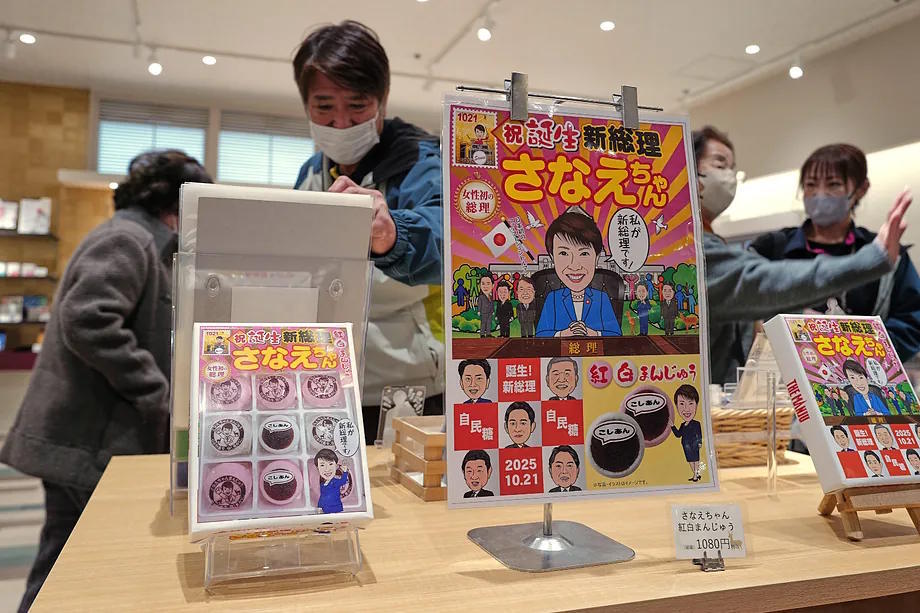
On social media, they call it sanakatsu -something like "sanaemania"- and manifests in seemingly trivial details: the pink pens with which she signs official documents, turned into a viral object; videos of her playing the drums circulating as memes; even small pilgrimages to her hometown, Nara, to try her favorite dishes.
None of this fits the traditional image of a Japanese prime minister. In a country where leaders used to strive to go unnoticed, Takaichi has achieved the opposite: bringing public attention back to a policy that for years was perceived as dull, hierarchical, and predictable. In that ability to generate enthusiasm also lies part of the explanation for her resounding electoral victory on Sunday, which allowed the coalition led by the Liberal Democratic Party (LDP) to regain the parliamentary majority.
Surveys reveal a fact that has puzzled analysts: in a country where youth participation has historically been low, support for Takaichi among those under 30 years old reaches unusual levels, around 90%. In January, during the coming-of-age ceremonies celebrated by millions of young Japanese, hundreds of photos of attendees dressed as the prime minister circulated on social media, imitating her hairstyle, clothing, and even way of speaking.
"My parents have been saying for years that nothing changes in Japan, that everything is slow and bureaucratic. When I hear Takaichi's speeches, I get the impression that at least someone was talking about making quick decisions and betting on technology and industry," says Haruto, a 22-year-old engineering student, outside a polling station in the Tokyo neighborhood of Roppongi.
"It's the first time I vote, and I was clear that I would vote for her. Takaichi appears a lot on social media and talks about real issues that affect people, far from that club of older and wealthy men who have always governed this country," says Kento, a 27-year-old programmer.
Part of the prime minister's magnetism, some analysts argue, comes from a biography that fits well with the meritocratic narrative that seduces in a country accustomed to leaders from political dynasties. Takaichi grew up in Nara, far from the power centers of Tokyo, in an ancient capital surrounded by mountains where deer roam among temples and parks. Her father worked in an auto parts factory, and her mother was an administrative assistant in the Police.
In her youth, she rode a Kawasaki motorcycle and played the drums in a heavy metal band inspired by Iron Maiden. Before entering politics, she spent nine months in Washington as a collaborator on Patricia Schroeder's team, a Democratic congresswoman who even considered her candidacy for the U.S. presidency.
She defines herself as a workaholic and cites Margaret Thatcher as her great influence. After taking office last fall, she promised to "work, work, work, work, and work," a phrase that ended up being chosen as the expression of the year in Japan.
However, her political positions are far from the prevailing feminism in other democracies. Takaichi opposes same-sex marriage, defends traditional family models, and has been criticized for downplaying the need for structural reforms in terms of equality.
When she stated that she could sleep only two or four hours a night while taking care of her sick husband, some activists accused her of reinforcing stereotypes of female sacrifice. For certain political analysts, she embodies a paradox: a woman who has reached the pinnacle of power in a male-dominated system and, at the same time, supports deeply sexist structures.
Her personal life has also attracted public attention. She has been married twice to the same man, former legislator Taku Yamamoto, and has three stepchildren. She herself has mentioned that when stress hits, she sits at home to play the electric drums.
Politically, Takaichi embraces a markedly nationalist vision of Japan's future, even more pronounced than that of her mentor, former Prime Minister Shinzo Abe, assassinated in 2022. Her message revolves around the country's resurgence as a power, with increased defense spending and an economic policy that combines tax cuts with a strong push for public spending.
"I think many young people are attracted to her not apologizing for talking about national pride. Perhaps older generations are uncomfortable with that, but for us, it's a way of saying that Japan can still have ambition," says Ren, a 25-year-old journalist. "Takaichi talks about regaining pride and having a clearer vision of Japan's role in the world. That idea resonates with a generation that has grown up hearing that everything was better before," adds Daichi, a 36-year-old nurse.
Not everyone shares that enthusiasm. "I understand the attraction to Takaichi because she is a different profile in Japanese politics, which has always been very boring. But the reality is that many of her proposals sound more like radical slogans than practical solutions," criticizes Kenta, a sociology professor.
"Japanese politics has always been conservative, and I feel that Takaichi represents a step back on many issues. Furthermore, she gives the impression that economic problems will be solved by closing the door to immigration, when what we need are more workers due to the aging population," says Daigo, a 72-year-old retiree.
During the campaign, Takaichi's team remained silent about the leader's ties to the controversial Unification Church, a religious group known for its mass weddings and the strong donations it demands from its followers. Various Japanese media have pointed out that the prime minister participated in events organized by organizations linked to this movement, which returned to the center of public debate after the murder of Abe, whose perpetrator claimed to have acted out of resentment towards the Church.
Between the sold-out bag in Ginza and the viral videos of a prime minister playing the drums, Takaichi's figure moves in a new territory for Japanese politics, halfway between ultraconservative leadership and cultural phenomenon. Her rise reveals the weariness of a society that has long felt that the country was moving slowly.