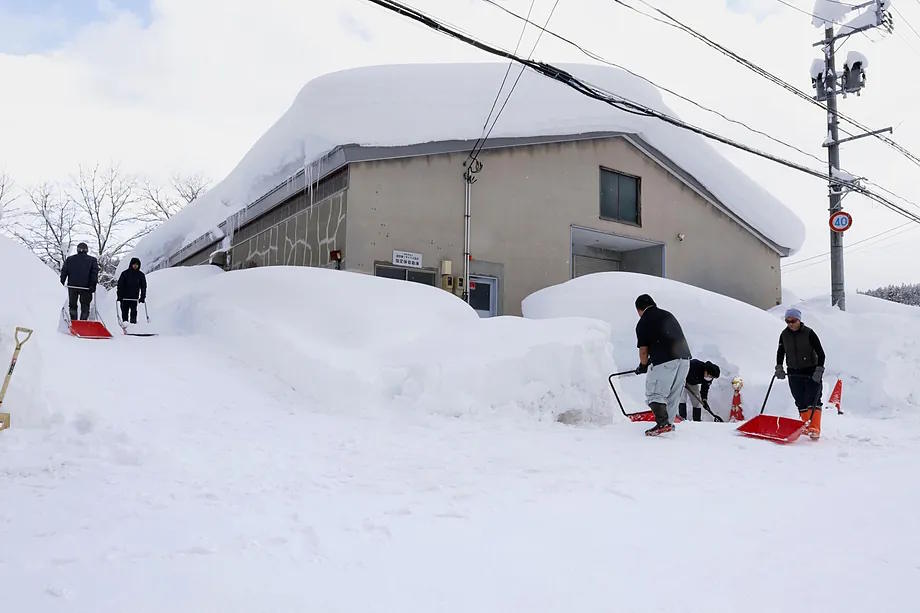
The provisional toll, released by the Fire and Disaster Management Agency, reflects a common pattern in Japanese winters, but aggravated this time by the magnitude of the snowfall. Most victims died falling from roofs while removing snow or in accidents around their homes.
In many rural areas in the north, with an aging population and houses with sloping roofs, clearing snow is not just a domestic task: it is a necessity to prevent roofs from collapsing.
The snowfall has hit the regions facing the Sea of Japan particularly hard. There, cold air masses from the Arctic pick up moisture while crossing the sea and bring persistent precipitation. In some areas, snow depth has exceeded two meters, blocking roads and forcing the cancellation of railway services, including sections of the shinkansen, the country's symbol of punctuality.
The impact now extends to 15 of the 47 prefectures. In Aomori, over 1,700 homes were left without electricity during the worst moments of the storm. Emergency teams faced difficulties accessing isolated areas. Governor Soichiro Miyashita acknowledged that in some cases, rescuers had to advance on foot, carrying stretchers over the snow to reach people trapped in their homes.
Niigata, accustomed to severe winters, has recorded at least a dozen snow-related deaths in just two weeks. Among them, a man found collapsed on the roof of his home and a septuagenarian who died after falling while removing ice, according to authorities.
The storm has also affected tourism, especially ski resorts frequented by foreign visitors. In Niseko, on the island of Hokkaido, a 27-year-old Australian worker died after collapsing while skiing. Days earlier, in Nagano, a 22-year-old Australian woman died in a ski lift accident when her backpack got caught, leaving her suspended in the air.
The government has warned that the expected rise in temperatures in the coming days could trigger avalanches and snow slides from accumulated snow on roofs. Government spokesperson Minoru Kihara urged the population to take extreme precautions and use helmets and safety ropes when removing snow.
Last winter, 68 people died from snow-related causes in Japan. Meteorologists point out that extreme episodes are becoming more frequent and concentrated, a phenomenon that some experts link to the increasing atmospheric instability associated with climate change. Japan, accustomed to typhoons, earthquakes, and torrential rains, is also facing more unpredictable winters.
The storm has also disrupted the political calendar. In several northern regions, there have been criticisms for scheduling early elections in the middle of winter, at times when cold and snow make it difficult for voters to travel.
In rural areas, where many polling stations are several kilometers away and access depends on cars or walking, ice and snow accumulation pose a real obstacle. Some mayors have requested extended hours or strengthened transportation to ensure that voters, especially the elderly, can safely reach the polls.