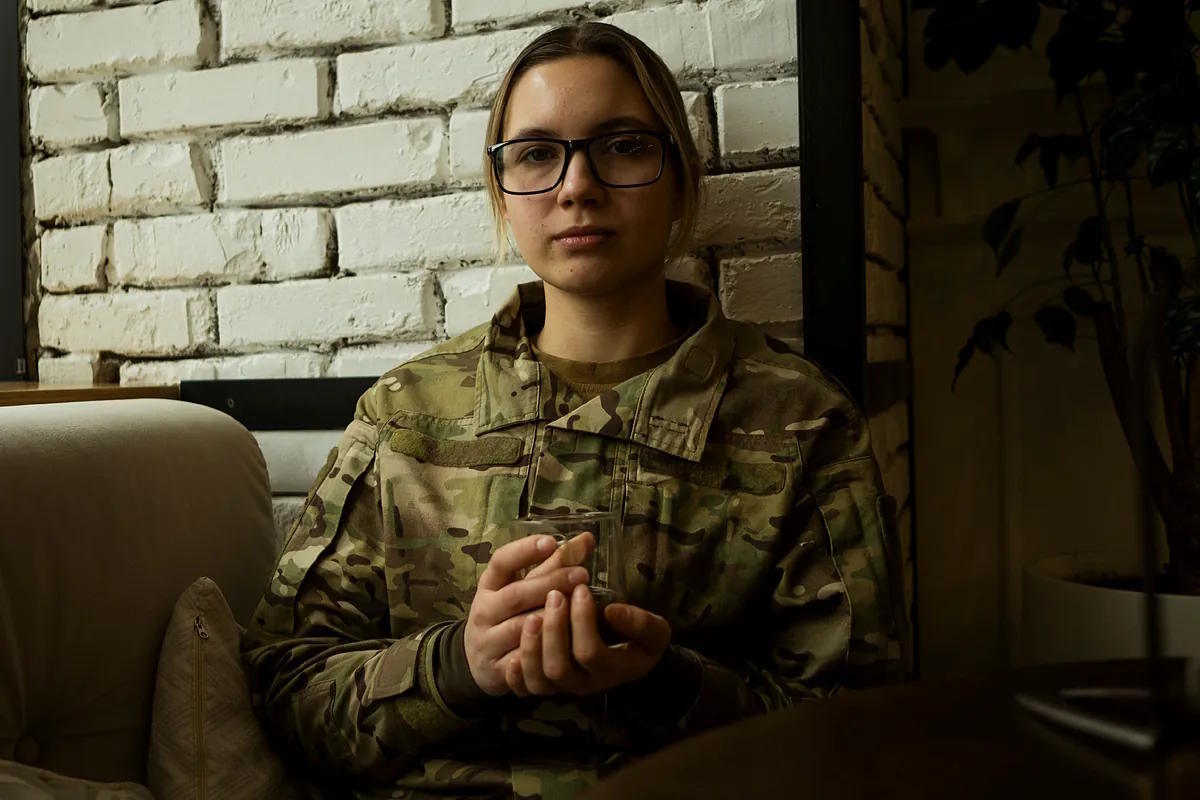
Customers entering this café in Kiev's most exclusive neighborhood, fueled by the hum of the generator, gaze at the blonde girl in uniform who has just arrived from the front and has sat at the back. Her military attire contrasts with the fur coats, leather boots, and astrakhan hats that the ladies wear under the snow.
When you read this text, Viktoriia Honcharuk, the girl in uniform, will be in Munich, where she will be one of the visible faces of the Ukrainian military effort before European politicians at the Security Conference. Holding a black tea in her hands, she anticipates her message to them: "If you are not willing to fight seriously, the best you can do is learn to speak Russian".
Viktoriia, born in a small village in Ukraine, is 25 years old and has been saving lives on the front line since the first year of the invasion. When the Z troops entered the country's borders, she was starting a promising career on Wall Street at just 22 years old. Living in Midtown Manhattan and having just signed with the investment bank Morgan Stanley, where her salary was growing thanks to the endless hours she dedicated each day to building a future in the world of finance. On February 24, 2022, she was in California when her phone started receiving hundreds of messages. At first, she struggled to understand them. She was in shock. The war had begun.
"My reaction was physical. I had to leave there and return to my country. That's what I told my colleagues and that's what I did. I came to help, but I didn't know how. When your country is fighting to survive, comfort or fear are no longer valid excuses. I joined the Armed Forces and the first thing I did was take a tactical medicine course, something I was unaware of. In December 2022, I was serving on the front line," says Viktoriia, who still wears the same glasses she appears in in old photos in a suit at the entrance to the powerful American bank's offices.
In a few weeks, she vaccinated herself against the pain and shock of seeing blood gushing, human flesh minced like fruit pulp, lacerating burns. This is the life she chose instead of her finance career. "I have not regretted it even once", she confirms. Her sister, who belongs to an assault unit, has it even worse, but both already have a good dose of extreme experiences: "At the beginning of the invasion, we formed a company of six people, two girls and four boys. They died one by one, and now only my sister and I are left. I had to retrieve the lifeless body of one of them some time after he died, when we could access his corpse. It was a horrible experience."
Honcharuk's story is that of many young Ukrainians who have been dragged into defending their country and identity from the aggression of Vladimir Putin's regime, facing forced disappearance. "If I die tomorrow, I don't have much to regret. I lived a good life. I contributed to the community. If I stayed in New York, how would I look my future children in the eyes?".
In her new world, she learned to evacuate wounded soldiers with an improvised ambulance 800 meters from the combat line, while the military joked about their future prosthetics and she tried to prevent them from bleeding out. "At first, I was not aware of the impact of this work. You would stabilize someone, evacuate them quickly, and then you would no longer hear from them. Now I work in the Third Assault Brigade, whose wounded are your comrades. Months after helping them in a critical moment, you see them again and understand that they are alive because your hands gave them decisive help in the most difficult moment," she says. And she concludes with an example: "Recently, a man stopped me in a supermarket. He was very happy to see me, but I didn't remember him at all. He said: 'You saved my life in Avdivka. I will never forget your face.' Then I remembered him. From his expression of sincere gratitude, I understood how important what we do here is."
She has already suffered three concussions from nearby explosions, but she has never taken leave due to exhaustion. For her, the decisive moment came when drones took over the skies and complicated her work. From 800 meters away from the front, they moved more than 12 kilometers away, which lengthened evacuation times and harmed soldiers' life expectancy, while complicating her work. "The risks have become lethal, almost unbearable", she says. She had a Venezuelan boyfriend, so she understands every question asked in Spanish:
- If this never-ending war ends one day, would you like to return to your position at Morgan Stanley? Do you think it would be possible to resume your previous life in finance?
- Last year, I had the opportunity to visit the United States for a diplomatic mission and passed by the office. My boss pointed to my old desk and said, "Look, that position is still empty and waiting for you".