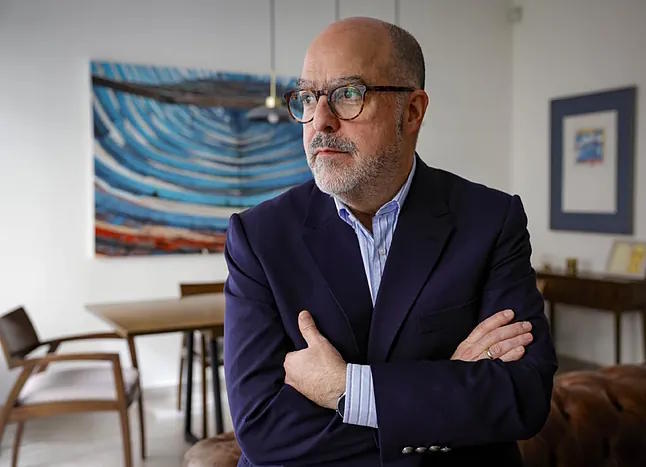
In the title La crisis espiritual de la democracia. Polarización, totalitarismo y relativismo (The Spiritual Crisis of Democracy. Polarization, Totalitarianism, and Relativism - edited by Sekotia), two words stand out: "spiritual" and "relativism," which are good clues to understand the book: "This is volume one," explains Julio Borges Junyent, lawyer, philosopher, former president of the National Assembly of Venezuela in 2017 (during Juan Guaidó's victory and the parliamentary challenge to the government of Nicolás Maduro) and coordinator of the book. "In April, volume two will be released, and in the end, we will have 30 thinkers from 13 countries with different perspectives, both diagnostic and curative. There is much talk about the crisis of democracy, but we often remain at a description of problems and judicial or management reforms. We have gone a step further, trying to find the spiritual crisis of democracy."
A step beyond that can be summarized in this phrase: "If democracy does not have very clear moral contents, if it becomes a mechanics of majorities and minorities, it ceases to be a governing democracy and becomes a democracy governed by the law of the strongest: the market, technology, totalitarianism."
"My father was born in 1930; my mother was born in 1936," explains Borges Junyent. "My grandparents left Spain due to the Civil War towards Venezuela. It was a generation marked by conflict and violence. They experienced the Venezuelan process towards democracy and its crisis, the crisis that has brought the next generation back to Spain. That round trip is quite illustrative of the search for democracy and its crisis. I like to remember that the word crisis, in its Greek origin, means judgment. It is normal for democracy to be in crisis because it must be subject to a permanent debate, to agitation. But what we are experiencing now is different. It is not about that permanent struggle that democracy demands, but we face a greater problem: the possibility that democracy may extinguish."
"If you look at the latest democracy indexes from Freedom House or The Economist magazine, you will see that the retreat of democracy has been palpable. Only 6% of the world lives in democracy, the rest lives in totalitarian regimes and what is called hybrid regimes, with a mix of flawed democracy and totalitarianism. In the time of our parents, during the Cold War, democracy was seen as a goal, a promised land. Democracy was the meeting place where we could build together. After the fall of the Wall, the big problem of democracy is that instead of being a meeting place, it has become a battlefield of identities, groups, and interests because there is no longer a shared system of values. That is why democracy has become polarization, attack, friend-enemy."
"200 years ago," Junyent continues, "Tocqueville, at 25, wrote Democracy in America, and tried to imagine what dictatorships would be like in the future. He left an idea that portrays the current crisis: the dictatorships of the future would turn citizens into characters solely focused on their personal well-being, on their little piece of land, isolated and obsessed with their equality and comfort. The State will provide them with pleasure, equality, and comfort; it will protect and sterilize creativity, freedom, community, social fabric of our communities. I feel that this is somewhat what happens to modern democracy. It has become a large nursery for citizen-children who want that, who want to be given their pleasures, regardless of the costs or what happens to others."
Joseph Ratzinger is cited 51 times in La crisis espiritual de la democracia (The Spiritual Crisis of Democracy). He is probably the most mentioned author in the text, which is in an almost constant dialogue between Christian thought and the discomfort of democracy. Christianity is not the bone, but the nerve of the book. "Democracy was born in Greece, as everyone learns in school, but complex and modern democracy is a product of Christian culture. The sense of equality, the sense of human dignity, which is the pinnacle of human rights... All of that comes from Christian thought. I do not mean to say that democracy cannot thrive in non-Christian societies, but it is important to recognize that the values that Christianity spread and promoted are the values that made democracy possible."
Are we talking about the unexpected imbalances of the multicultural world? "Christianity made the strongest separation between political power and religious power, although we may not realize it. Jesus' phrase, 'render unto Caesar what is Caesar's and unto God what is God's' is unique," Junyent continues. "Now, in the world, we have to live with the perspective of Islamism that puts democracy in question. Many times, migration does not understand that foundational value of the West. Democracy also suffers because of that."
"We are in a moment of every man for himself and the law of the strongest in international relations, many countries act as neo-imperial powers: Russia, China, the United States... The first victim will be democracy if we do not manage to rescue those values that made human rights and human dignity possible in the West."
Why do illiberal systems succeed, if, at first glance, they are mediocre and dysfunctional? "That is the key question. When the Constitutional Congress of the United States was debating which system to adopt in its independence, some ladies approached Benjamin Franklin and asked him, 'What are we going to be? A monarchy, a republic?'. And Franklin replied, 'We will be a democracy if you are able to sustain it.' Sometimes, illiberal regimes have it easy, believe it or not, because fear, brute force, and the need for security above freedom make them possible. In contrast, democracy, if citizens do not feel it as their own, commits suicide. I can speak for the Venezuelan case and the Spanish case. I see worrying symptoms here, and I can say it because I lived it in my country. Venezuela was a democracy and committed suicide. It was not that a dictatorship took over Venezuela, but that society, due to the blindness of the elites, the mistakes of political leaders, individualism, and the comfort of citizens, committed suicide as a democracy and surrendered to Chávez."
Last question: How does Borges Junyent view the hypotheses of the alleged hijacking of democracy by financial and technological elites? "It is the absence of common values that leads us to the law of the strongest. A few people and a very few states believe they can be above others. The hijacking of democracy is not a conspiracy theory, it is a reality that we are unable to confront. Power has concentrated at the market level, at the technology level, and at the political level to a proportion where there are no counterweights demanding values, laws, or visions." In other words, the hijacking is a consequence, not a cause. "Exactly."