In the Fuchu prison, the largest in Japan, one in five inmates is over 65 years old. Many of them, as soon as they step outside, return to crime because freedom means going back to a world where no one is waiting for them.
"They return to empty homes, to entire days without talking to anyone, not knowing if their pensions will be enough to eat or pay for medications," says Tachi, a volunteer from an NGO that helps reintegrate the elderly for whom loneliness weighs more than the bars.
This same loneliness also extends among the growing elderly population in neighboring South Korea. There, as in Japan, specialized companies have begun to multiply in a task as necessary as it is heartbreaking: cleaning the apartments of elderly people who died alone and whose bodies remained for days, sometimes weeks, without anyone noticing their absence. "It's the silent trace of an increasingly long and lonely old age," says Park Ji-hoon, a sociologist at the National University of Seoul.
In China, the aging population has become so evident that there are increasingly more manufacturers of baby diapers now making diapers for the elderly, responding to a growing demand.
The same trend - with diapers - is observed among manufacturers in South Korea and Japan. In the latter country, the phenomenon is even seeping into areas where, in theory, youth had always been the ideal. Local media have reported that in the Japanese pornographic industry, more and more older actors and actresses are appearing.
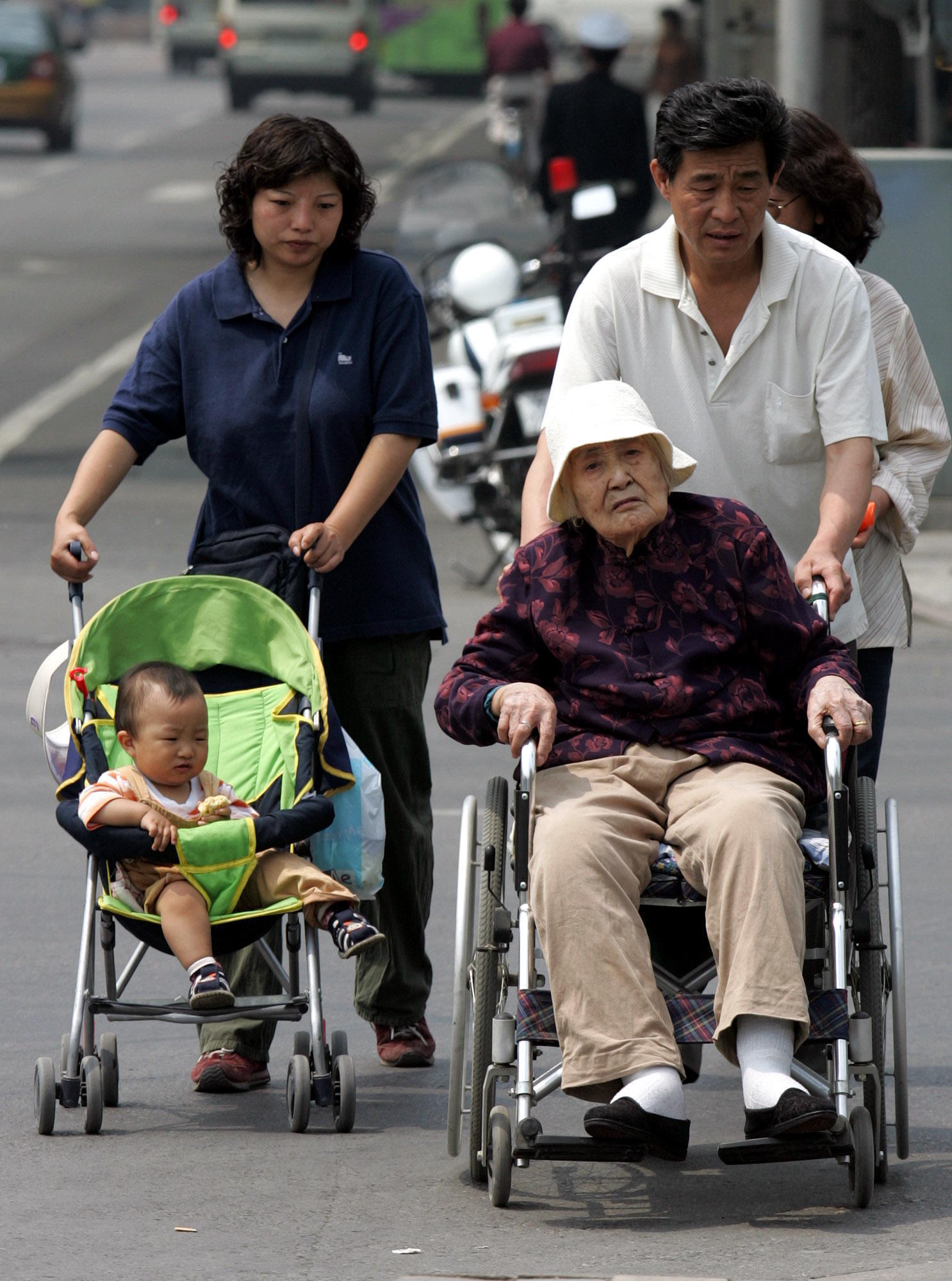
The engines of growth in Northeast Asia are simultaneously facing a huge demographic crisis that threatens to redefine their global weight. Japan, the most advanced in the process, has around 36 million people aged 65 or older, approximately 30% of the total population. South Korea's birth rate is one of the lowest in the world, and in China, where they suffer the accumulated consequences of decades of radical demographic control, the total number of births last year was the lowest since 1949.
A few days ago, in the Chinese province of Hubei, a youth organization linked to the ruling Communist Party held a massive dating event where more than a hundred singles were invited. In other regions, local authorities have even turned to technology, promoting dating apps in the style of Tinder. Faced with the current demographic shock, the idea is gaining ground in the Asian giant that the solution lies in promoting the formation of couples and, through official campaigns, encouraging young people to have children as soon as possible.
According to the latest data released by Beijing, the number of births plummeted by over 17% between 2024 and 2025, and last year there were more than four deaths for every three births. Among the most recent and striking measures to stimulate childbirth is the elimination of the exemption from value-added tax for contraceptives, which has been in place since the introduction of VAT in 1993. "We are facing an unprecedented demographic shock," warns Li Wei, a researcher at the Population Studies Center of the University of Beijing. "It is not just an economic problem: it is a profound social change."
In Seoul, the phenomenon most pointed out by local observers is seen in everyday scenes: cafes and restaurants where it is increasingly common to see older men and women eating or drinking alone. In the suburbs, elderly people surviving on minimal pensions seek companionship in karaoke rooms, paying to sing alongside strangers. Loneliness has become so common that it has even generated new words: honbap (eating alone) and honsul (drinking alone).
Last year, the municipal government of the South Korean capital presented a comprehensive plan to address social isolation among older citizens, which includes, among other measures, a 24-hour call center.
The rapid aging of these three Asian countries is driving the so-called golden economy, a market oriented almost exclusively to the elderly population. In Tokyo, businesses are increasingly adapting to the needs and preferences of this group: care companies, medical insurance, and even the leisure sector have found in the elderly a consumer willing to invest in their quality of life. In South Korea, senior gym chains and assisted technology devices are growing at double-digit rates. In China, humanoid robots equipped with artificial intelligence and designed for care are starting to appear more frequently in residences.
Europe also faces major demographic challenges, but experts say that aging is more gradual than in the mentioned Asian countries. In Spain, for example, the proportion of older people is around 21%, significantly lower than in Japan, and the fertility rate is around 1.2 children per woman, higher than South Korea (0.75).
Many European countries have more solid welfare systems, higher pensions, and more well-oiled social services in caring for the elderly than the Asian powers, as well as much more open migration policies.
We return to Japan, to its prisons, but this time to the women's prison in Tochigi, north of Tokyo. There, as in the rest of the country's prison system, the population of inmates over 65 has quadrupled in the last two decades. In Tochigi, the younger inmates earn points by helping the older ones bathe, eat, walk, or take their medications, in a routine that increasingly resembles that of a nursing home behind the walls of a prison.