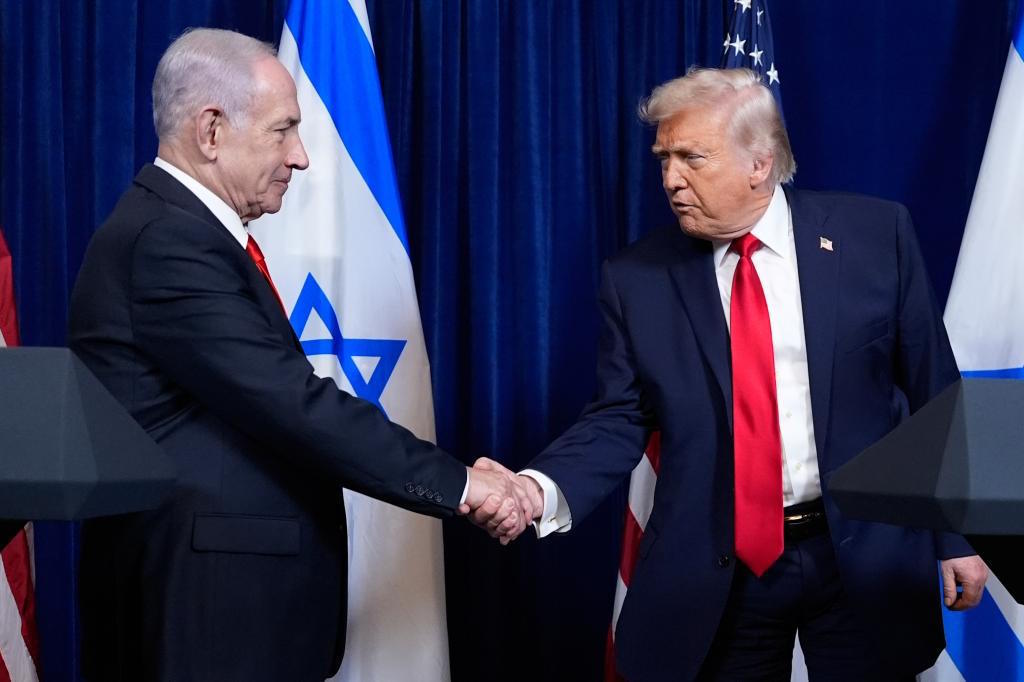
Donald Trump aims to achieve an agreement with Iran. He is not very clear if it will be possible, or on what exactly, but he does want to score a point. The alternative, in any case, is very clear: a new bombing. And he does not tire of warning while his warships approach the region. This Wednesday, the U.S. leader met with his first ally, Benjamin Netanyahu, the most skeptical person on the planet about an agreement with Tehran. The one who has done the most to sabotage any relationship in the last decade and the one with the most at stake. The summary offered by the Republican, as well as the fact that it was behind closed doors, shows the differences in approach and tension.
"I just met with the Israeli Prime Minister, Netanyahu, and several of his representatives. It was a very positive meeting; the excellent relationship between our two countries continues. No definitive agreement was reached, except that I insisted that negotiations with Iran will continue to see if an agreement can be reached," Trump wrote on his social media after the talk. "If possible, I told the Prime Minister that is my preference. If not, we will simply have to see what the outcome is. Last time, Iran decided it was better not to reach an agreement and received a blow from the Midnight Hammer. Let's hope they are more reasonable and responsible this time. Additionally, we discussed the enormous progress being made in Gaza and in the region in general. There is truly PEACE in the Middle East," reads the president's message.
The meeting was behind closed doors, something increasingly common. In his early months, Trump appeared several times a day in front of the cameras and opened up to journalists almost every visit, official or unofficial. Lately, however, less and less. He chose a reserved formula for the Syrian president before Christmas, only with photos. And he repeated it for María Corina Machado and Gustavo Petro in recent weeks. And now even for Netanyahu, undoubtedly the figure with whom he has the most complicity, but who this time came to complain, to pressure, to say things that Trump does not want to hear while trying to negotiate with one of his traditional enemies.
Today's meeting was the fifth visit of the Israeli Prime Minister to the White House since the U.S. president began his second term. But they have also met at his Mar-a-Lago residence, in Israel, and have spoken on the phone countless times. No international leader has even set foot in the Oval Office more than once in these thirteen months, which shows the level of relationship between both countries and leaders. The past meetings, however, have been marked by highs and lows due to what was happening in Gaza or after the attack ordered by Tel Aviv in Doha, which angered Washington greatly, to the point of forcing a humiliating apology call with Trump physically holding the phone.
The context of this visit is entirely Iranian. Inevitably, issues such as the situation in Gaza, where 586 Palestinians have died since the ceasefire came into effect, according to Palestinian authorities; the Peace Board created and led by Trump, which will meet for the first time next week; and the situation in Syria were part of the agenda, but Netanyahu's priority is Iran, in a very delicate framework with the United States deploying its navy and considering the possibility of attacks to try to force a regime change. The discussions between the Trump administration and Tehran can evolve in any direction: break down and lead to bombings or progress and become the basis of a new nuclear agreement, probably in terms not very different from those signed during Barack Obama's presidency and that Trump disrupted in his first term. Something that Israel considers a mistake and a threat, to the point of having reserved in the past the option of unilateral attacks to stop any Iranian program, even if it was for civilian use. That is why his prime minister advanced this visit, which was initially scheduled for the end of the month.
"The Prime Minister believes that any negotiation should include limitations on ballistic missiles and the cessation of support for the Iranian axis," Netanyahu's office stated in a press release on Saturday. "I will present to the president our perspective on the principles of these negotiations; the essential principles, which, in my opinion, are important not only for Israel but for all those who desire peace and security in the Middle East," Netanyahu said on Tuesday before heading to the airport.
Today's meeting was preceded, exactly like the previous time, by a bilateral with Marco Rubio, the Secretary of State, in which the Israeli took the opportunity to formalize with a signature the country's entry into the Peace Board. "I met with the Secretary of State of the United States. Before my meeting at the White House with President Trump, I signed Israel's accession as a member of the 'Peace Board'. We will continue to strengthen the unbreakable alliance between Israel and the United States," Netayahu wrote on his social media.
Hours earlier, he had dinner, also at the Blair House, the official residence for visitors, with Trump's special envoy, Steve Witkoff, and the president's son-in-law and advisor, Jared Kushner, who are his mediators for both the Middle East and Russia. Both had "indirect conversations" with Iranian negotiators in Oman, a regular mediator, last week, apparently without significant progress. The language is especially important for Tehran, which has insisted since last year that it is something not direct. Ali Larijani, Secretary of Iran's Supreme National Security Council, told Al Jazeera that they have not yet "received a concrete proposal from Washington" and that what happened in Oman was only "an exchange of messages."
The United States wants the country to stop enriching uranium, to halt the construction of ballistic missiles, and to cut ties with Hezbollah and other satellite groups that the ayatollahs have financed, directed, or used for decades to operate in the region. Trump has ordered the aircraft carrier USS Abraham Lincoln and other U.S. warships to the area, something he did in the Caribbean before the operation that led to the capture of Nicolás Maduro, while urging Iranian protesters to take to the streets and not give up, saying, "Help is on the way." Israel's Channel 12 and Axios reported on Tuesday that Trump is considering sending a second aircraft carrier to the Middle East, a very clear sign of what will happen if negotiations do not progress in the direction desired by the White House. "The Iranians really want to reach an agreement. Either we do it, or we have to do something very tough, like last time," the president told Channel 12.