If the homeland still means something, if patriotism has not been hollowed out to become an empty slogan, perhaps it is necessary to look for it in the voice of Daviel Gaínza. A former Cuban prisoner, sentenced to 20 years in prison for a minor terrorism attempt, has decided to tell his story to seek help for others, those who survive in some of the most inhumane prisons on the planet, and for a country pushed into misery for over 60 years by a regime that feeds on its own devastation.
In 2025 alone, there were 3179 repressive actions in Cuba, according to the Cuban Observatory of Human Rights, and over 800 political prisoners were still in their prisons. Among them is Leudis Arce, detained for the same reason as Daviel, who answers the questions of this supplement by phone from the Combinado del Este prison - where he is serving a life sentence - despite the dictatorship's surveillance. "There is no description that fits the reality of a Cuban prison. All the imagination one may have does not come close to representing the magnitude of everything we experience here," says Leudis.
Leudis and Daviel are united by the same desperate idea. On April 10, 2003, six Cubans and the two of them had a plan: to hijack a commercial plane covering the route between Nueva Gerona (Isla de la Juventud) and Havana, and divert it to the United States. "I knew it was crazy, but the circumstances, one way or another, made me have to leave," he says, "in Cuba, you were valued for what you had, not for who you were. I was 25 years old then and saw no future."
That same April dawn, the regime executed, after a summary trial, three Cubans who had tried to steal a passenger boat to flee to the U.S. "That was our first option," explains Daviel. Nevertheless, they proceeded.
They were not the first to try. Just ten days earlier, on March 31, Adermis Wilson had hijacked, with fake grenades in hand, a Russian Antonov-24 with 46 passengers on board on the same route. Once on Florida soil, Adermis and 15 passengers requested political asylum. All were granted asylum except the hijacker, for whom a U.S. federal court sentenced to 20 years in prison for air piracy and is now free. Others had already managed to cross. Why should they be any different?
The plan involved intimidating the pilot. "We have never been terrorists at heart, we committed treason out of desperation and the need caused by the Cuban-Communist dictatorship. We did everything for migratory purposes," Leudis explains. Five of them managed to obtain various knives and an AK-M rifle. Daviel and two other companions - Fidel and Bodanis - were waiting for them at the airport. "We didn't have transportation to move on our own, so we looked for a company driver. When my companions already had the weapons, they argued among themselves because they weren't sure what we were going to do, the driver overheard the conversations," he recounts, "we didn't know he was the son of a State Security military."
Leudis was in the group responsible for obtaining the weapons. As the car entered the airport, the deployment of the Black Wasps of the Revolutionary Armed Forces of Cuba (FAR), an elite special force that recently gave their lives to protect Venezuelan dictator Nicolás Maduro, began to become visible. "They knew what they were looking for because they knew the vehicle's license plate," Daviel explains about the scene he observed from the airport entrance, "the tip-off had to come, we believe, from the driver, because I didn't even know the license plate."
It took a day to arrest the other three. Daviel recalls that there was no violence at the time of the arrest. "On the way to prison, yes," he explains, "for some, like me, blood was running down their hands from the handcuffs. I went months without feeling in them." Insults, he remembers, accompanied the way. "One of my companions was crying from the pain, and the military would say things like 'cry, bitch' or 'look how he cries, he looks like a bitch'."
The eight detainees already knew the sentences that would be imposed on them before the trial held on May 13. Two days earlier, they had an unprecedented confrontation with American filmmaker Oliver Stone - known for his filmography openly favorable to leaders at odds with the United States - in the presence of Fidel Castro and then-Foreign Affairs Minister Felipe Pérez Roque. There, without due process -"the lawyer is a decorative figure," Daviel explains- Castro sealed the fate of those "adventurers," as he defined them to Stone, and de facto dictated the sentences that would be formalized in court. "Our sentences were an attempt at exemplarity and to intimidate society," says Leudis.
For five of them -Leudis Arce Romero, Josi Ángel Díaz Ortíz, Francisco Reyes Rodríguez, Lázaro Ávila Sierra, and Jorge Luis Pérez Puente- life imprisonment for terrorism. Daviel, Fidel, and Bodanis received sentences of 20, 25, and 30 years of deprivation of liberty.
"If on the streets the conditions of misery and hunger are enormous, inside the prisons they triple," explains Daviel. The prisoners were deliberately distributed among prisons throughout the country -Pinar del Río, Combinado del Este, Agüica, Quivicán- a dispersion intended to also punish families. There, Cuban inmates coexist crowded in, as Leudis describes, "tiled cells three meters wide by four meters high" with only one hour of daylight. The conditions are so extreme that many, among other things, no longer have teeth due to nutritional deficiencies. "Medical care does not exist. The doctor comes once a month, but there are no medicines... In any case, your family has to send them to you, just like many times the soap," he recounts.
Violence was - and continues to be - part of the prison machinery. "They tie you to a post, and so your family doesn't see how you end up, they prohibit visits claiming you are in isolation," Daviel recounts. "The greatest torture is psychological: being imprisoned and knowing that your sentence is unjust," adds Leudis.
In prisons designated for foreigners, there are certain "benefits," such as a prison store. For Cubans, however, degradation is absolute. "Where we ate, there were leaks of fecal water, I would say that you could even see stalactites, and our mattresses were made of sea sponge." "Being there," says Daviel, "was the greatest misery in the world."
When Daviel had stopped imagining the future and found it, as he admits, indifferent to continue in prison or end up facing the firing squad, he received a call. "Mr. Daviel?" said a voice on the other end of the phone. The treatment caught him off guard. "I was surprised that they addressed me like that. The mildest is to be called an inmate," he says. His interlocutor introduced himself: it was Cardinal Jaime Ortega, Archbishop of Havana and a key figure in defending basic rights of the Cuban people. "He told me who he was, that they were releasing me, and asked me to give the names of the relatives I wanted to come with me," he recalls. It was March 19, 2011.
The call came after a three-way meeting between the Spanish Minister of Foreign Affairs, Miguel Ángel Moratinos, Raúl Castro, and the cardinal himself. From that meeting emerged an agreement long demanded by the international community, leading to the release of over 140 political prisoners, most detained during the intense wave of repression of the Black Spring of 2003. Among the released were Daviel, Fidel, and Bodanis.
Daviel has been living in Spain for more than 15 years. He cannot return to Cuba, nor does he know if he ever will be able to. Díaz-Canel's repressive regime, in power since 2018, reserves the right to decide who can enter the country. When he left, through Ortega's mediation, he left behind a country he describes as "a prison." Although, since 2013, there is no longer a formal exit permit, the network of legal, administrative, and political controls that deny the issuance of passports on vague grounds such as "public interest" and "national security" still exists.
Since the arrival of the Castros—first Fidel, then his brother Raúl—and the current policy of continuity under Díaz-Canel, the country has become a place of deprivation. Contributing factors include an inefficient economic model, poorly managed external dependence (first on the USSR, then on Venezuela), the impact of the US embargo, and prolonged political isolation.
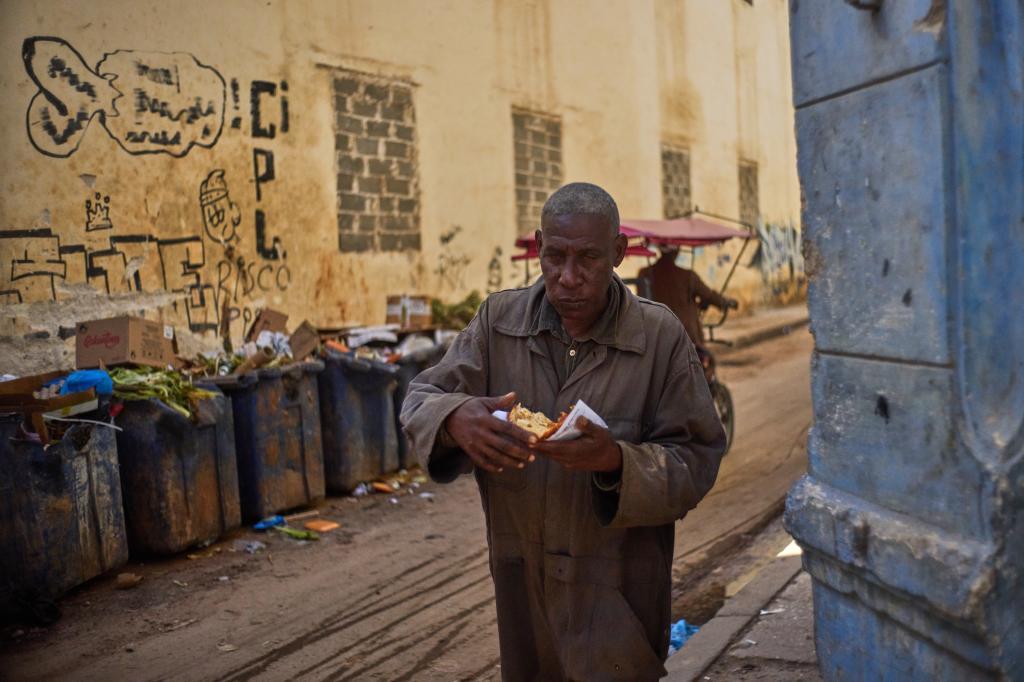
"Anything you can do to survive is a crime," explains Daviel. Currently, the average monthly salary ranges between 2,100 and 2,500 Cuban pesos (between 75 and 89 euros), while half a kilo of pork can cost around 1,000 pesos (35 euros) and chicken, when available, around 340 pesos (12 euros). "There is almost never any chicken meat," explains Daviel, "the beef you eat is stolen." Only in the face of one of the island's worst food crises, in 2021, did the government authorize the sale of surplus beef. Even so, the Cuban Penal Code classified the illegal slaughter and sale of cattle, as well as their purchase, as crimes punishable by three to 10 years in prison. "Humans are not made for that."
Survival and helplessness drive many to leave the island. For decades, this sustained pressure has led thousands of Cubans to take to the sea in makeshift rafts or risk everything with desperate plans in the hope of finding a different future. "No human being would want to emigrate from their homeland, but here in Cuba we are born and everything is forbidden to us," says Leudis. In 2023, the Pew Research Center estimated that 475,000 unauthorized immigrants from Cuba had arrived in the United States, 375% more than in 2021 (100,000).
"Such is the situation that many find it does not pay to study," says Daviel. "Salaries are so low that even doctors resort to prostitution." The crisis has led to thousands of stories in Cuban cities, especially in Havana. Prostitutes sell their bodies—mostly to foreigners—to earn between 100 and 250 pesos (US$3.59 and US$7.17). Many testimonies claim that, in a good week, they can earn between €258 and €430 (7,200 and 12,000 Cuban pesos), the equivalent of between three and five monthly salaries.
Daviel Gaínza speaks from the harsh reality of an incomplete freedom, made up of distance, guilt, and names that weigh heavily on him. He tells this story so that tomorrow no one can say that they didn't know that the others are still there. He does not talk about the past, but points to the present and the silence that surrounds it. He wants the international community to look right where the regime does not want it to look and for Leudis, Josi, Francisco, Lázaro, and Jorge not to be lost in the comfort of a statistic. On the other end of the line, from prison, Leudis sums up the essential: "We just need an opportunity."