It was in November 2022 when North Korea first showed the world a letter that had been kept hidden until then: Kim Jong-un's daughter. The scene seemed like it was taken from a propagandistic script written with irony. Father and daughter, hand in hand, walked in front of the cameras alongside the Hwasong-17 - the "monster," as the North Koreans themselves dubbed it - one of the most powerful intercontinental ballistic missiles in Pyongyang's arsenal. The message seemed transparent: the future of the regime and its capacity for destruction, all in the same image.
The girl's name was not revealed by the state press, but by an unlikely character: Dennis Rodman. The former NBA player, who boasts of his friendship with the North Korean leader, revealed after a visit to Pyongyang in 2013 that he had held in his arms a baby named Kim Ju-ae, the "marshal's" daughter. She is believed to have been born around that year, although in North Korea, even dates are part of the state secret.
Since that carefully choreographed appearance, images of Kim Jong-un with his daughter have multiplied: military parades, missile tests, visits to strategic units. They were not just family photos, but political signals.
This Thursday, South Korea's intelligence agency has stated that Kim is preparing Ju-ae to be his successor. The assessment, communicated behind closed doors to lawmakers in Seoul and later disseminated by the Yonhap agency, reinforces the thesis that almost all analysts have been handling for some time: the girl will be the heir to the dynasty that has ruled the North Korean regime for over seven decades.
North Korea operates as a single-party hereditary monarchy. Since 1948, power has passed from Kim Il-sung to his son Kim Jong-il and from him to Kim Jong-un, in transitions carefully orchestrated over years. State propaganda plays a decisive role: before each succession, the heir is gradually introduced into the official iconography, appears alongside the leader in military events, and begins to receive titles that place them in the hierarchy of the ruling Workers' Party.
That pattern seems to be repeating now. Ju-ae's image is carefully disseminated by the state press. In January, for example, she appeared during a test of a large-caliber multiple rocket system, prominently standing next to her father.
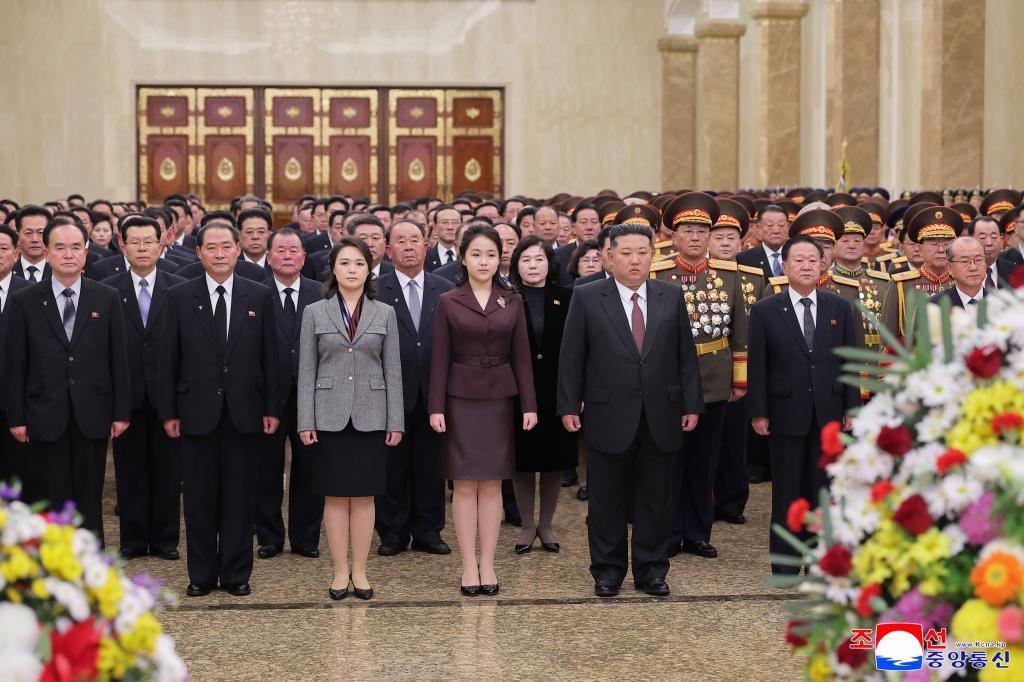
As explained in a press conference by South Korean lawmakers Park Seon-won and Lee Seong-gwon after receiving the report from the National Intelligence Service, Ju-ae's public presence has continued to increase. She has appeared in symbolic events of high political value, such as a visit to the Kumsusan Palace of the Sun, the mausoleum where the remains of Kim Il-sung and Kim Jong-il rest. In North Korean liturgy, that place is much more than a monument: it is the center of dynastic legitimacy, the sanctuary where the Kim family is presented as an almost sacred lineage.
"We believe they have entered the succession selection phase," Lee told reporters, using a cautious formula that, in the usual language of South Korean intelligence, usually means that there are consistent indications, although there is still no formal announcement. South Korean spies cited as signs of succession that the young Ju-ae was expressing "her views on certain state policies."
Previous successions in North Korea were announced indirectly. Kim Jong-il was gradually introduced in the 1970s, while his father was still alive, and assumed key positions in the party and the army before Kim Il-sung's death in 1994.
Kim Jong-un, on the other hand, was granted the rank of a four-star general and positions at the top of the party in 2010, just a year before Kim Jong-il's death. In both cases, propaganda began to build the heir's image long before the formal transition.
The potential rise of a woman as heir now also raises questions in a deeply patriarchal and militarized society. Although North Korean propaganda has shown influential female figures (such as Kim Yo-jong, the leader's sister and the second most powerful figure in the country), never before has a woman been prepared to take on the supreme position. Specialized media on the isolated Asian regime explain that if this succession is confirmed, the regime will have to construct an ideological narrative capable of justifying this break with tradition without weakening the cult of the Kim family.