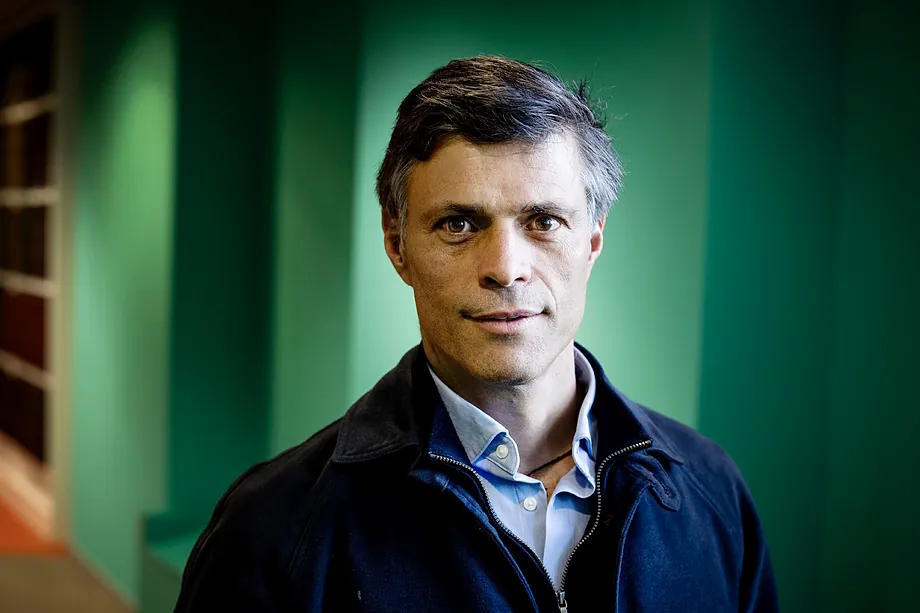
Only those who have passed through the dungeons of chavismo can understand what the closure of El Helicoide in this 'new' Venezuela, which is beginning to take shape with more uncertainty than certainty, means today. One of the most emblematic former political prisoners of the Venezuelan regime is Leopoldo López. The opposition leader spent four years in Ramo Verde, where he implemented a series of routines to resist. He is also a symbol of the fight against Hugo Chávez and Nicolás Maduro and is well acquainted with the intricacies of a system that exploded on January 3. Currently, he continues to work, without losing hope, for the freedom of his nation from exile, leading the World Liberty Congress, a project that brings together dissidents from around the world, and will soon travel to the US, where he will include Venezuela in his agenda. López, who visited the EL MUNDO Journalism Master's program yesterday, analyzes the Venezuelan situation on a key day, when youth returned to the streets while the controversial amnesty law was being discussed in the National Assembly.
Question. What does the closure of El Helicoide mean for a former political prisoner?
Answer. It is an aspiration that we, the prisoners, have had. When I was imprisoned in Ramo Verde, I always dreamed that one day that prison would become a university. El Helicoide will eventually become the Museum of Memory in a democracy. This is not what the interim dictatorship will do. There must be memory. I was in Chile many years ago, and the Museum of Memory in Chile is very impressive and much needed. While it is true that we must transition to democracy, to reconciliation, that should never mean forgetting, because forgetting puts us on the precipice of repetition. I believe that El Helicoide will be the center of what I hope will be a network of spaces for memory, to be done with the spirit of the Venezuela that is to come, one that does not allow forgetting but also does not anchor itself in vengeance, but in justice.
Q. Do you expect there to be more closures of other torture centers?
A. That will happen in the coming days with the interim dictatorship or it will happen when there is democracy. The mark left by political prisoners in this last stage of the dictatorship is very deep. There are many stories, much memory that needs to be vindicated, of people who even died in prison, friends of mine, people I knew, who were murdered. People who have already spent 24 years in prison, like the metropolitan police officers, with whom I was also imprisoned. I was imprisoned for four years, in solitary confinement most of the time, but occasionally I could go to mass, go to the courtyard, and there I got to know stories of people who have been imprisoned for years, who were never brought before a judge, who were kidnapped by the dictatorship, like many of the prisoners in Venezuela today.
Q. What does someone like you who defied chavismo think of the events of January 3? What did you feel that day?
A. I felt happiness, justice, a bit of freedom, joy, and also felt the weight of responsibility for everyone, that this very important step leads us to where we want to go, which is a free and democratic Venezuela. This is a necessary step. We have gone through all paths: elections, protests, negotiations, sanctions, pressure. I paid a high price for expressing my opinion, and I will never stop expressing it. I agreed with the pressure being exerted on the dictatorship, which led to the loss of my nationality, the raid on my house, the killing of my dogs, and the destruction of my home. And I don't say this just on a personal level, I say it as an example of what many of us have left behind in this fight for freedom: expropriations, imprisonment, exile, murder, victims of the insecurity promoted by the dictatorship... That is what we have had to endure during all these difficult years.
Q. Chavismo is releasing prisoners slowly: some end up under house arrest, like you did, others with very limited freedom conditions... Is this a double game to comply with the US but still maintain control?
A. They do not want to lose control of repression because what sustained Maduro was terror through repression, and it is hard to understand for someone living in a democracy. A country of millions that can be controlled by a handful of thousands is only achieved through terror and the threat of repression. That's why repression was a strategic tool for the dictatorship, and they implemented it strategically. You see that there were prisoners who were representative of all sectors: a businessman, a student, a politician, a Twitter user... Meaning that they allowed any citizen to have a reference who had been imprisoned at a degree of separation. This is how these states of terror are built, and that is being dismantled. Obviously, the interim dictatorship of Delcy Rodríguez does not want to let go of the tool of repression, and pressure must be applied. I am very pleased to see the courage of the families of political prisoners. At some point, it will be written about how the civic space in Venezuela began to open up through the families of political prisoners.
Q. Those mothers who stand guard at the prison gates...
A. Who are there holding vigils and have been so powerful that students, unions have joined them... but it is the tip of the arrow towards the opening of the civic space.
Q. Precisely, the amnesty law is currently being debated, can it be trusted?
A. We must trust in the process that the United States is leading today. The reality is that all this that is happening has occurred because of the decision made by the United States to remove Nicolás Maduro and bring him to justice. The law itself, I do not know the latest draft, and I believe no one does, will have many gaps, as does everything they are doing, it will have many areas of arbitrariness, and we will have to continue to press for the release of all prisoners, the return of all those in exile, and also an end to repression.
Q. One of the things mentioned about that amnesty law, which is not clear and we still do not know, is that the return of exiles with leadership like yourself or María Corina Machado will be limited. Do you fear that will happen?
A. We will have to continue pushing, but María Corina Machado must return to Venezuela. Edmundo González must return. All of us in exile must return and we must do so challenging the status quo that may not want all prisoners to be released or all exiles to return. We will have to keep pushing.
Q. They will not want people like you, who are capable of mobilizing the population, to return...
A. Well, but we will have to push. But I also tell you that the scenario has changed a lot. That is, we are no longer in a scenario where the dictatorship has control over everything that will happen. There is a push from the United States that weighs heavily on what is happening. What we have to build is that space that allows us to go to elections.
Q. Do you trust that there can be a roadmap to end up in elections?
A. There will be. There has to be. It is not sustainable. Some people say, "Venezuela will be an autocratic model with economic prosperity." That is not sustainable in Venezuela. Now I cannot tell you when the elections will be. I can tell you that I would hope they are as soon as possible.
P. I ask you that because just this week Jorge Rodríguez said in an interview: "There will be no elections in the immediate future."
R. Well, immediate could be tomorrow or immediate could be six months. What we need to do again is push, build, and propose. That, in my opinion, has to be the agenda. It has to be the opening and the democratic transition. I deeply believe that the vision we need to project is one of total democracy, where everyone can see themselves reflected.
P. Do you intend or are you going to seek to be part of that path towards democracy? Are you working on it in any way?
R. Of course. Talking to everyone, with our elected president, with María Corina, with other political organizations, with people from civil society, with those who think alike, with those who think differently...
P. Do you see the possibility of María Corina and Edmundo's leadership, which was legitimized by the people on June 28th, coming to power?
R. Without a doubt. The leadership that is now legitimized through the elections of Edmundo and María Corina.
P. Do you think Donald Trump really trusts Delcy Rodríguez?
R. They have stated it very clearly. I believe that Delcy Rodríguez is useful to the agenda that Trump is promoting. When she stops being useful, there will be consequences as the Americans themselves have stated. It is up to us [Venezuelans] to build the democratic agenda, that is, let's not ask others for what is our obligation.
P. What do you think about Zapatero being the only interlocutor for the Rodríguez?
R. I don't know if that's the case or not. I don't have information.
P. Among those released, one of the affected has been Freddy Superlano, who is from Voluntad Popular and is close to you. Have you been able to talk to him? How does he feel?
R. I talk to him every day, he feels strong and hopeful. For me, these days have been days of great personal joy [shows screenshots of conversations with former political prisoners].
P. Despite everything... Do you still have hope?
R. Because doing politics without hope... You are destined for failure or cynicism. I never want to be in the quadrant of cynicism.