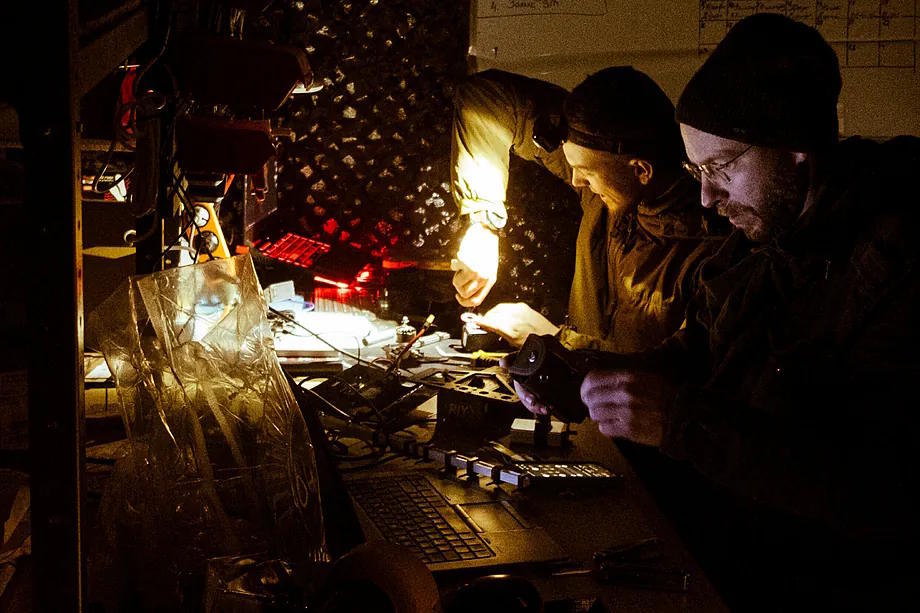
Several engineers, an architect, university professors... You have to drive on the icy roads of Kharkiv to find this place. From the outside, it looks like just another abandoned house due to the proximity of the front, like all the others. However, someone who sees us through a hidden camera answers our call and opens the door. We go down two flights of stairs to a deep basement where a generator can be heard. There is light at the end and the sound of conversations. The best minds of Ukraine work here.
We are in the heart of the special unit of unmanned systems Taifun (typhoon, in English) belonging to the National Guard of Ukraine. In this shelter lies one of the most secret places on the northern front of Ukraine, the laboratory of the future war, a group of individuals with high technical and military capabilities whose work is to push technology even further. The goal is simple: to robotize the battlefield so that fewer of their own soldiers have to die, but more of the enemies. We are welcomed by Dmytro, or Dima, as everyone calls him, a former footballer who now captains this heterogeneous troop.
Unlike other brigades, Taifun has no infantry, artillery, or tanks, but was born in 2024 solely as a drone unit to lead the way for humans to transition to increasingly autonomous and lethal machines. No one can remember who brought a Spanish ham to the unit, complete with its stand and ham knife, but the arrival of a Spanish reporter aligns the stars for them and gives them the opportunity to finally taste it.
This vision took shape in the mind of Mijailo Kmytyuk, also known as Michael, commander of the unit, who adds that Taifun's goal "is not only to train soldiers in handling a wide range of drones," but also to "attract diverse profiles, such as engineers and video game players, to join this new force." In fact, several veterans from other units have joined Taifun to take drone warfare to another level. They are even training female crews in Kyiv who will soon be on the front lines.
The revolution unfolding in basements like this one was noticed by NATO during Exercise Hedgehog 2025 in Estonia. It was a "war game" in which two battalions of the Alliance with soldiers from 12 partners (including 17 armored vehicles) were eliminated in 24 hours by 10 teams of Ukrainian drone pilots that the allies were unable to detect, but who had all the information in real time, thanks to spy drones. According to The Wall Street Journal, the Ukrainian pilots said that the drone concentration in Estonia was much lower than what they themselves provoke in the war in Ukraine. "The reality would have been much worse for the Alliance," one declared. At the end of the exercise, one of the NATO commanders stated: "We are screwed."
But let's go back to the basement. If we look to the left, we see a stack of hundreds of drones ready for immediate use on the nearby front, and also others that still need to be modified and fine-tuned. At first glance, there are FPV drones or "First Person View", meaning "first-person view," but also Mavic observation drones and even heavy bombers like Vampire, with six large propellers and for nighttime use.
Several engineers are trying to get into the minds of these devices, which are increasingly relying less on foreign-purchased parts, to make them more effective. This is one of the unit's greatest advancements, making their drones increasingly impervious to Russian electronic warfare countermeasures. They aim to intercept enemy devices, cutting their frequencies and even controlling their movements, preventing the Russians from doing the same with theirs. Before us, there are also several examples of fiber optic drones, which instead of being radio-controlled, are controlled by cable, making them immune to electronic warfare.
These devices, initially developed by the Russians, are responsible for disrupting logistics on both sides of the battlefield. There is no two or four-wheeled vehicle, even tracked ones, that is not threatened by them. Ukraine copied the enemy's invention within weeks, and before us, there are several examples of drones with a range of 20 kilometers (the capacity of their reel), although they now manufacture them with ranges of 50 to 60 kilometers. Two engineers are giving the final touches to the software to get them ready.
Afterwards, a vehicle speeds through the positions in the so-called kill zone, leaving drones to the operators, hundreds each day, just like the truck driver who leaves artillery shells to feed the howitzers or bullets for the infantry.
At the back of the room is Max, an architect working with a 3D printer that never stops all day. His engineers have discovered that by modifying the position of the antenna of commercial drones, the device can go even further, allowing their operators to be further away from dangerous launch areas. This is achieved by adding a non-existent piece, which Max has designed and 3D printed. He shows us a bag with these pieces, already prepared to be added to the drones that arrive here: "We don't print drones here, but many of their parts invented by us. We achieve devices with better vision, greater autonomy, higher speed, and more lethal than those that can be purchased."
All innovations are immediately tested in the deadliest and most demanding battlefield of the 21st century, and no European arms company has that advantage. To verify this, we head out in one of their vehicles to the front.
The roads, covered by anti-drone nets, already announce the dangers flying behind them. The asphalt, worn out by the passage of armored vehicles, causes a very peculiar sound vibration on the routes that lead to war. Finally, in the middle of nowhere and amidst a line of trees stripped bare by the cold, we enter a hidden position. Inside, several dark corridors lead to a concrete bunker where four soldiers attentively watch several screens. On the largest one, the eye of a ceramic drone with a five-kilometer precision zoom observes all enemy movements. Its task is to return to a specific point where Russian engineers dug a hole to install a large-caliber cannon.
So they direct the Ukrainian-produced drone and verify that, indeed, the cannon has been installed. We can even see how several Russian soldiers try to cover the gun with wood and other natural elements. Too late. "This afternoon or tomorrow we will destroy it," says the position commander, now monitoring cars coming and going, logistics routes, and tire tracks imprinted in the snow. "Anything informs us where the enemy is hiding. Thanks to this drone, we can see all their movements."
A while later, the drone, costing around 60,000 euros, returns and lands with a parachute. But when the soldiers go out to retrieve it, the anti-drone detector goes off. An enemy FPV drone is circling the area looking for unsuspecting targets. We are asked to stay inside the shelter until the beeping of these devices, true canaries in the mine, stops ringing and fades away. The drone flies off to another location in search of prey, and the drone can be recovered. "We have already lost one out of three, and we don't want to lose another," says the commander.
After this, all that was left was to cut the ham for them.