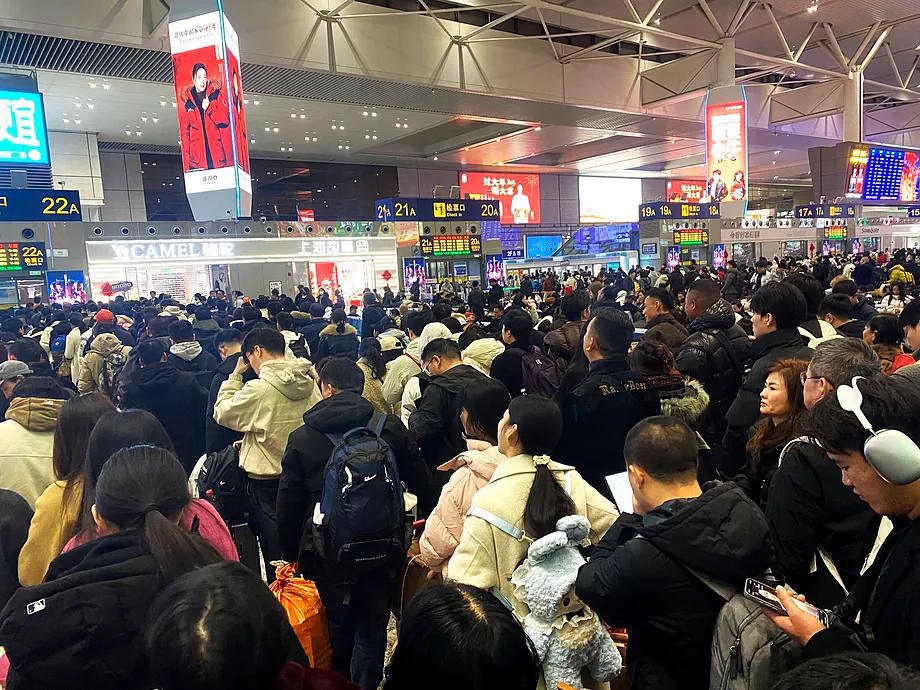
The taxi jerks forward on an elevated highway. Ahead, an endless snake of red lights flickers under the low, milky sky of Shanghai. It's barely 4:00 in the morning. The February mist crushes the skyscrapers and blurs their tips, as if someone had decided that the night doesn't deserve horizons. We are at the gates of the Chinese New Year, and the whole city seems to have sprung to life at once. In the distance, the illuminated silhouette of Hongqiao train station looms.
Every corridor, every escalator, is filled with human rivers carrying abundant luggage, gifts, and food bags. The murmur of conversations mixed with announcements over loudspeakers creates a chaotic symphony, interrupted by children's cries and the metallic clatter of suitcase wheels on the ground. This immense station seems to shrink under the pressure of the tide heading to its cities and towns.
Tickets these days are the most coveted treasures, sold at prices that elicit sighs and tears. Our destination is Longkou, a small city anchored in front of the Bohai Gulf on the northeast coast of China. From Shanghai, there is a distance of 900 kilometers, and on normal dates, we would have taken a flight of just over an hour, costing around 100 euros. But for Saturday, February 14, the few available tickets were close to 350 euros.
The train was by far the most affordable option. And as millions of Chinese come to the same conclusion, getting a ticket always becomes a race against time. After two weeks of trying random combinations - because the most direct routes to Longkou sold out within seconds of going on sale - the travel app finally confirmed one possibility: a twelve-hour and fifteen-minute journey, with many stops and a one-and-a-half-hour transfer at another station.
The train departs from Shanghai with its relentless punctuality. Outside, the whole country is in motion. And the entire well-oiled machinery seems to be working. During the 40 days surrounding the festival, a record of 9.5 billion trips is expected. It is the largest migration on the planet. This year, moreover, the government has extended the holidays to nine days, prolonging that collective pause in which China, for a moment, stops producing to rest.
For most passengers, this is the only time of the year when families gather under one roof again. Millions of workers embark on endless journeys back home.
As the convoy advances northward, the landscape transforms. The mega-city gradually dissolves, giving way to winter fields, geometric plots, and villages that shine under the pale light of dawn.
From the window, villages clinging to low brick houses and uneven roofs can be seen. But next to them, rows of newly built skyscrapers rise almost abruptly, identical towers that emerge in the middle of nowhere like life-size models; elevated roads and huge bridges cross undeveloped fields; motionless cranes dominate the horizon, reminding that the landscape is not finished.
The impression is that China, where the rural and the modern coexist in constant tension, continues to build without pause. The unrestrained development that the country has experienced in recent decades is evident in each of the 160,000 operational kilometers of track, 50,000 of them high-speed, connecting many of the most remote corners of the vast territory.
The first train we board reaches 350 kilometers per hour, the speed that the Spanish Minister of Transport, Oscar Puente, boasted of bringing to Spain before the Adamuz accident. At the end of last year, Puente himself traveled to China to closely observe the operation of these modern trains, famous for their extreme punctuality, and evaluate the feasibility of a potential acquisition for the national network, a plan that did not sit well with Spanish manufacturers.
In the carriage's televisions, disjointed images alternate: at times, Winter Olympics competitions appear; then, military maneuvers videos, and later, documentaries about tea plantations. As lunchtime approaches, the air becomes thicker, almost chewable. The pungent smell of freshly opened instant noodles mixes with the humid steam of hot buns and the slightly sweet, oily perfume of chicken spices being stirred in a bowl of rice. Slurps, the rustle of wrappers, and the sharp clink of chopsticks against bowl edges can be heard. For a moment, the entire carriage feels like a rolling market.
We decide to order a couple of KFC burgers. On these trains, all it takes is scanning a QR code on each seat to order food from the station restaurants the train passes through. The app calculates everything with millimeter precision: from the time it will take to prepare the order to the exact seconds the stop will last. There's no need to move from your seat. When the train resumes its journey, a stewardess brings the food directly to your seat.
During these holidays, the Chinese press has highlighted an even more surprising novelty: on many journeys, the food is distributed by Fuxing, the first humanoid steward of the railway service. This robot, equipped with artificial intelligence, not only serves and assists passengers but also guides, informs, and entertains.
Our one-and-a-half-hour transfer takes place at Dezhou station in Shandong province. We still have five hours to reach the final destination. Some passengers, tied to their backpacks, carry a small red plush horse. This 2026, the Lunar New Year, starting on February 17, marks the beginning of the Year of the Fire Horse. In Chinese astrology, each year is associated with one of the 12 zodiac animals, paired with one of the five elements: metal, wood, water, fire, or earth. These complement and contrast with each other, promoting harmony and balance in the natural world.
On the last train, a lady observes a newlywed couple. She leans slightly and, in measured Mandarin, begins to explain: "Fire symbolizes light and warmth, while the horse represents intelligence and courage. It's a good year to have children. People born in the year of the horse are usually independent and energetic."
We arrive in Longkou before mid-afternoon, as the sun is already melting over the Bohai Gulf. Family reunions are not effusive, affection is conveyed without grand gestures, a smile and a wave are enough. The air carries the salty smell of the sea mixed with kitchen smoke, reminding that life here follows a different rhythm, slower than the speed of the trains passing through.