The defense of the United States needs Europe as much as Europe needs the United States. Perhaps that is the true talent of Donald Trump: to make his allies fear him without anyone wanting to think about what the United States needs from those partners he has been insisting on treating as vassals for the past 13 months. In the European case, this dependence is summarized in numbers.
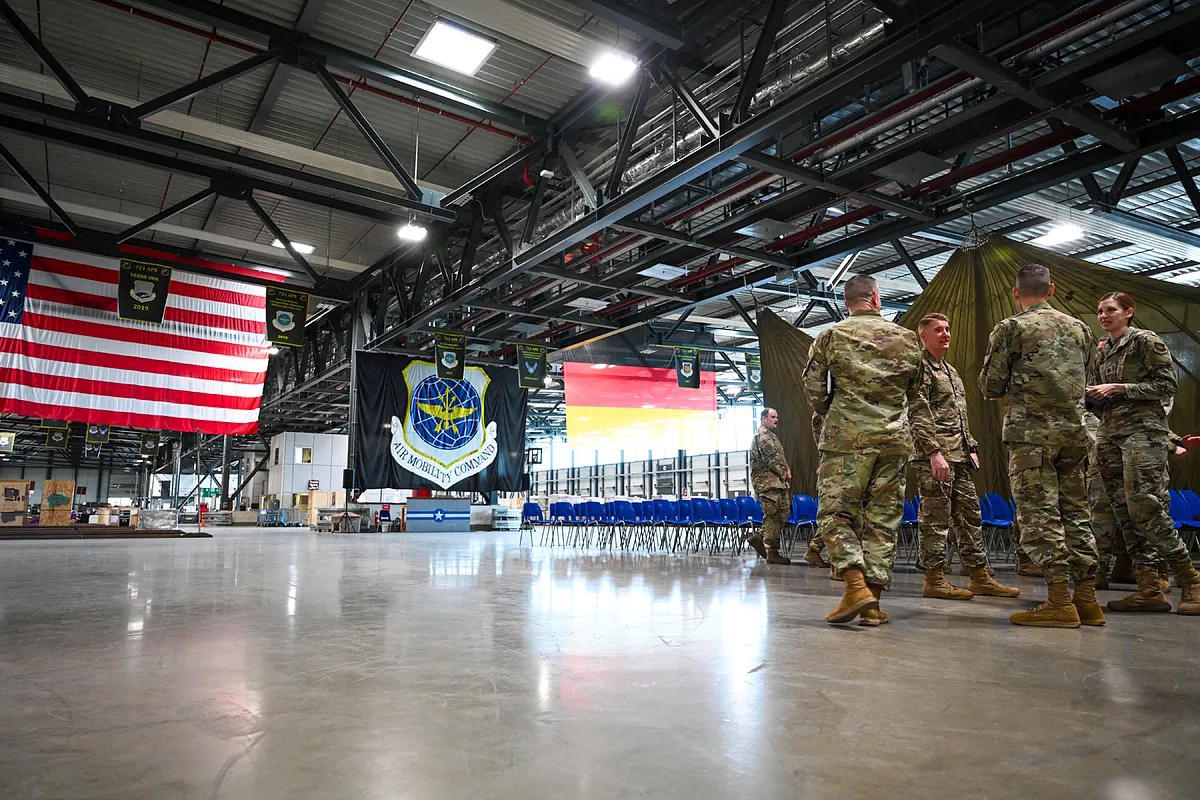
Just as the Munich Security Conference is taking place, this reality is more obvious than ever and, at the same time, being completely ignored. For the past two weeks, a massive aerial operation has been taking place from the United States to Europe and from here to the Middle East. Bases like Lakenheath in the United Kingdom; Rota and Morón in Spain; Lajes in Portugal; and Chania in Greece are being used by the U.S. Armed Forces as stopovers in the deployment of a massive military apparatus with which Washington is surrounding Iran.
The entire operation is reminiscent of the one launched by the United States last June, which culminated in the protection by its Navy of Israeli airspace during the 12-day war between that country and Iran, including the bombing of three Iranian nuclear centers. Eight months ago, Washington also carried out a massive air and naval deployment in the Middle East. And, as now, it could not have done it without its European bases.
The logistical infrastructure of the United States in Europe is a gigantic open secret. There is no official figure, and as incredible as it may seem, no one knows the exact number. The U.S. Congress declared in February 2024 that there were "31 permanent bases and another 19 sites to which the Department of Defense has access in the region." The Council on Foreign Relations estimated just a year ago that there were more than 40, from the far northwest of Greenland, 1,500 kilometers from the geographic North Pole, the United States has around 85,000 soldiers in them, although the Trump administration aims to reduce them to about 65,000. The Pentagon also has around a hundred atomic bombs between Germany, Belgium, the Netherlands, Italy, and Turkey.
But that is only a fraction of the U.S. military network in Europe. For the Pentagon, the Old Continent is not a system of bases. It is a logistical network with its axis in Germany and, to a lesser extent, the United Kingdom, projecting the military force of that country towards other regions. The permanent bases are just one part of the framework. In addition, there are military and civilian facilities to which the country has, depending on the circumstances, access rights. There are also prepositioning centers - in practice, warehouses with all kinds of material - and rotational bases where, as the name suggests, there are no permanently stationed units, but rather rotating ones. Additionally, there are command and control centers, radars, and other electronic warfare and data collection facilities. The result is hundreds of points available to the United States, although the conditions of use vary in each case.
The functions of these bases are varied. Defense of Europe against Russia - and previously the Soviet Union - is just one of them and, moreover, of decreasing importance. Today, the U.S. network in Europe is a launchpad towards the Middle East, Africa, and the Arctic. Several of the destroyers that patrolled the Black Sea before the Russian invasion of Ukraine four years ago, and that shot down missiles launched by Iran against Israel in June, are based in Rota. The tanker aircraft that refueled French fighter-bombers attacking Islamists in Africa for years were stationed in Morón, one of the two European bases from which the United States bombed Iraq in 1991. The increasing importance of the Arctic, as climate change melts the ice, is also giving Europe value as a platform in that theater of operations.
All of this poses a much greater interdependence between the two sides of the Atlantic. The protection of Israel and other U.S. allies in the Middle East goes through Europe, just as the projection of its military force towards the Arctic and Africa. In fact, the headquarters of the U.S. African Command is in the German city of Stuttgart.
Southern, central, and western Europe are, for the United States, logistical bases. If the U.S. Department of Defense were to lose access to the region, its response time to a crisis in Eurasia, the Middle East, or the northern half of Africa would go from days to weeks. An analysis by the Washington-based think tank Center for Strategic and International Studies (CSIS) published in 2024 states that in the event of a war in Europe, the United States would not be able to control the Atlantic if it lost its bases in the United Kingdom, Spain, and Italy. Europe is also the rear area - or, in official jargon, the "critical strategic platform" for the theaters of operations in the Middle East and Africa, according to the Pentagon itself. This even includes the treatment of the wounded: the main military hospital available to the U.S. Central Command, whose responsibilities range from the Kazakhstan-China border to Egypt, is in Ramstein, right on the border of Germany and France.
The system is perfectly oiled. The era of Yankees, go home!, of NATO, no bases outside - or the surreal NATO, no entry - is a thing of the past. U.S. planes are heading to the Middle East carrying not only weapons but also antimissile systems that have just been deployed in Jordan, yet no one is thinking of setting up a women's peace camp like the one that existed for nine years at Greenham Common base, north of London, when NATO deployed nuclear missiles there in 1982. The same goes for attacks. Last year, no one remembered the 40th anniversary of the El Descanso massacre, the restaurant where Islamic terrorists killed 18 people, all Spanish, in an attempt to target U.S. military personnel from the nearby Torrejón de Ardoz base in Madrid.
This is largely because military installations are less visible today. Light presence bases are more common now (in Pentagon jargon, lily pads, which literally means lily pads). And this is a consequence of changes in the organization of the U.S. Armed Forces. With the collapse of the Soviet Union, the Pentagon massively reduced its presence in Western Europe, which had reached around half a million troops in the 1950s. Subsequently, it began using private sector management techniques, including flexible inventory management inspired by the retail giant Walmart: light logistics, following the Toyota model; and storing products (in this case, weapons) close to where the demand is (potential conflict zones) to supply the consumer (or eliminate the enemy). The Russian invasions of Ukraine in 2014 and 2022 reinforced this model.
Trump has threatened not to invoke Article 5 of NATO, which in practice would mean dismantling the alliance. But he has never said anything about leaving the bases, because he needs them. That is one of the reasons that justify the optimism of some, like the former NATO Supreme Allied Commander, the Dutchman Rob Bauer, who claim that the United States will not leave the alliance under any circumstances.
If Washington must have access to the bases because it allows them to extend their influence, Europe needs them as a guarantee that, if necessary, the United States will be able to help. Therefore, they cannot be used as a bargaining tool. Trump has managed to turn his chronic trade deficit into a political weapon by imposing tariffs that hit his trading partners. But Europe cannot do the same with the bases because their disappearance would worsen their security deficit.
In any case, the transatlantic interdependence generated by this logistical network is a debate that has never been raised. The 50 military installations, plus the hundreds of access areas, are not only an instrument of power projection but also an institutional arrangement that has helped organize transatlantic cooperation in an increasingly anarchic world.