Only 25, a meager number, negligible when talking about the population of a wild species. But these specimens have been enough to spark one of the biggest controversies in the Spanish environmental sector in recent times. It pits conservationists against each other and leads to opposing opinions among specialized scientists.
Spearheading the species recovery projects that disappeared from Spain, the international trend known as rewilding and the programs to establish a breeding population of the European eagle owl (Haaliaeetus albicilla) in northern Spain and the Eurasian lynx (Linx linx) in the Pyrenees, may be followed by half a dozen other plans to release animals into the wild that have traces and more or less evident historical references in our country. Among them, species as unique as the crested pelican and the lyrebird. Developed to a greater or lesser extent, they are driven by their proponents in search of an improvement in national biodiversity. However, their detractors warn of a threatening downside.
The breeding area of the eagle owl covers much of Europe and central Asia. Abundant in northern regions, it reaches places as far south as Croatia and the Caspian Sea. Known as the sea eagle, it is related to the bald eagle, the emblem of the United States.
With a wingspan of up to 2.5 meters, its size and character, along with territorial behavior, lead some to consider it a super predator capable of hunting birds such as cormorants and waterfowl and impacting other raptors with which it shares space, such as vultures and Iberian eagles. Its defenders argue that its mainly scavenging and fish-eating diet - although it also feeds on other birds and even mammals, they acknowledge - prevents it from being a problem.
The reintroduction of the eagle owl took flight in August 2021, to establish in Spanish territory a species that, according to its defenders, existed in our country until relatively recent times. Last year, it was announced that the first chick of an imported pair was born in Spain in April. Its parents are part of the first release of 25 specimens from Norway that were set free that year in the municipality of Ribadedeva (Asturias).
The Spanish revival of the northern bald ibis: "Pairs have even formed between birds from Cadiz and Central Europe, it has been a total success"
Permaculture, the art of creating paradises on Earth
"We are very happy about this first birth and also about the five pairs already formed in the north of León, where they have naturally moved. We are also concerned about the criticism of our project. In 45 years of existence, we have never faced similar attacks, especially from conservationists and some scientists. Despite the fact that the International Union for Conservation of Nature (IUCN) has issued a report supporting us and 'strongly' recommending actions like ours," says Ernesto Álvarez, president of GREFA, the group behind the project, to this newspaper.
Miguel Ferrer, former director of the Doñana Biological Station and president of the Migres Foundation, has expressed support for the reintroduction of the eagle owl and the crested pelican. In a YouTube video, he states that "there are people and groups who do not like these projects ... based on a conservationist spirit is not a reasonable stance, it is a religious thought. Nature doesn't care about what happens. It doesn't act based on moral criteria and cannot be a reference for what is good." This newspaper has tried to gather his opinion, but has not received a response.
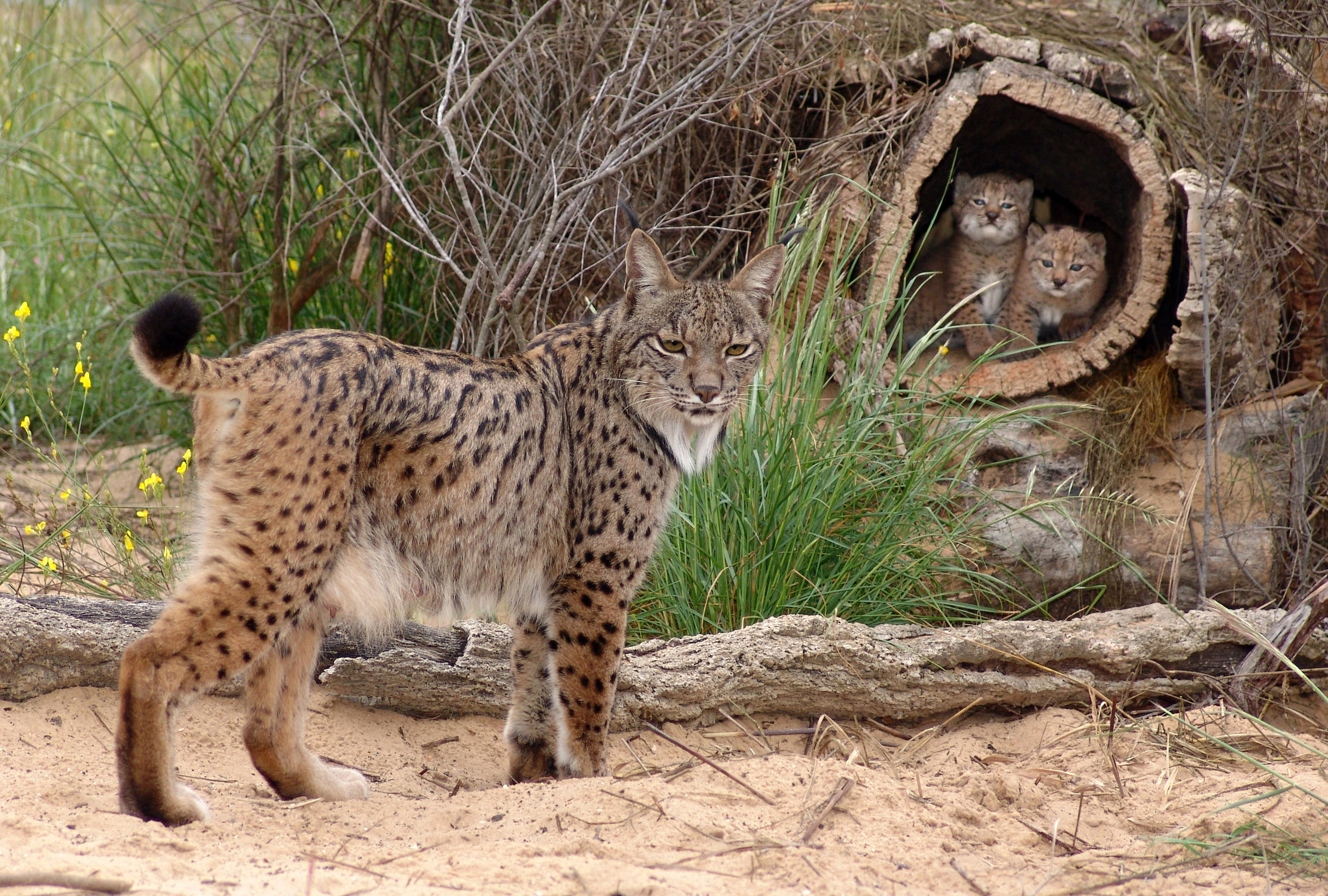
A Eurasian lynx perched on a treeShutterstock
The Spanish Ornithological Society, SEO/Birdlife, is strongly opposed to the reintroduction. "We consider that the eagle owl does not meet the IUCN criteria for a species whose historical presence we doubt in Spain and for which only some fossil remains exist," says Nicolás López, spokesperson for the organization in Asturias and coordinator and editor of the Red Book of Birds. He emphasizes that "neighbors and farmers have opposed the project. And this is one of the essential criteria imposed by the IUCN for the reintroduction of species: social peace."
A group of Asturian scientists, including Germán Orizaola, a biologist at the University of Oviedo, maintains the same opinion. "It is ecologically irrelevant to bring a species that is expanding in Europe. Supporting this project is a misuse of public funds and attention, instead of using them for other species that are currently slipping away from us, such as eels, salmon, and capercaillies."
According to both, the origin of this confrontation lies in the incorrect inclusion of the eagle owl in the Law for the reintroduction of extinct native wild species, drawn up in 2007 by the Ministry for Ecological Transition and the Demographic Challenge (Miteco). "The eagle owl should be removed from this list, as it has never been in Spain. Doing so would solve the problem," López emphasizes.
Criticisms from conservationists and scientists, along with social opposition, prevented the reintroduction of the eagle owl in Galicia and Cantabria. However, in Asturias, where the specimens were released, the Miteco provided technical support and financed the project with 360,000 euros, according to some sources. Shortly after, the authorities of the Principality withdrew from the project. Finally, in 2024, the ministry officials decided to look the other way. "Last year they stopped supporting us, even though we still maintain good relations with them," Álvarez laments. EL MUNDO has tried to gather information from the Ministry but has not received a response.
GREFA states that they will continue forward. Currently, 17 individuals are already flying freely, and they assure that there will soon be more. "There are already three established pairs, which will soon have chicks, and there is a willingness to expand the program to Catalonia and Andalusia," Álvarez states.
"The solution is nothing other than capturing the released specimens. Their expansion could seriously affect threatened species such as salmon, yellow-legged gulls, shags, and even bearded vultures," warns López. "If it arrives on its own, fine, but it makes no sense to bring a species that has never been here," adds Orizaola.
Reintroduction of the Eurasian lynx in the Pyrenees
Many kilometers away from the Cantabrian coast, another rewilding program echoes. The group Amics del Parc Natural de l'Alt Pirineu and the Association for the Defense of the Wolf and the Bear in the Pyrenees, ADLO, seek to reintroduce the Eurasian lynx in the Pyrenees. They aim to bring specimens from Romania.
Along with the wolf and the bear, the Eurasian lynx is one of the three major predators in Europe. It is distributed across the north, center, and east of the continent. With a size of up to 120 centimeters and a weight that can reach 30 kilos, it differs from the Iberian lynx (Linx pardinus) - an exclusive species of Spain with only 2,400 surviving individuals - in that the latter does not exceed 46 centimeters and a weight of 15 kilos.
The Eurasian lynx disappeared from Spain in the early 20th century. "Its presence in historical times in our territory is fully demonstrated, and it coexisted with the Iberian lynx for a long time, even hybridizing with it," states Miguel Delibes de Castro, one of the leading experts on the Iberian lynx.
"Its disappearance was caused by humans and also because its population must not have been very significant, as it requires a lot of territory. The Eurasian lynx attacked livestock, and in some places, they paid as much or more for the death of one of them than for a wolf. In the past, moreover, the countryside was much more populated than it is now, which contributed to its disappearance," he explains.
The first attempts to reintroduce this feline date back to 2001, led by the Territorio y Paisaje Foundation. "We considered releasing a pair of boreal lynx as ambassadors for a reintroduction project of the species in the Pyrenees, which could be a very interesting ecosystem controller. The problems that arose with the reintroduced bears made us give up," recalls Miquel Rafa, then deputy director of the Foundation.
Two decades later, the project has regained relevance. "The goal is to see how the boreal lynx influences the balance between predators and prey in the area," said Jordi Canut, spokesperson for the conservation group that is promoting their release again. They believe the feline can control the relatively abundant populations of chamois, mouflons, and deer, as well as small predators like foxes, martens, and beech martens, which exert strong pressure on the highly threatened capercaillie.
"It is not advisable to reintroduce the boreal lynx; it would be better to wait for it to arrive on its own. In a territory already subjected to many tensions, such as the birth of the first wolf litter in Catalonia and the tension between reintroduced bears and local populations, introducing a species that does kill livestock does not seem the most appropriate," Delibes considers.
Without delving into the possible hybridization of both lynx species, beneficial or detrimental to the Iberian lynx, according to opinions, the problems that the release of the boreal lynx could pose are more serious than those posed by the Iberian lynx. "Although the Iberian lynx does not attack livestock and only feeds on small prey, its reintroduction has been ruled out in Aragon and Castilla y León due to social rejection. If this happens with a 10-kilo animal that does not harm, what would happen if one weighing more than 25 kilos and attacking livestock is introduced?" Delibes wonders.
"I understand that naturalists are very fond of these animals, but personally I oppose playing around, not serious planning. These projects must be carried out in the most professional manner, and if they fail, we pay for it, but if they succeed, we educate, increase biodiversity, and save species like the Iberian lynx," states Delibes.
"These projects lead to other similar ones, which would pose severe environmental risks. Releasing flashy animals sells a lot; no one releases beetles, no one takes pictures with them, it is more profitable to do it with boreal lynxes and sea eagles," concludes Germán Orizaola.