The National Police has detected the activation of three migration routes to Spain following Pedro Sánchez's announcement to regularize 500,000 migrants already residing in Spain starting next April. Immigration experts highlight the route from the United Kingdom - through the English Channel - to France and finally reaching Spain through the Pyrenees. These are Pakistani, Afghan, and Indian citizens who, according to the same sources, seek to legalize their presence in Europe. The Police also note the arrival in the country from France of a "considerable number" of migrants of Algerian and Moroccan nationality as well as from Italy.
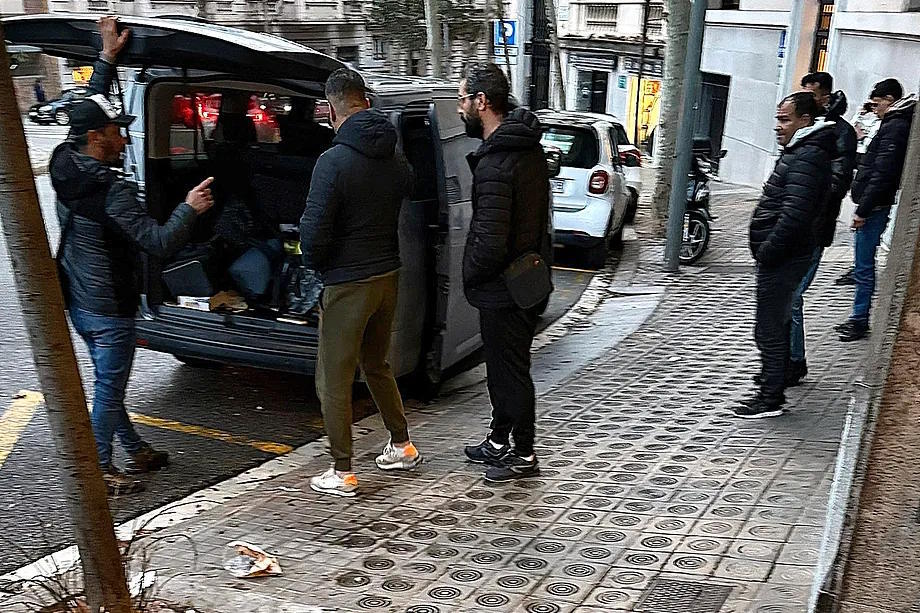
The latter country, they explain, presents a special case as vans are chartered to Spain carrying Indian, Moroccan, Algerian, or Pakistani citizens. These movements and the lack of information with which the plan has been launched - the Government has not sought the opinion of experts - have triggered the first reaction from Immigration agents.
As EL MUNDO has learned, the Police have addressed the Ministry of the Interior to warn of the "difficulty" that, according to their experience, executing the planned mass regularization entails. The same sources specify that various emails have been sent to the ministry of Fernando Grande-Marlaska expressing their concerns. "We don't know how to proceed because there are no instructions, possibilities, or resources," explains one of the police officials consulted by this newspaper.
A recent report by the Savings Banks Foundation (Funcas) raises the number of regularizations to 840,000 people. The police officers assigned to the Immigration and Borders units will be the ones facing the central government's initiative, as they will be the ones handling the "massive" processing of residence authorization requests, administrative procedure certifications, identity checks, and criminal background verifications. They claim that this "increased workload" could become "lethal" for teams that are already overwhelmed nationwide.
Detecting the arrival of vans from the Alpine country
The General Immigration Commissioner includes the Central Unit for Illegal Immigration Networks and Document Forgery (UCRIF) - dedicated to combating human trafficking and illegal immigration and which will be the unit overseeing the process - as well as the National Immigration and Borders Center (CENIF), which carries out intelligence tasks.
Agents dedicated to combating human trafficking also anticipate that organized crime could try to take advantage of the "lack of technical and human resources" given the expected influx in the regularization process. "Under false pretenses, they may bring women to Spain to legalize their situation and then exploit them sexually." They are wary of this particular situation because it is a route they often monitor, but if it were to happen, it would now be on a massive scale and not as "manageable" cases. They explain that these are groups of people who conspire to bring women to Spain from Colombia, Venezuela, and Paraguay, primarily.
Also generating distrust, as the same sources claim, is the "lack of control" over legal matters in some countries of origin of the migrants who will benefit from Pedro Sánchez's plan. "There are countries where public officials are easily bribed, and for example, obtaining a clean criminal record is not a problem," they explain. Conducting the necessary checks, they say, "will be very difficult" with the current resources and the number of requests to be processed. The National Police insists that the figures being considered - both 500,000 and 840,000 people - "are numbers that are difficult to handle at this time and under these circumstances." And this concern has been raised to the Interior Ministry.
There is a "considerable number" of Moroccans and Algerians
The post-regularization period is another aspect that concerns immigration agents. They fear that criminal organizations may see an opportunity in family reunifications. "There may be cases where foreign nationals pay those already in legal status to pass as family members like a child or parents. That is, paying for papers and certificates. We already see cases like this, where they even bring witnesses, but they are quickly detected because there are not as many applicants."
To prove residency in Spain, as announced by the Minister of Inclusion, Social Security, and Migration, Elma Saiz, "any public or private document, or a combination of both" will be required. In this case, documents such as registration certificates, rental contracts, medical appointment reports, or certificates of attendance at social services will be accepted.
It can also be proven with remittance receipts, a demand from various social entities due to the difficulties that individuals in irregular situations usually face in Spain to access the registry or official contracts of any kind. Another requirement will be to have no criminal record. The deadline to submit applications will start in early April and last until the end of June.