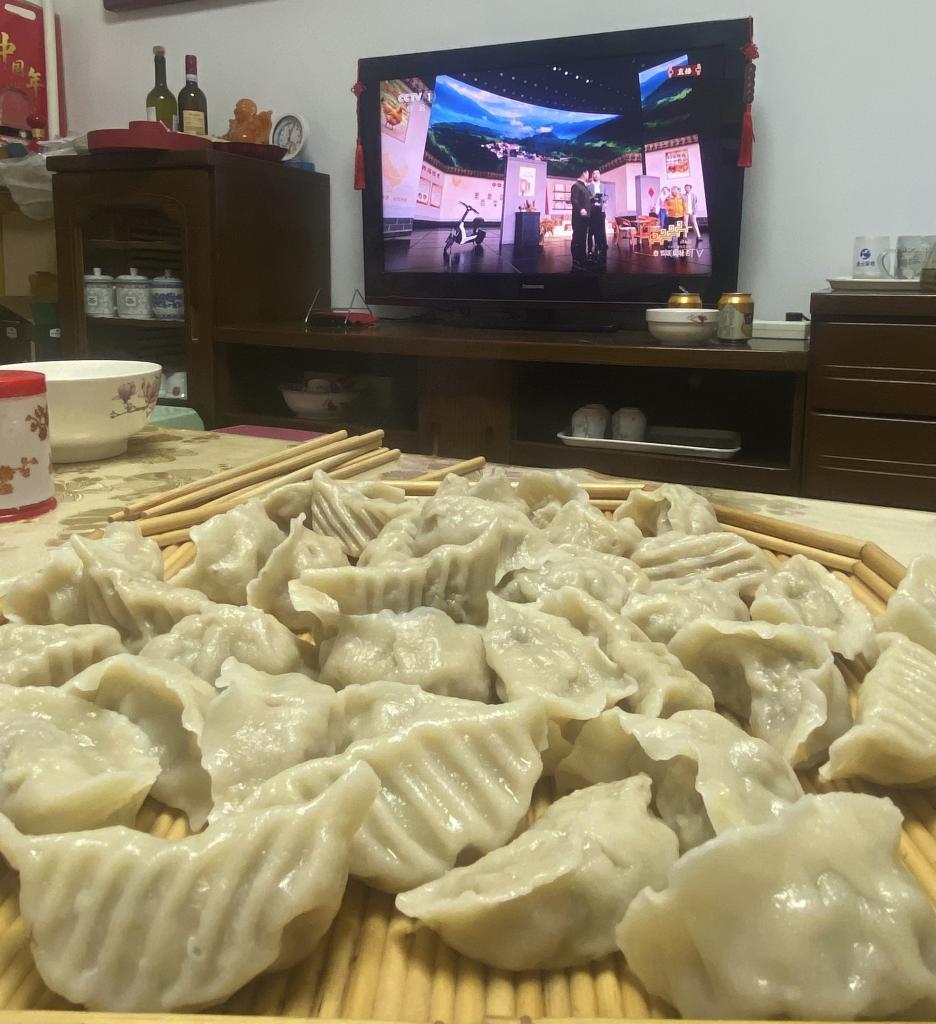
Chinese New Year Dinner. At the Yuan's house, the dining table disappears under 32 generous dishes for nine diners. Fried tofu balls, pork knuckle, seaweed salad, cubed pig's blood, gelatinous rice with dates, different types of potato and rice noodles, spicy pork belly, giant meatballs, chops, soy sauce-drenched eggplants, fish with oyster sauce...
At 7:00 sharp, the chopsticks start flying. We are in Longkou, a small city on the east coast of China, where moderation is not on the menu for their New Year's Eve; it is devoured with enthusiasm, without pauses except for toasting. An hour later, still savoring the feast, we squeeze onto the sofa to witness the other great ritual of the night: watching the Chunwan, the Spring Festival Gala broadcast by the state-owned CCTV. Year after year, it is the most-watched program on the planet, with an audience exceeding 1 billion viewers.
The show is a live extravaganza, with performances that have the visual level of the best Super Bowl halftime show broadcast. In this edition, humanoid robots take center stage. They are not mere futuristic props: they engage in sword duels sparking under the spotlights, perform traditional dances, somersault in all directions, and act in monologues. There is something hypnotic about watching these machines, symbols of the technological advancement that the country proudly showcases, interpret some centuries-old choreographies.
The show starts with a massive dance, impeccably synchronized from various cities, involving humanoids mingling with dozens of dancers dressed in red and gold, the colors of prosperity.
The program is a mosaic of genres: patriotic songs performed by established stars, dance numbers evoking ethnic minorities, acrobatics, magic, traditional opera, and, above all, the famous xiangsheng, monologues combining wordplay and light satire. In a country where direct political humor is rare on national television, these sketches serve as a carefully calibrated pressure valve. There were jokes about housing prices, work pressure, or generational gap.
The importance of the gala goes beyond entertainment. It is a showcase of the official narrative about the nation: unity, prosperity, and harmony. Each edition highlights the major achievements of the year and wraps them in a festive aesthetic. This time, it was about praising advances in robotics, artificial intelligence, and showcasing military strength with images of the army.
The production alternates shots of the audience in the studio with scenes of families in different parts of the country. It is a carefully constructed emotional map: millions of households, the same night, the same music, the same ritual. An entire synchronized nation dancing to a version of the classic We Are The World, performed by the American singer Lionel Richie and the Chinese actor Jackie Chan. Even at the end of the show, there was a flamenco performance mixed with dances from different Chinese ethnicities.
CGTN, the international division of CCTV, also produces its own New Year Gala in English and Spanish. While broadcasting some performances from the main gala, it features its own presenters and robots. The English version also adopts a more ideological tone, with interviews with Chinese and foreign citizens praising the policies of the Communist Party, as well as congratulatory messages from international figures such as the UN Secretary-General, António Guterres; the President of the European Central Bank, Christine Lagarde; and the President of Cuba, Miguel Díaz-Canel.
As midnight approaches, the television becomes background noise while at the Yuan's house, four huge trays of homemade dumplings (jiaozi) are being prepared, some with pork and cabbage, others with beef and chives, to be eaten at 00:00, just like in Spain we wait for the grapes.
The family has set aside three plates for the spirits of the ancestors, another habit in a China that still embraces ancient superstitions. Another custom is to put some coins inside the dumplings. Whoever finds them is in for a good year. It is a domestic, intimate lottery where luck is not measured in millions but in small omens.
The gala hosts start the countdown until the clock strikes midnight. The character for the word "fortune" appears on the screen inverted, a symbol that good luck has arrived. A long toast is made in the Yuan family's living room. Outside, firecrackers and fireworks explode, a noise storm meant to scare away Nián, a demon who, according to legend, fears loud noises.
Before starting with the dumplings, the elders at the table distribute hongbao, red envelopes with carefully chosen bills so that the amount ends in an even number, a sign of auspiciousness. A custom dating back to the Han dynasty (206 BC-220 AD), where they were used to ward off evil spirits.
Tuesday is the first day of the Year of the Fire Horse. In the traditional Chinese calendar, time does not move in a straight line but in circles: twelve animals that succeed each other, combined with five elements -metal, wood, water, fire, and earth- that attract and oppose each other, as if the universe operates on delicate balances.
On that first day, new clothes are worn, and visits are made to friends and family, in a procession of good wishes and hot tea. Guests arrive loaded with fruit trays and milk cartons. Many families also visit the cemetery. There, they burn incense, clean the tombstones, and leave food on the graves as offerings of gratitude and respect.
On television, during the holidays, the New Year Gala is broadcast around the clock. As the days go by, no one pays attention to it, but it becomes a familiar background noise. It is there from morning until night, when the elders nod off on the sofa still holding the remote. The same choreographies, the same robots somersaulting, the same jokes. When someone finally turns off the TV days later, the silence feels strange, almost uncomfortable. As if, with the disappearance of that background noise, the illusion of national synchrony that has kept an entire country glued to the screen also dissipates.