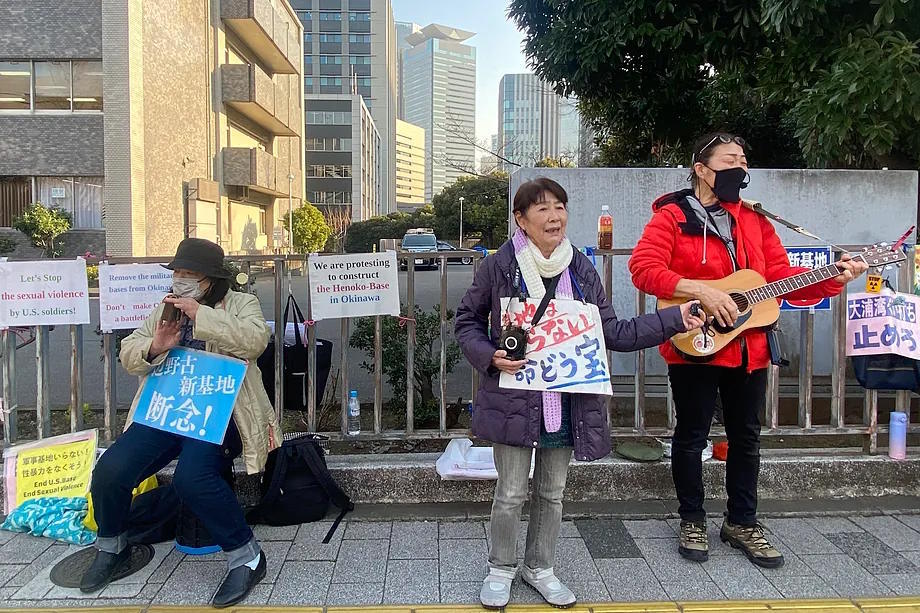
It's a cold February morning in Tokyo. In the Nagatacho district, where the Diet (Parliament) and many important government offices are located, suit-clad officials, with dark coats and briefcases in hand, walk briskly on the sidewalks dampened by the overnight frost. The sober building where power emanates stands amidst streets with trees pruned with precision. Its facade, made of light stone, reflects the grayish light of the winter dawn.
At the entrance of the chamber, among legislators and local television cameras, a small group of elderly women with guitars disrupt the routine, singing against the militaristic shift of the Japanese government and denouncing the violations committed by American soldiers in Okinawa.
Koyomi Iwasaki, the apparent leader of the group, hands out leaflets and puts up posters on the Parliament's fences. "The United States, whose soldiers have sexually assaulted young Japanese women with impunity, now wants to push us into a war against China," she asserts without hesitation.
Iwasaki, 81, and the other protesters, all natives of Okinawa, are part of the Anti-War Landlord Association, founded in 1983 to protest against the American bases in a prefecture that hosts over 70% of Washington's military forces in the Asian country.
"Japan, in Article 9 of its Constitution, declares renunciation of war. But the government plans to increase the military budget to make it the third largest in the world, funding it through more taxes and burdening those who already suffer from high inflation. Even in Okinawa, where child poverty is double the Japanese average. We cannot accept it," reads Iwasaki in front of a poster denouncing another more sensitive issue: the sexual violence committed by American soldiers.
For decades, Okinawa has seen numerous cases of sexual assaults by American personnel. Last June, a marine named Jamel Clayton, 22, was sentenced to seven years in prison after being found guilty of strangling and sexually assaulting a young islander in May 2024. A few months earlier, another soldier was sentenced to five years in prison for kidnapping and raping a minor.
"Okinawa, still under American military control, continues to experience episodes of sexual violence because the US military operates outside the framework of the Constitution", denounces Iwakasi. Some recent surveys published by Japanese media highlight that over 70% of the island's residents support the withdrawal of American troops from the 32 bases that Washington has scattered across Japanese territory.
Okinawa's history is also a tale of loss and occupation: the former Ryukyu Kingdom, prosperous with vibrant trade in Southeast Asia, was annexed by imperial Japan in 1879. After World War II, the United States took control until 1972, allowing its troops to remain indefinitely. Since then, local authorities have documented over 6,000 cases of sexual assaults committed by American soldiers, shielded for decades by extraterritorial protections that have limited the legal responsibility of military personnel.
In the streets of Okinawa, demonstrations calling for the withdrawal of US forces are common. Exactly 20 years ago, Washington committed to Tokyo to reduce the number of troops stationed on the Japanese island, relocating over 5,000 marines to Guam, a US overseas territory. However, there was only one relocation, in 2024, when barely a hundred left Okinawa. Currently, around 30,000 American soldiers are stationed there.
Analysts point out that the United States has maintained a stable and secure network of military bases and training areas because it considers Okinawa a critical area in the event of a future military operation in Taiwan in the face of a hypothetical Chinese army invasion. The relationship between Tokyo and Beijing has also deteriorated in recent months following a statement by Prime Minister Sanae Takaichi, stating that Japan could intervene militarily in the event of a Chinese attack on Taipei. "The presence of the Marine Corps in Okinawa is essential to deter China and North Korea," argues Caleb Eames, an American lieutenant colonel, in a publication by the Atlantic Council, a Washington-based think tank.
The newly endorsed government under the conservative Takaichi has defended that the American military bases are justified due to the economic support they provide to the region (Okinawa is Japan's poorest prefecture), especially by generating jobs in local commerce. But critics remind that Tokyo pays around $1.4 billion annually to the United States for what Takaichi has called an "essential shield to safeguard Japan's national security," and President Donald Trump has been pushing for further increases in that fee.
Local leaders and the population of Okinawa also continue to pressure for troop withdrawal, mainly due to cases of sexual violence. According to the public broadcaster NHK, between January and September 2025, 77 criminal cases involving American soldiers were recorded, without specifying how many were sexual assaults.
In Tokyo, as officials pass through security checks and enter the chamber, the voices and guitars of the Okinawan women continue to resonate in the street. Despite the cold and the apparent indifference of politicians and passersby, the posters remain high, firm as a constant reminder of a reality that persists in the shadow of American bases. Each note and each word is an echo that the injustices of Okinawa cannot be ignored.