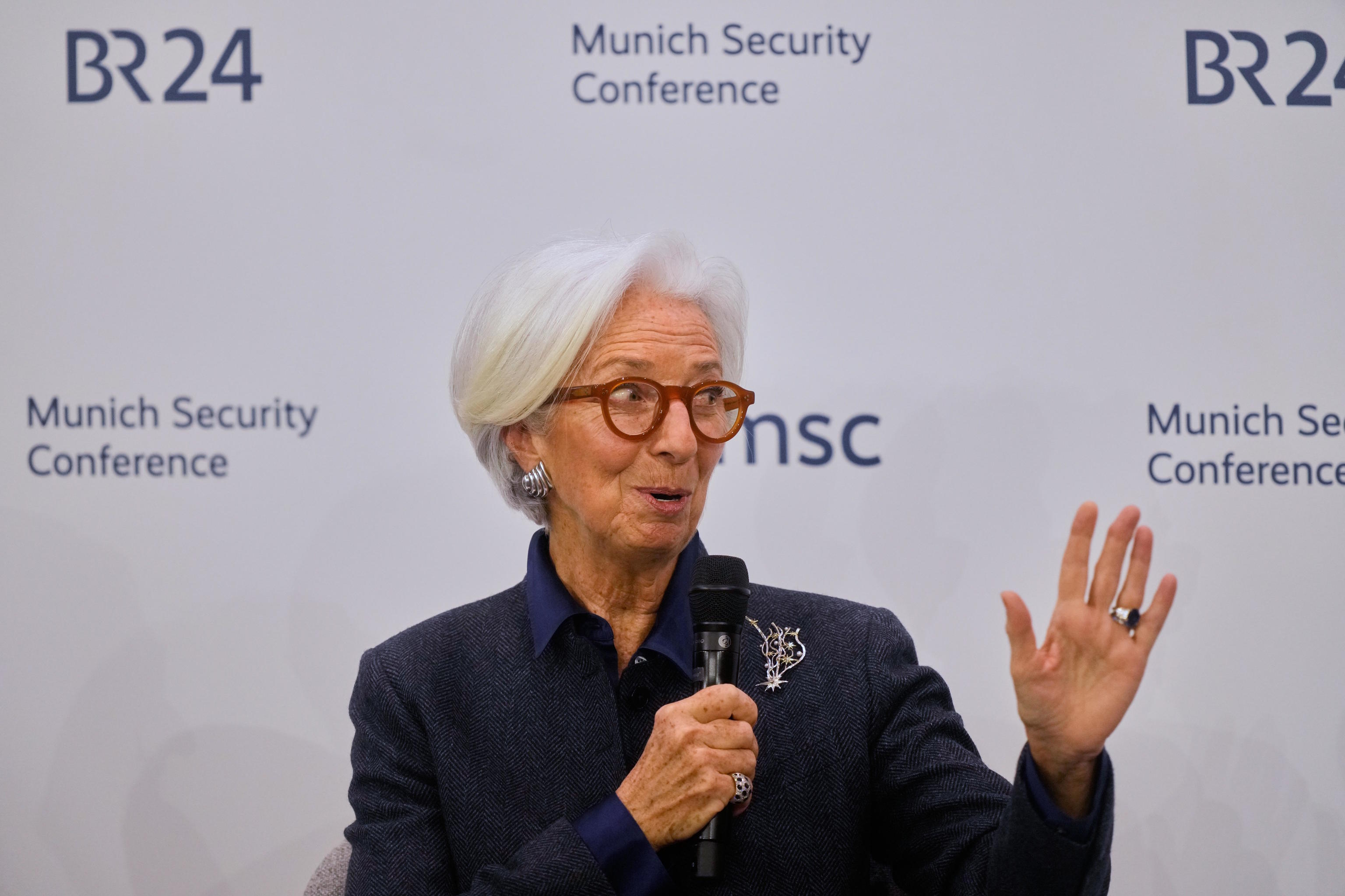
Fear of a victory for the eurosceptic party of Marine Le Pen in the French presidential elections of April 2027 is accelerating changes at the European Central Bank (ECB), which faces a significant overhaul next year. The ECB President, Christine Lagarde, with a mandate until October 2027, does not guarantee that she will complete it. This is evident from the response of an official spokesperson of the institution after the 'Financial Times' reported on Wednesday that the Frenchwoman is considering leaving her position before her eight-year term expires to facilitate an agreement between the outgoing French President, Emmanuel Macron, and the German Chancellor, Friedrich Merz, on a new central banker for the eurozone.
An ECB spokesperson simply stated that "President Lagarde is fully focused on her work and has not made any decision regarding the end of her term." She has not decided whether to complete it or leave earlier, according to this official version.
This move coincides with the surprise resignation of the veteran Governor of the Bank of France and influential member of the ECB's Governing Council, François de Villeroy. He has decided not to complete his term, so his successor will be chosen this year by Macron before the presidential elections, sparking protests from Le Pen's party.
De Villeroy stated on Wednesday that "no one has asked him to resign" and presents his departure as voluntary, but he avoids allowing the French far-right to influence the most powerful and federal institution in the EU, the ECB. This institution was crucial in enabling countries like Italy and Spain to continue financing themselves in 2020 after their economic collapse during the pandemic.
In 2026, only the Vice President, Luis de Guindos, needs to be officially replaced due to the end of his term, but in 2027, up to three more changes will occur in the select executive committee, including Lagarde's. An earlier departure by the Frenchwoman would allow Merz and Macron to agree on the changes this year and set the stage for the next eight years. In this scenario, the Spanish Prime Minister, Pedro Sánchez, increasingly isolated, faces difficulties in keeping a Spaniard in the upper echelons of the ECB. De Guindos has been replaced by the Croatian Boris Vujcic, and the declared attempt by the Economy Minister, Carlos Cuerpo, is for Spain to secure one of the upcoming positions that may become available.
Lagarde's appointment as ECB President came after Macron and the then German Chancellor, Angela Merkel, reached a surprise agreement in 2019, while the former German Defense Minister, Ursula von der Leyen, became President of the European Commission.
Last month, Lagarde told Bloomberg TV that she accepted the ECB position under the impression that she would serve a five-year term, leading analysts to interpret it as a possible preparation for an early exit, according to Europa Press.
These same rumors gained strength last summer after the former President of the World Economic Forum, Klaus Schwab, stated that Lagarde had considered resigning to take over the leadership of the World Economic Forum, although an ECB spokesperson emphasized at the time that the ECB President was "determined to complete her [eight-year] term."
European economists surveyed by the Financial Times last December considered former Spanish central bank governor Pablo Hernández de Cos and his Dutch counterpart Klaas Knot as the top candidates to become the next president of the eurozone central bank. Isabel Schnabel, a member of the ECB's executive board, has expressed interest in the position, although legal obstacles may be insurmountable in her case, while individuals familiar with the stance of the Bundesbank President, Joachim Nagel, stated that he was also interested.
Rumors have been swirling since last week when François Villeroy de Galhau announced his "personal decision" to step down from his position as Governor of the Bank of France, which he has held since 2015, to assume the presidency of the Apprentis d'Auteuil Foundation, an institution dedicated to providing social assistance to children and training disadvantaged youth.
Villeroy de Galhau, who is about to turn 67, will leave the position he has held since September 30, 2015, almost a year before his second term expires, thus giving French President Emmanuel Macron the opportunity to choose his successor.
Marine Le Pen, leader of the far-right National Rally party, leads the polls for the upcoming elections. Although the French politician may be disqualified from running as a candidate, her protege, Jordan Bardella, would step in under these circumstances, both being considered eurosceptics, which could complicate relations with European institutions such as the ECB.