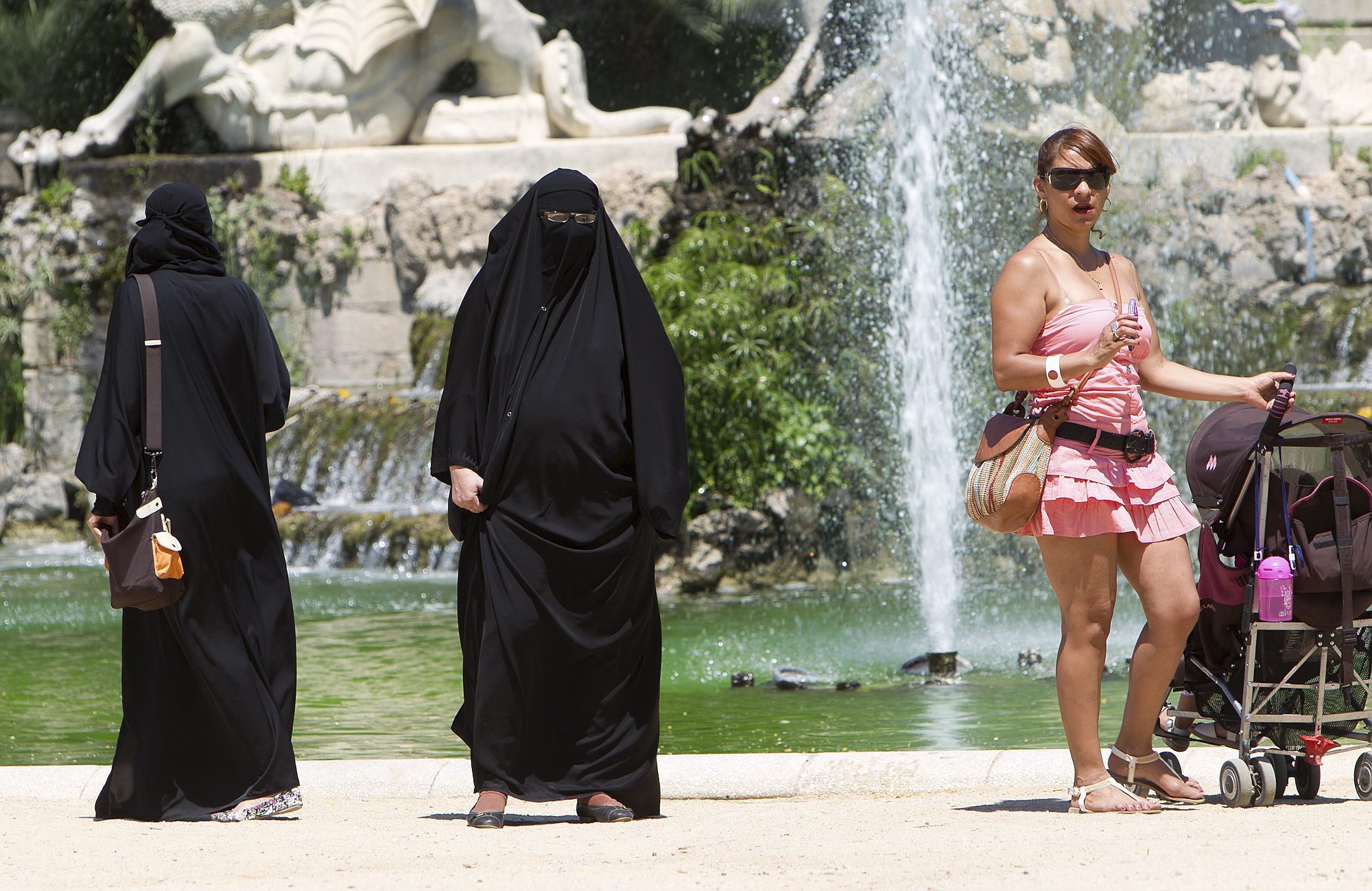
The debate on the prohibition of the burka or garments with religious connotations reached national and European courts years ago, with some guidelines set and nothing definitive.
The numerous rulings of the European Court of Human Rights (ECHR) have a common denominator: it is a matter on which there is no consensus, and each state is in a better position to apply what is most convenient. As for the Supreme Court, it addressed the case in 2013 and ended up annulling municipal ordinances that banned the use of veils in public spaces. But it did so for reasons of jurisdiction, not substance.
Therefore, any prohibition that the General Courts might approve - which would surely be examined by the Supreme Court, the Constitutional Court, and Strasbourg - would not clash a priori with any of the judgments issued so far.
In the case of the ECHR, it has allowed the limitations imposed in various countries. Its first judgments on the matter date back to 2001 when it accepted that Switzerland could prevent a primary school teacher from wearing a veil in class. The most relevant issue in this category, known as the "affaire du foulard" (the veil case), came in 2014. In the case of SAS v. France, it endorsed by 15 votes to two the ban on full-face veils in all public spaces, accepting that their use did not respect the right of others to "live together."
The French authorities had argued the existence of "minimum requirements for living in society." Showing the face was one of them. "The Court can accept that the barrier raised against others by a veil covering the face may be perceived by the respondent State as a violation of the right of others to live in a socialization space that facilitates coexistence," Strasbourg responded.
The Grand Chamber did set three requirements for these limitations: that they are provided for "by law" and are "necessary in a democratic society" to achieve "legitimate aims." To establish these aims, it gave precedence to each country's criteria: "It can be said that the question of whether full-face veils should be allowed in public places constitutes a choice of society."
A year before that key ECHR judgment, the Supreme Court had received the decision of the Lleida City Council to ban full-face veils in municipal spaces. The court annulled the plenary agreement that introduced it, arguing that the municipality did not have the capacity to limit a fundamental right, which would require an organic law. "The insurmountable constitutional requirement of the need for a law to limit the exercise of the fundamental right cannot be replaced [by] municipal ordinances," it stated.
This was sufficient to resolve the appeal without delving into the substance of the matter, something that the Supreme Court claimed it did not want to do: "This judgment does not in any way mean the Court's response to whether in Spain and within the framework of our Constitution a ban on the use of full-face veils in public spaces like the French law is possible or not."
Nevertheless, the judgment continued and delved into the arguments of the Superior Court of Catalonia to authorize the ban. It revoked that approval with arguments that could serve as guidelines for the examination of a potential law limiting certain garments. For example, the Supreme Court indicated that the "disturbance of tranquility in our Western culture" referred to by the Superior Court of Justice "lacks convincing evidence." Or that, no matter how "shocking" that attire may be to Spain's cultural conceptions, "it is not acceptable to disregard whether that use is voluntary or not."
The Supreme Court also deemed it "appropriate" to recall that three years earlier, the Senate had urged legislation on veil use. "Our national legislature has not adopted the legislative solution requested in said motion," it stated, "which is indicative of the political significance of the issue."